
Can Ohio Stores Sell CBD and Hemp THC Products Again? The SB 56 Court Battle Explained
Ohio Stores Can Sell CBD and Hemp THC Products Again...For Now.
Ohio's hemp market has gone through several dramatic changes in only a few months.
First, state lawmakers passed Senate Bill 56, a sweeping cannabis law that changed the definition of legal hemp and effectively removed many hemp-derived THC products from ordinary smoke shops, CBD stores, beverage retailers, convenience stores, and online sellers.
Then businesses sued.
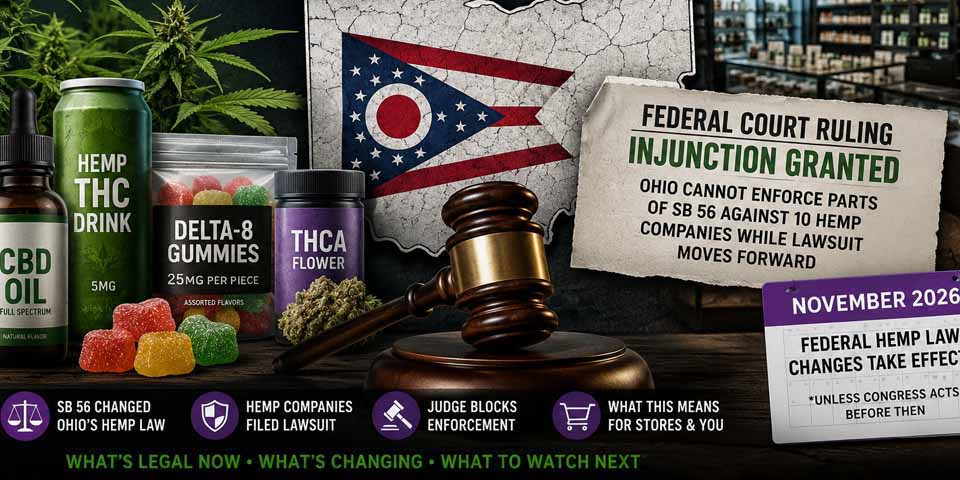
A federal judge temporarily blocked Ohio officials from enforcing parts of the law against ten hemp companies. The court later issued a preliminary injunction allowing those companies to continue handling federally compliant hemp products while the constitutional lawsuit proceeds.
That led to headlines suggesting that Ohio had reopened the hemp market or that CBD and THC products were suddenly legal everywhere again.
The truth is more complicated.
Ohio's hemp restrictions have not been completely erased, the entire law has not been overturned, and the court order does not automatically protect every store in the state.
However, the ruling is a major setback for Ohio's attempt to force many hemp-derived products into the state-licensed marijuana system before similar federal restrictions are scheduled to take effect.
This guide explains what Senate Bill 56 changed, why hemp companies sued, what the federal judge actually decided, which products are involved, what November 2026 has to do with the dispute, and what Ohio consumers and retailers should understand right now.
What Is Ohio Senate Bill 56?
Senate Bill 56 is a large cannabis law covering adult-use marijuana, medical marijuana, hemp, taxation, licensing, possession rules, advertising, and enforcement.
Governor Mike DeWine signed the bill in December 2025, and most of its provisions took effect on March 20, 2026.
One of its most controversial changes involved the legal definition of hemp.
Before SB 56, Ohio generally followed the federal standard created by the 2018 Farm Bill. Under that framework, hemp was distinguished from marijuana largely by its concentration of delta-9 THC.
SB 56 broadened Ohio's calculation to include total THC and other THC compounds. Products crossing the new state threshold could be treated as marijuana even when they still qualified as hemp under current federal law.
That distinction matters because marijuana products may generally be produced and sold only through Ohio's tightly controlled, state-licensed cannabis system.
What Products Did Ohio Target?
SB 56 was aimed primarily at products sometimes called intoxicating hemp.
These products are manufactured from federally legal hemp but may still produce noticeable intoxicating effects.
Examples can include:
- Hemp-derived delta-9 THC drinks
- Delta-8 THC products
- THCA flower and concentrates
- Hemp-derived THC gummies
- Products containing delta-10 THC
- Some full-spectrum CBD products containing measurable THC
- Certain chemically converted or synthesized cannabinoids
The law established extremely low per-package THC limits for products sold outside licensed marijuana dispensaries.
As a practical matter, many gummies, beverages, tinctures, edibles, and full-spectrum products that had been sold as legal hemp could no longer be offered through ordinary retailers under Ohio's new definition.
Was Regular CBD Completely Banned?
No.
This is one of the biggest misunderstandings surrounding the law.
CBD itself was not simply outlawed across Ohio.
Products made with CBD isolate and containing no meaningful THC may still fall within Ohio's legal hemp definition.
The bigger problem involves full-spectrum CBD and other hemp products containing naturally occurring trace amounts of THC.
Full-spectrum products are designed to preserve a wider mixture of cannabinoids, terpenes, and plant compounds. That means even a product marketed primarily for CBD may contain enough total THC to exceed Ohio's new per-package limits.
Therefore, the correct answer is not simply:
"CBD is legal" or "CBD is banned."
The product's ingredients, total THC content, package size, manufacturing method, source, labeling, and the business selling it may all matter.
Why Did Hemp Companies Sue Ohio?
Ten hemp businesses filed a federal lawsuit challenging SB 56.
The plaintiffs argued that their products remain legal under federal hemp law but Ohio created a system that effectively prevents out-of-state businesses from participating unless they move their production and distribution entirely inside Ohio.
Their main constitutional argument relies on what lawyers call the Dormant Commerce Clause.
That legal doctrine comes from the U.S. Constitution's grant of authority over interstate commerce to Congress.
States generally have broad power to protect health and safety, regulate products, require testing, impose age restrictions, and prohibit dangerous goods.
What states generally cannot do is design a market that unfairly favors in-state businesses or builds an economic wall against interstate commerce.
What Was Allegedly Discriminatory About SB 56?
Ohio argued that its law applied the same hemp definition to both local and out-of-state companies.
The plaintiffs argued that this was only true on paper.
Under the system created by SB 56, products that exceeded Ohio's hemp limits were pushed into the marijuana market.
To legally participate in Ohio's marijuana market, products generally must be cultivated, processed, transferred, and distributed through licensed facilities located within Ohio.
An out-of-state company producing a product that remains federally legal could not simply ship that product into Ohio and sell it through normal retail channels.
Instead, it would effectively have to establish an Ohio-only production and distribution system or gain access to Ohio's limited marijuana licenses.
The federal judge found that the plaintiffs had shown a strong likelihood that this structure unlawfully burdened interstate commerce.
What Did the Federal Judge Actually Rule?
U.S. District Judge Jeffrey Helmick initially granted the ten plaintiffs a temporary restraining order.
The order stopped Ohio officials and other named defendants from taking criminal, civil, administrative, or regulatory enforcement action against those plaintiffs based on SB 56's amended hemp definition, as long as the products involved qualified as hemp under current federal law.
A temporary restraining order is emergency relief.
It does not settle the lawsuit.
It simply preserves the situation temporarily while the court considers the larger constitutional dispute.
The court later granted a preliminary injunction, extending protection while the case moves forward.
Does the Court Order Apply to Every Ohio Smoke Shop?
Not necessarily.
This is probably the most important part of the story for retailers.
The federal order specifically protects the named plaintiffs and people legally acting in concert with them.
It does not plainly declare that every smoke shop, CBD store, convenience store, distributor, or online seller in Ohio may ignore SB 56.
A retailer carrying a plaintiff's protected products may have a stronger argument than a store selling unrelated products from companies outside the lawsuit, but the exact legal protection can depend on the order, the parties involved, the supply relationship, and enforcement circumstances.
That means businesses should not assume that seeing products return to one store automatically gives every retailer statewide permission to sell anything previously removed.
This article is informational and not legal advice. Ohio businesses facing compliance questions should speak with an attorney familiar with cannabis, hemp, retail, and constitutional law.
What Can the Ten Companies Sell?
The federal order protects activity involving products that meet the current federal definition of hemp.
Under the federal standard presently at issue, hemp generally includes cannabis containing no more than 0.3% delta-9 THC by dry weight.
That standard allowed manufacturers to create products with meaningful amounts of hemp-derived THC while still remaining beneath the percentage limit.
A beverage, gummy, or other product could contain several milligrams of THC yet remain federally classified as hemp because the total product weight kept the delta-9 concentration below 0.3%.
Critics call this the Farm Bill loophole.
Hemp businesses argue that it is not a loophole at all—it is the definition Congress enacted, and companies invested in products and interstate supply chains based on that law.
• Did Ohio's Biggest Cannabis Companies Secretly Rig the Market?
The State of Ohio alleges that nine of the country's largest multi-state cannabis operators secretly coordinated business practices instead of competing against one another. The lawsuit accuses these companies of entering reciprocal purchasing agreements, allocating valuable dispensary shelf space, sharing confidential pricing information, and limiting opportunities for smaller independent cannabis businesses.
Why Does Everyone Keep Mentioning November 2026?
The Ohio lawsuit is taking place against the backdrop of a major scheduled change to federal hemp law.
Congress approved language that is expected to replace the current delta-9 percentage standard with much stricter total-THC and per-package limits.
Those federal restrictions are scheduled to take effect in November 2026 unless Congress changes the law before then.
The new federal framework is expected to count a wider range of THC compounds and sharply restrict products containing more than trace amounts of total THC.
That could affect:
- Hemp-derived THC beverages
- Delta-8 products
- THCA products
- Full-spectrum CBD products
- Some tinctures and balms
- Gummies and other hemp-derived edibles
- Interstate and online hemp sales
Ohio adopted similar restrictions months before the federal change is scheduled to begin.
The hemp companies argue that until federal law actually changes, Ohio cannot wall federally legal products out of the state in a way that discriminates against interstate commerce.
Does November Automatically End the Lawsuit?
No.
November 2026 is important because federal law is scheduled to change, but it is not accurate to describe it simply as the date of an Ohio court case.
The Ohio litigation may continue before and after the federal effective date.
The federal change could alter the dispute because products protected as federally legal hemp today may no longer qualify under the new definition.
However, several possibilities remain:
- Congress could delay the federal restrictions.
- Congress could revise the new definition.
- Additional lawsuits could challenge the federal law.
- States could create their own regulated hemp markets.
- The Ohio court could rule on unresolved constitutional issues.
- The parties could settle.
Therefore, November is a major legal deadline—but not necessarily a clean ending to the entire dispute.
Featured at Waterbeds 'n' Stuff
Explore Trip Drip Gummies
Browse bold Trip Drip edible collections featuring high-potency cannabinoid blends, layered fruit flavors, and options created for experienced consumers.
Trip Drip x Ocho x Sugar
Double Stacked Bitez Gummies
Discover sweet and sour dual-flavor gummies available in multiple cannabinoid blends and potency options.
Shop Double Stacked BitezBold Flavor Collection
Mushroom Edible Gummies
Explore powerful gummies in fruity flavor choices, including including dragon fruit melon or plum cherry.
Premium Cannabinoid BlendsFor adults of legal purchasing age only. Availability and shipping eligibility vary by location. Always review the individual product page before ordering.
Why Did Ohio Want These Products Restricted?
Ohio officials argue that intoxicating hemp expanded faster than the state's regulations.
Products were often sold through businesses that did not operate under the same rules as licensed marijuana dispensaries.
State officials raised concerns about:
- Sales to minors
- Products resembling candy
- Inconsistent testing
- Misleading labels
- Unknown manufacturing methods
- High-potency products
- Synthetic or converted cannabinoids
- Retailers without specialized cannabis licenses
From Ohio's perspective, products producing marijuana-like effects should be regulated like marijuana.
That means stronger testing, controlled production, age restrictions, licensed retail locations, tracking requirements, and enforcement through the Division of Cannabis Control.
What Are Hemp Businesses Arguing?
Hemp businesses generally agree that reasonable safety standards can be appropriate.
Their objection is that Ohio did not merely establish testing, packaging, labeling, and age rules.
They argue SB 56 effectively transferred a federally legal market to Ohio's limited group of licensed marijuana businesses.
From their perspective, this does several things:
- Eliminates existing hemp businesses
- Blocks interstate manufacturers
- Reduces consumer choice
- Raises prices
- Creates a state-protected marijuana monopoly
- Destroys investments made under federal law
They also argue that a company selling a federally compliant beverage should not be required to build an entirely separate Ohio cultivation, manufacturing, and distribution network just to reach Ohio customers.
Is This Really About Safety or Competition?
It may be about both.
Ohio has legitimate authority and responsibility to protect consumers, especially when products can intoxicate users or attract minors.
At the same time, laws justified as safety measures can still violate the Constitution when their practical structure discriminates against interstate commerce.
The federal judge did not rule that Ohio is forbidden from regulating hemp.
The ruling does not prevent the state from enforcing unrelated laws governing contaminated products, false advertising, sales to minors, dangerous packaging, or other safety issues.
The constitutional problem identified by the court was the way SB 56 allegedly forced companies into an Ohio-only marijuana system.
What Does This Mean for Hemp THC Beverages?
Hemp-derived THC drinks are at the center of the current battle.
These beverages have grown quickly because they provide an alternative to alcohol and are often sold through liquor stores, bars, restaurants, specialty retailers, and online sellers.
Under Ohio's new restrictions, many could not remain in those channels.
The injunction allows the named plaintiffs to continue dealing in federally compliant products while the lawsuit proceeds.
Consumers may therefore see certain hemp THC beverages return to shelves.
That does not mean every beverage from every manufacturer has automatically been approved.
Retailers still need to confirm that products comply with current federal law and understand whether the court order protects the manufacturer, distributor, and seller involved.
What About Delta-8 THC?
Delta-8 became one of the largest products created under the 2018 Farm Bill.
It is often produced by converting hemp-derived CBD into delta-8 THC.
Ohio's law targets a wider range of THC compounds and unnaturally produced or synthesized cannabinoids.
The federal court order protects federally legal hemp products associated with the named plaintiffs, but that does not mean every delta-8 product in Ohio is clearly protected.
Delta-8 also faces legal uncertainty under federal agency interpretations and court decisions concerning whether chemically converted cannabinoids qualify as lawful hemp.
Retailers should treat delta-8 as a particularly complicated category rather than assuming the beverage ruling resolved everything.
What About THCA Flower?
THCA flower presents another complicated issue.
THCA is the non-intoxicating precursor that converts into delta-9 THC when heated.
Products may test below the federal delta-9 limit before use while containing high levels of THCA.
Ohio's total-THC approach is designed to count that potential THC and classify many THCA products as marijuana.
The federal changes expected in November are also designed to close this gap.
Although the lawsuit challenges Ohio's treatment of federally legal hemp, retailers should not assume that all THCA flower is freely legal statewide simply because hemp companies obtained an injunction.
Can Ohio CBD Stores Reopen Their Full Product Lines?
Not automatically.
A CBD store can generally continue selling products that clearly meet Ohio's hemp requirements.
The harder questions involve products that:
- Exceed Ohio's limits but meet current federal hemp standards
- Come from one of the protected plaintiffs
- Contain converted cannabinoids
- Contain full-spectrum trace THC
- Are marketed as intoxicating
- Could be treated as marijuana under SB 56
Some stores may resume carrying particular protected products.
Others may remain cautious until courts clarify whether broader protection applies.
Businesses should obtain documentation including laboratory testing, certificates of analysis, ingredient records, federal-compliance information, and confirmation of the product's relationship to the lawsuit.
Could Ohio Appeal?
Yes.
Ohio can challenge the preliminary injunction through the federal appellate process while defending SB 56 in the trial court.
The state may argue that:
- The law protects public health.
- It applies equally to all companies.
- Federal hemp law does not prevent stricter state standards.
- The burden on interstate commerce is justified.
- The plaintiffs have overstated the law's effect.
Preliminary injunctions can be modified, stayed, reversed, or replaced by later rulings.
That is another reason retailers should avoid treating the current order as a permanent statewide legalization decision.
Could Ohio Rewrite the Law?
Lawmakers could attempt to revise SB 56.
Instead of forcing hemp products entirely into the marijuana system, Ohio could create a regulated hemp framework built around:
- Age restrictions
- Serving-size limits
- Testing requirements
- Child-resistant packaging
- Clear warning labels
- Retail licensing
- Product registration
- Restrictions on marketing to children
- Rules that treat in-state and out-of-state companies equally
Other states have created regulated consumable-hemp systems rather than choosing between unrestricted sales and a near-total dispensary-only model.
A rewritten law could potentially address safety concerns without creating the same Commerce Clause problem.
How Could This Affect Prices?
Competition between hemp retailers and marijuana dispensaries can influence pricing.
Hemp products sold through ordinary retail and interstate distribution often have lower regulatory costs than products sold through state-licensed marijuana systems.
If Ohio forces all meaningful-THC products into dispensaries, consumers may face:
- Higher retail prices
- Fewer brands
- Reduced online access
- Limited store availability
- Less interstate competition
Supporters of stricter regulation argue those added costs pay for testing, tracking, security, consumer protection, and enforcement.
The debate is therefore not simply about whether products should be cheaper.
It is about how much regulation is appropriate and whether Ohio can impose that regulation without unlawfully protecting its local marijuana market.
What Should Ohio Consumers Do?
Consumers should avoid assuming that every product sold as hemp is automatically legal, safe, or accurately labeled.
When buying CBD or hemp-derived cannabinoid products:
- Purchase from an established retailer.
- Look for current independent laboratory testing.
- Read total-THC information, not only delta-9 percentages.
- Check serving and package amounts.
- Avoid products with vague ingredient lists.
- Keep intoxicating products away from children and pets.
- Do not drive after using intoxicating hemp products.
- Remember that THC can appear on drug tests regardless of whether it came from hemp or marijuana.
A product being offered for sale does not guarantee that every legal question surrounding it has been settled.
What Should Ohio Retailers Do?
Retailers should document their compliance efforts.
That may include:
- Identifying whether suppliers are protected plaintiffs
- Keeping updated certificates of analysis
- Confirming federal hemp compliance
- Reviewing package-level total THC
- Confirming age-verification procedures
- Following local zoning and retail rules
- Monitoring court filings and appeals
- Obtaining advice from qualified legal counsel
The market is changing too quickly for businesses to rely solely on social-media posts, distributor assurances, or headlines.
What Happens Next?
The federal lawsuit will continue unless it is settled, dismissed, or resolved through legislation.
The court will examine whether SB 56 unlawfully discriminates against interstate commerce and whether Ohio can justify the structure it created.
At the same time, the federal hemp definition is scheduled to change in November 2026.
That means the legal landscape may shift again even before the Ohio lawsuit reaches a final conclusion.
Consumers and businesses should watch for:
- Appeals filed by Ohio
- New preliminary or permanent court orders
- Changes made by the Ohio General Assembly
- Federal legislation delaying or revising the November rules
- Guidance from Ohio regulators
- Changes affecting full-spectrum CBD
- New rules for hemp beverages and edibles
The Bottom Line
Ohio has not simply reopened every CBD and hemp product market until November.
The more accurate explanation is:
- SB 56 remains an Ohio law.
- A federal judge has blocked enforcement of its amended hemp definition against ten named hemp companies and those acting with them.
- The court believes those companies have a strong chance of proving that Ohio's system unlawfully burdens interstate commerce.
- The ruling is temporary and does not decide the entire lawsuit.
- Ordinary non-intoxicating CBD was never the main target, but some full-spectrum CBD products may be affected by strict total-THC limits.
- Not every smoke shop or hemp retailer automatically receives the same legal protection.
- Federal hemp law is scheduled to become much stricter in November 2026 unless Congress acts.
For now, certain products from protected companies may return to Ohio shelves.
But the larger fight over CBD, hemp-derived THC, interstate commerce, consumer safety, and dispensary control is far from over.
Explore Waterbeds 'n' Stuff
Waterbeds 'n' Stuff has served Ohio customers since 1972, offering smoking accessories, storage solutions, glass, vaporizers, rolling supplies, and lifestyle products online and through 13 Ohio locations.
As Ohio's hemp and cannabis laws continue changing, we will keep breaking down the latest developments in clear language so consumers can understand what changed, what did not, and what may happen next.
Official and Legal Sources
- Ohio Senate Bill 56 – Ohio Legislature
- Federal Court Temporary Restraining Order – Titan Logistics v. Ohio Officials
This article is for general educational purposes and does not constitute legal advice. Hemp and cannabis laws are changing rapidly. Consumers and businesses should verify current laws and consult qualified counsel when necessary.
You May Also Like
- Ohio's Cannabis Cartel? Inside the Attorney General's Lawsuit Against Nine Major Weed Companies
- Why More Cannabis Users Are Ignoring THC Percentage in 2026
- Cold Start Dabs Explained
- Best Dab Temps for Flavor vs Clouds
Looking for premium smoking accessories, dab tools, quartz bangers, vaporizers, and more? Browse our full selection online or visit one of our Ohio locations.
Shop Our Online Headshop For Smoking Essentials and Tons More!
Want more cannabis education, news, and product tips?
Subscribe to our newsletter or follow us on social media.
Facebook
Instagram
Twitter X
Pinterest
Recent Posts
-

New Ohio Weed Laws 2026: What Marijuana Buyers Need to Know After the October Changes
OHIO WEED LAWS CHANGE Updated October 7, 2026 Ohio's marijuana laws changed again. And judging fro …Oct 06, 2026 -

Why Does My Dab Rig Clog So Fast? How Reclaim Builds Up & How to Reduce It
You cleaned your dab rig. The glass looked perfect. The water was fresh. The percolator was comple …Sep 22, 2026 -

Why Concentrates Confuse So Many People: Wax vs Shatter vs Badder vs Rosin vs Resin
You walk up to a concentrate display and see: Wax Shatter Badder Budder Rosin Live rosin Resin Li …Sep 17, 2026