

Federal Marijuana Rescheduling Explained: What Schedule III Means in 2026
New Federal Marijuana Rescheduling: What It Means for Consumers, Businesses & the Future of Cannabis
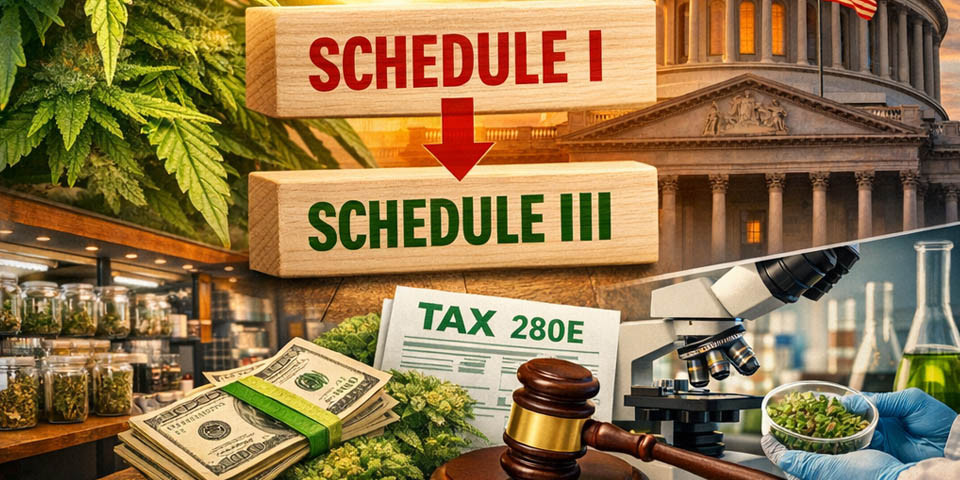
For decades, cannabis has been classified under Schedule I of the Controlled Substances Act — a category defined as having high abuse potential and no accepted medical use. The proposed move to Schedule III represents one of the most significant regulatory shifts in modern cannabis history.
Schedule III substances are recognized as having medical value and moderate-to-low physical dependence risk. If finalized, this reclassification would not legalize marijuana federally for recreational use — but it could reshape the legal, financial, medical, and research landscape. This is not just a symbolic move. It changes how cannabis is treated in taxation, banking, scientific study, and potentially workplace policy.
The Shift From Schedule I to Schedule III — Why It Matters
Rescheduling is best understood as a major federal re-categorization. It can reduce friction for legitimate research, reduce certain compliance-related financial penalties, and signal long-term momentum toward normalization. However, states still control most day-to-day cannabis rules for sales, licensing, and enforcement within their borders.
What Could Change Quickly
1) The 280E Tax Burden Could End for Compliant Cannabis Operators
One of the biggest practical impacts would be the potential end of IRS Code 280E for cannabis businesses. Today, because marijuana is treated as a Schedule I substance, many state-legal cannabis operators cannot deduct ordinary business expenses like rent, payroll, or marketing in the same way other businesses can.
If cannabis is moved to Schedule III, compliant operators could be treated more like standard businesses for federal tax purposes. That could:
- Increase profitability and stability for operators
- Improve cash flow for hiring, compliance, and product development
- Encourage expansion and reinvestment
- Potentially reduce consumer prices over time as tax pressure eases
For adjacent retailers and accessory shops, a healthier legal market can mean better brand consistency, stronger vendor partnerships, and more predictable product availability.
2) Scientific Research May Expand Dramatically
Schedule I classification has historically created major barriers to cannabis research: limited access, heavy approvals, and slow institutional participation. A Schedule III classification could:
- Make clinical trials and institutional studies easier to run
- Increase university and hospital participation
- Encourage new cannabinoid-focused therapies and formulations
Over the next few years, this could lead to stronger evidence around cannabis use for sleep, pain management, PTSD, epilepsy, inflammation, and other conditions — along with more clarity on dosing, interactions, and long-term risk.
3) Banking & Investment Conditions Could Improve (Even Without Full Legalization)
Rescheduling is not the same as legalization, and it does not automatically enable interstate commerce. But it can reduce perceived federal risk for banks and capital providers. Over time, that may:
- Increase access to traditional banking services
- Reduce cash-heavy operations
- Improve lending options for compliant operators
- Encourage more institutional participation in cannabis markets
For consumers, healthier competition tends to produce better labeling, better pricing, and more innovation — especially in wellness and low-dose formats.
What Does NOT Change (Important)
Even if rescheduling is finalized, it does not automatically:
- Legalize cannabis nationwide
- Override individual state laws
- Allow interstate cannabis commerce by default
- Remove state-level testing, licensing, and compliance requirements
States will still regulate cultivation, distribution, and sales independently. Consumers still need to follow their local laws, and businesses still need to remain compliant within their state framework.
Workplace & Drug Testing: A Slow-Moving Change With Big Implications
Schedule III status would formally acknowledge medical use, which could influence employer policy discussions. While private employers generally retain discretion, pressure may increase to update zero-tolerance policies — especially in states where cannabis is legal and where safety-sensitive work rules can be separated from off-duty consumption rules.
Over time, the market may move toward impairment-based standards (how someone is functioning at work) rather than simply detecting prior use. That shift will take time, and it will vary by industry and state.
Future Outlook: What Happens Next?
Short-Term (1–2 Years)
- Possible federal tax relief for compliant operators
- Increased investor confidence and deal activity
- More research approvals and institutional participation
Mid-Term (3–5 Years)
- More standardized cannabinoid-based medicines and therapies
- Better labeling norms and consumer education
- More federal clarity on banking and compliance expectations
Long-Term (5+ Years)
- Further normalization of cannabis as a regulated medical category
- Renewed debate around national legalization frameworks
- More consistent national safety and testing expectations
The overall trajectory suggests cannabis is continuing its transition from a counterculture product into a regulated consumer and wellness industry — with more evidence-based rules and more emphasis on safety and consistency.
What This Means for Consumers
Consumers may benefit from:
- Potentially lower prices over time as tax pressure eases
- More consistent lab testing and product standards
- Better education around dosing, effects, and product selection
- More wellness-focused options (low-dose, terpene-forward, targeted cannabinoid blends)
As research expands, expect clearer product labeling, more targeted formulations, and a bigger shift toward “use-case” purchasing (sleep, calm, focus, recovery) rather than shopping only by strain name or THC percentage.
Conclusion
Federal marijuana rescheduling is a structural turning point — not full legalization, but a major shift in how cannabis is treated under federal law. It could reduce tax burdens, unlock broader research, improve financial access, and create momentum toward more standardized regulation.
State laws still control most consumer access and retail rules, but the federal shift signals long-term movement toward normalization and evidence-based policy.
Disclaimer
This article is for information only and not legal advice. Laws change quickly; consult state resources or counsel to confirm current rules in your jurisdiction.
Recent Posts
-

Top 10 Smoking Accessories Every Smoker Should Own In 2026
Smoking Accessories You Need In 2026 Whether you're a casual smoker or a seasoned enthusiast, the r …Mar 10, 2026 -

The 2026 Ultimate Head Shop Gift Guide: What to Buy for Every Type of Smoker
Shop Gifts for Every Type of Marijuana Smoker Shopping for the perfect gift for someone who enjoys …Mar 07, 2026 -

Top 7 Functional Mushrooms and Their Benefits: Lion’s Mane, Reishi, Cordyceps and More
Functional Mushrooms Have Become Mainstream Functional mushrooms have rapidly become one of the fas …Mar 04, 2026