

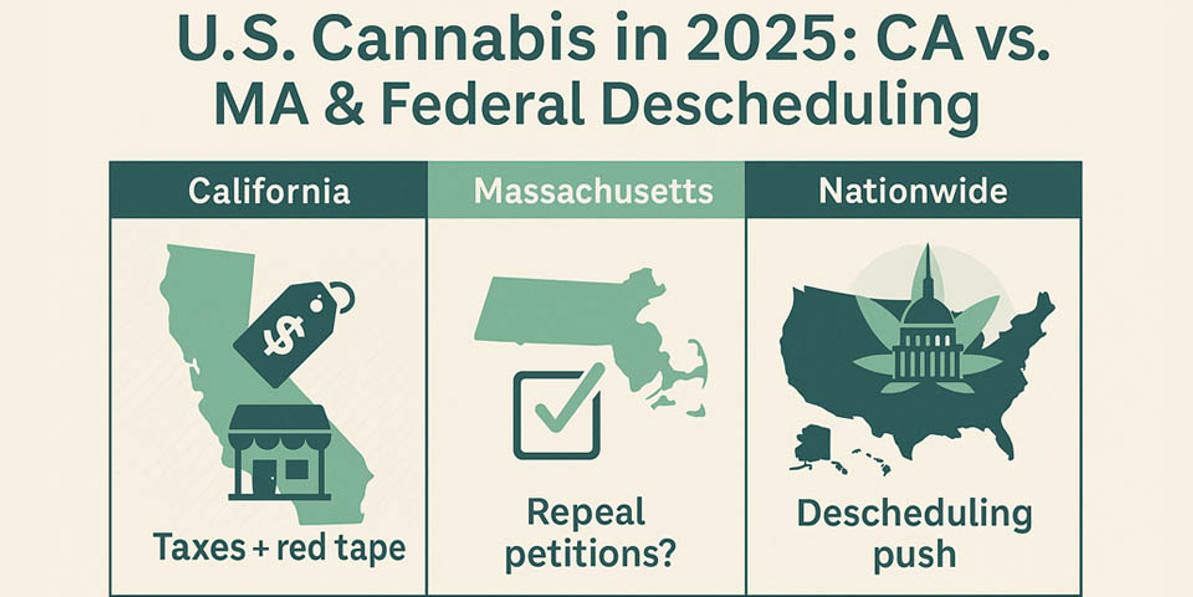
From “Gold Rush” to Growing Pains: What California, Massachusetts, and a Descheduling Push Signals for U.S. Cannabis
What Descheduling Push Signals for U.S. Cannabis
If you follow legal cannabis, the latest headlines carry a common warning: good intentions aren’t enough—market design and execution decide whether legalization actually works. California’s legal market is being cast as a cautionary tale. Massachusetts is entertaining the unthinkable—a rollback of adult-use retail via ballot questions. And nationally, a broad coalition (including major labor groups) is urging Congress to deschedule cannabis outright. Put together, these stories sketch a simple truth: when rules align with real-world behavior, legal markets thrive; when they don’t, the illicit market fills the gap.
California: When Taxes and Red Tape Outrun Reality
California set out to be the model. Instead, many operators are running uphill against stacked taxes, uneven local rules, and inconsistent enforcement. The result is a price gap the illicit market happily exploits. Shoppers don’t buy abstractions; they buy what’s available, affordable, and trusted. If compliant stores can’t deliver on those three, consumers drift back to unregulated channels—no protest signs required.
California’s lesson isn’t “legalization failed.” It’s that overly complex legalization fails. Sustainable programs streamline licensing, reduce friction between state and local mandates, and keep total tax burden low enough that regulated prices remain competitive—especially during wholesale price dips.
Massachusetts: Could a Legal Market Actually Be Repealed?
Massachusetts faces petitions that would end adult-use retail while leaving medical intact. The path from petition to policy is long and procedurally demanding, but the conversation itself is a flashing yellow light. If voters lose confidence—over product access, prices, or regulatory performance—policy can move backward.
For a state with a sizable adult-use economy, repeal would shift sales and tax dollars out of regulated channels and back into the shadows. Even if repeal never reaches the ballot, the pressure should spur regulators and lawmakers to tighten operations, communicate clearly, and focus on the consumer experience.
National Momentum: A Coalition Backs Descheduling
Meanwhile, more than two dozen organizations—spanning labor, civil rights, and policy advocacy—have lined up behind federal descheduling (removing cannabis from the Controlled Substances Act). Why does that matter to state markets? Because descheduling would finally eliminate the structural mismatches that keep compliant operators on their heels: punitive federal tax treatment, limited banking access, and the balkanized rules that stifle scale and consistency.
Descheduling wouldn’t instantly solve every problem, but it would clear the biggest federal roadblocks and let states regulate with fewer contradictions—opening the door to normalized banking, rational taxation, interstate logistics, and nationally consistent safety standards.
The Through-Line: Build Markets People Actually Want to Use
- Price parity beats symbolism. If regulated products are consistently pricier, consumers migrate to cheaper channels.
- Enforcement must be credible and consistent. Once legal options exist, unlicensed storefronts and delivery hubs can’t be allowed to define the market.
- Regulators are brand stewards. Clear timelines, transparent data, and predictable decisions build public trust.
- Federal alignment is the keystone. Descheduling removes structural handicaps (like harsh tax treatment) that no state can fix alone.
A Practical Playbook for 2025
- Right-size taxes. Keep total burden low enough to maintain real price competition with unregulated supply.
- Streamline licensing. One clear, time-bounded pathway reduces startup burn and expands compliant access points.
- Target the worst illicit hubs. Focus on repeat bad actors and supply nodes, not one-off, whack-a-mole raids.
- Publish service-level promises. Post and track SLAs for application reviews, lab turnarounds, and compliance actions.
- Back federal descheduling + expungement. Normalize banking and taxation while addressing past harms.
Bottom Line
Legalization isn’t a finish line—it’s a system that needs constant tuning. California shows what happens when friction and taxes crowd out value. Massachusetts shows how fragile public consensus can be if the system feels clunky or costly. And the national descheduling push shows a way to fix the scaffolding so states can build durable, consumer-friendly markets. Get the mechanics right, and the promise of legalization becomes everyday reality.
Sources
- California’s legal market as a cautionary tale (Washington Examiner)
- Could Massachusetts repeal legal marijuana sales? (MassLive)
- 30+ organizations endorse federal descheduling (The Marijuana Herald via NewsBreak)
**The beliefs and opinions expressed in this blog are not those of Waterbeds 'n' Stuff.
Want more cannabis education, news, and product tips?
Subscribe to our newsletter or follow us on social media.
Explore More:
Recent Posts
-

Top 10 Smoking Accessories Every Smoker Should Own In 2026
Smoking Accessories You Need In 2026 Whether you're a casual smoker or a seasoned enthusiast, the r …Mar 10, 2026 -

The 2026 Ultimate Head Shop Gift Guide: What to Buy for Every Type of Smoker
Shop Gifts for Every Type of Marijuana Smoker Shopping for the perfect gift for someone who enjoys …Mar 07, 2026 -

Top 7 Functional Mushrooms and Their Benefits: Lion’s Mane, Reishi, Cordyceps and More
Functional Mushrooms Have Become Mainstream Functional mushrooms have rapidly become one of the fas …Mar 04, 2026