

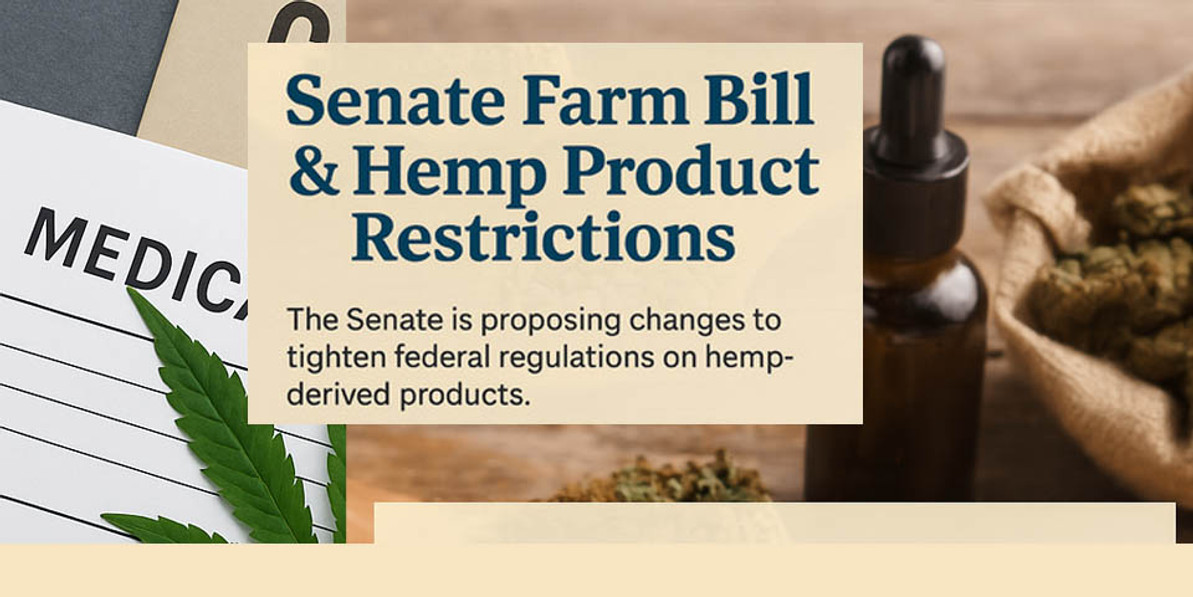
Senate Farm Bill & Hemp Product Restrictions: What the Industry Needs to Know
New Senate Farm Bill Reshapes Hemp Product Restrictions
As of mid‑2025, the Senate has introduced sweeping changes to the Farm Bill that could fundamentally reshape how hemp-derived products are regulated—especially intoxicating cannabinoids like delta‑8, delta‑10, HHC, and THCA. If you're a producer, retailer, or advocate, here's what’s happening and what you can expect.
How We Got Here: The Original 2018 Farm Bill Loophole
The 2018 Agriculture Improvement Act legalized hemp federally by defining it as Cannabis sativa L. with less than 0.3% delta‑9 THC by dry weight. That opened the door to a booming hemp industry—but also to unintended byproducts:
- Retail products containing lab‑converted intoxicants (delta‑8, delta‑10, HHC)
- No federal required testing or labeling standards for downstream products
- A patchwork of state rules—some banning tetrahydrocannabinols entirely
The result? A gray market full of products beyond traditional cannabis laws, yet still psychoactive. That loophole is what the new Senate bill aims to close.
Key Provisions of the Senate Farm Bill Update
The Senate version—often titled the Rural Prosperity and Food Security Act—proposes:
- A tighter definition of “hemp” excluding intoxicating derivatives, even if under 0.3% THC :contentReference[oaicite:4]{index=4}
- A ban on consumer products containing any quantifiable THC, including synthetic cannabinoids like delta‑8 and HHC :contentReference[oaicite:5]{index=5}
- No preemption of state laws—states may still enact stricter bans
Senator Mitch McConnell and others emphasize that the original intent of the 2018 bill was to grow industrial hemp—not legalize intoxicants hidden in unregulated products.
What Producers and Retailers Are Saying
On Reddit forums and industry boards, real users are weighing in:
“That 0.3% limit isn’t new—in NC they just now group natural THCA and synthetics, banning both. People are furious.” – u/Sphankstah1 on r/asheville {index=8}
“Farmers in Arkansas are being told their delta‑8 and HHC products are banned outright—and federal preemption arguments aren’t holding up in court.”
These voices illustrate how definitions and product categories are under fire—and how legislation is sidelining nuance in favor of total prohibition.
State-Level Snapshots: From Alabama to Texas
- Alabama legislated strict THC caps per serving and banned smokable hemp; critics argue it will destroy small businesses that rely on calming tinctures and treats
- Texas is pushing Senate Bill 5 (SB 5), which proposes felony-level penalties for any detectable THC—even packaging trace amounts—while Governor Abbott advocates a regulated milligram-based system instead. Hemp advocates warn it’s an existential threat to the industry.
Practical Takeaways for Stakeholders
For Farmers & Processors
- Be ready to shift focus to fiber, grain, or approved CBD channels without THC
- Track pending state rules—some ban more than federal proposals (Arkansas, California)
- Prepare for product discontinuations or R&D into compliant terpenes or extracts
For Retailers & Brands
- Audit inventory now: remove products that include any trace THC—even if under federal 0.3% threshold
- Adjust labeling and testing protocols, especially if delta‑8 or similar compounds are involved
- Advocate for licensed dispensary access or conversion to low‑THC alternatives
Why Consumers Should Care
Many people use hemp-derived products for sleep, anxiety, or chronic pain—with delta‑8 being an alternative to prescription drugs. Loss of access could drive customers to untested or illicit products.
Some advocates argue that banning THC in all forms pushes consumers underground and undermines regulated cannabis’s potential to deliver safe, monitored alternatives. Ethan Lindsey from American Trade Association of Cannabis and Hemp said, “Regulation—not prohibition—is the answer.”
Bottom Line
The Senate’s Farm Bill revisions represent a pivotal shift: a move from hemp legalization with minimal controls toward a tightly regulated—or restricted—market for intoxicants derived from hemp. Whether you are growing, selling, or consuming hemp products, the months ahead will bring major changes. Staying informed, adapting early, and advocating for balanced regulation may determine your survival in this evolving landscape.
*These statements have not been evaluated by the United States Food and Drug Administration.
**The beliefs and opinions expressed in this blog are not those of Waterbeds 'n' Stuff.
Want more cannabis education, news, and product tips?
Subscribe to our newsletter or follow us on social media.
Explore More:
Recent Posts
-

Valentine’s Day Gift Ideas That Go Beyond Chocolate & Flowers ❤️
Unforgettable surprises for every kind of lover Valentine’s Day is the perfect excuse to slow down, …Jan 27, 2026 -

18mm vs 19mm Bong Joints: What’s the Real Difference?
If you’ve ever tried to buy a new bowl, banger, or downstem for your bong, you’ve probably run into …Jan 12, 2026 -
Ohio Marijuana & CBD Laws 2025: The Real Story on Issue 2, Delta-8 & Hemp
Updated: December 8, 2025 Ohio’s cannabis laws have changed rapidly since voters approved Issue 2 i …Dec 08, 2025