
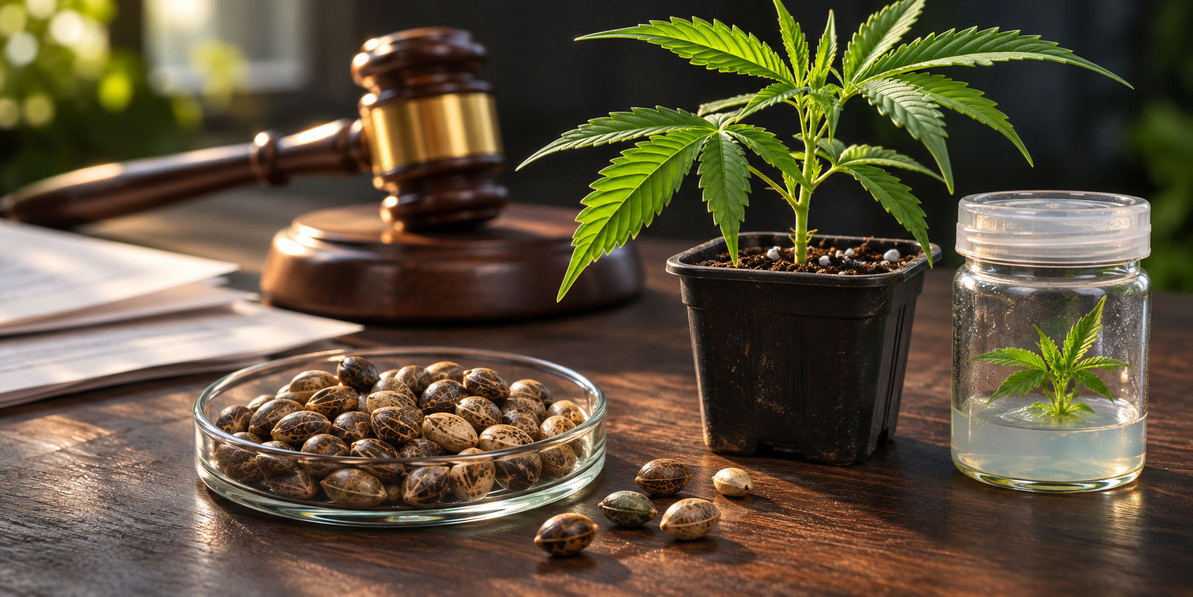
Are Cannabis Seeds and Clones Being Banned in 2026? Dates, Ohio Laws and Who Is Behind It
Updated November 4, 2026
Are cannabis seeds and clones about to be banned? If you have been following cannabis news, breeder announcements or Reddit discussions, you have probably encountered several different answers. Some people say everything disappears in November. Others say the restrictions were delayed, clones are exempt, or the entire situation is just seed companies trying to increase sales.
The actual situation is more specific. Congress has enacted changes that will remove many products and certain viable cannabis seeds from the federal definition of hemp. Most of those changes are currently scheduled for December 11, 2026. A narrower category of cannabinoid products faces a November 12 deadline.
Clones and tissue cultures require a separate explanation. Ohio also has its own rules already in effect. Here is what Waterbeds 'n' Stuff readers need to know about the laws, the political fight and the claims circulating online.
The quick answer
Certain viable cannabis seeds are scheduled to lose federal hemp status on December 11, 2026. Clones are not expressly named in the seed exclusion, but that does not make them automatically lawful. Ohio still permits qualifying adult home growing, while regulating marijuana seeds, plants and clones separately from ordinary hemp merchandise.
When Does the Federal Hemp Ban Take Effect?
There are two dates to understand. The original hemp-definition amendment was enacted in November 2025 through Section 781 of Public Law 119-37. Subsequent legislation, Public Law 119-103, delayed most of that amendment until December 11, 2026.
The Congressional Research Service's October 28 analysis confirms that the delay leaves certain provisions scheduled for November 12.
| Date | Scheduled federal change |
|---|---|
| November 12, 2026 | Hemp-derived cannabinoid products containing cannabinoids that cannabis cannot naturally produce are expressly excluded from hemp. THC-O is an example discussed by CRS, although its existing legal status has already been disputed. |
| December 11, 2026 | Most remaining changes take effect, including the total-THC standard, viable-seed exclusion, restrictions on cannabinoids synthesized or manufactured outside the plant, and the finished-product THC limit. |
These are enacted deadlines, not merely dates in a proposed bill. Congress could change them again, but a proposal, interview or social-media announcement does not itself change the law. The controlling extension appears in Section 2019 of Public Law 119-103.
Which Products Are Affected?
Calling this a ban on “everything cannabis” is misleading. The law changes which materials qualify for the federal hemp exemption. Products excluded from hemp can become subject to federal controlled-substance requirements; state marijuana programs are a separate legal framework.
| Product or material | What changes |
|---|---|
| Viable cannabis seeds | Seeds from plants exceeding 0.3% total THC, including THCA, are excluded from hemp beginning December 11. |
| THCA flower | Flower exceeding the total-THC threshold cannot qualify based only on low delta-9 THC. |
| Hemp THC gummies, drinks, vapes and other finished cannabinoid products | Covered products containing more than 0.4 milligrams per container of the combined counted THC and similar-effect cannabinoids are excluded. |
| Converted cannabinoids | Products containing naturally possible cannabinoids synthesized or manufactured outside the plant face a separate exclusion. Commercial delta-8 made by converting CBD is a major concern. |
| Intermediate cannabinoid products | Additional exclusions cover excessive combined cannabinoid concentrations and intermediates sold directly to consumers or marketed as finished products. |
| Some full-spectrum CBD products | Trace THC can add up across a container. CBD-dominant products can exceed the finished-product limit even when they are not marketed for intoxication. |
The details are in Section 781 of the enacted federal law. The Minnesota Office of Cannabis Management also explains the upcoming federal changes and the distinction between state authorization and federal compliance.
The finished-product threshold is 0.4 milligrams per container, not 0.4%, and not 0.4 milligrams per serving. For perspective, a bottle containing 30 servings with 0.1 milligram of THC each contains 3 milligrams altogether. That exceeds 0.4 milligrams despite the small amount in each serving.
This does not automatically prohibit all CBD, hemp fiber, hemp food ingredients or ordinary smoking accessories. Industrial hemp has its own protected uses within the amended framework. A product remaining outside controlled-substance restrictions must still satisfy other applicable laws.
Why Are Cannabis Seeds Included if Seeds Do Not Get You High?
The controversy is that the new seed exclusion looks at the source plant. It does not simply ask how much THC is physically present in the seed.
A viable seed can germinate. Under the amendment, viable seeds from a cannabis plant exceeding 0.3% total THC lose hemp status even if the seeds themselves contain very little THC. This closes a route through which marijuana genetics have been sold as hemp.
That explains the legal mechanism. It does not settle the policy argument. Breeders question why non-intoxicating planting material should be restricted alongside intoxicating consumer products. Their concerns include access to genetics, preservation of varieties, research and the survival of small seed businesses.
The American Seed Innovation and Growth Alliance advocates treating seed genetics separately from finished cannabinoid products. Its position is an industry advocacy position, rather than a government interpretation.
Are Cannabis Clones and Tissue Cultures Being Banned Too?
This is where blanket claims become unreliable. The specific source-plant exclusion names viable seeds. It does not expressly name clones or tissue cultures. However, the broader hemp definition covers cannabis plants and plant parts and applies the new total-THC standard.
A clone is a cutting used to reproduce a plant. Tissue culture involves plant material maintained under laboratory conditions. Neither should be assumed compliant merely because it is small, immature or not flowering.
Attorneys at Harris Sliwoski have discussed a possible statutory gap for clones and tissue cultures that themselves meet the total-THC threshold. They also warn that regulatory interpretation remains uncertain. Their older article predates the subsequent deadline extension.
The defensible answer is that seeds are expressly targeted, while clones and tissue cultures require a separate compliance analysis. Neither “all clones are banned” nor “clones are a guaranteed legal workaround” accurately captures that distinction. State licensing, cultivation, shipping and import requirements can also apply.
What Does This Mean for Ohio Home Growers?
Ohio's written law already excludes certain viable seeds from hemp. Ohio Revised Code Section 928.01, effective March 20, 2026 under Senate Bill 56, uses a total-THC definition and contains a source-plant seed exclusion.
Ohio also continues to authorize qualifying adults 21 and older to grow up to six marijuana plants per person, with a maximum of 12 at one residence. Growing must follow the requirements in Section 3796.04, including a secured area at the primary residence, restricted access and visibility requirements. Rental restrictions and other statutory conditions can apply.
A separate Ohio rule effective October 5 limits each direct-customer-sale package to no more than six seeds, six clones or six live plants, as applicable. Rule 1301:18-4-06 also requires clones and live plants offered for sale to remain vegetative.
Six seeds per package is not the same thing as a six-seed possession limit. Likewise, home-grow permission does not give every retailer permission to sell marijuana genetics. The federal changes do not automatically repeal Ohio's home-grow statute, but Ohio authorization does not erase federal restrictions.
Read our broader Ohio marijuana law update for more about the state's changing cannabis framework. Hemp litigation also affects particular enforcement questions; businesses should not assume an order protecting another company covers their own sales.
Who Is Behind the Restrictions?
Senator Mitch McConnell was a leading federal advocate. In his November 10, 2025 Senate remarks, he described securing the appropriations language and argued that businesses had exploited the 2018 hemp law to sell unregulated intoxicating products. He emphasized child access, candy-like packaging and sales through ordinary retail outlets.
Congress passed the legislation, and President Donald Trump signed it. The changes were enacted through a broader spending law rather than a standalone nationwide cannabis-seed referendum. Representative Andy Harris has also opposed delaying the hemp restrictions, as reported in coverage of the subsequent funding negotiations.
A bipartisan coalition of 35 state and territorial attorneys general supported keeping the reforms. Their August 2026 position was that Congress should not delay or weaken the new definition. The Pennsylvania attorney general's announcement lists Ohio among the signatories and explains the coalition's consumer-protection arguments.
Ohio's separate changes came through the state legislature's SB 56. Governor Mike DeWine signed that legislation in December 2025, with a line-item veto.
The stated case for the crackdown centers on intoxication, inconsistent regulation and consumer safety. The criticism is that its reach extends to seed genetics and some low-THC CBD products that do not fit the ordinary image of an intoxicating gummy or vape.
Did Alcohol Companies Push for the Hemp Ban?
There is recent reporting worth distinguishing from online speculation. On October 30, Marijuana Moment reported on emails obtained by Politico in which lobbyists associated with major alcohol companies encouraged attorneys general to support keeping the federal hemp restrictions on track. The report named Anheuser-Busch, Molson Coors and Diageo.
That is reported lobbying activity. It does not establish that those companies wrote the seed provision, bribed officials or secretly controlled every part of the legislation.
The alcohol industry is not unanimous. In a separate opinion piece by a Wine & Spirits Wholesalers of America representative, the organization advocated a regulated pathway for hemp THC beverages. Different businesses have different interests in whether these products are prohibited, licensed, distributed or taxed.
What Are Reddit and Cannabis Forums Saying?
The discussions reviewed for this article show several competing reactions. They are examples of online opinion, not a representative survey of cannabis consumers.
Some collectors are worried about losing access to genetics
In a Reddit discussion about the December seed changes, participants described concern about future availability and reported people purchasing seeds in advance. Those purchases are unverified personal anecdotes. They illustrate anxiety, not evidence that buying before the deadline creates permanent legal protection.
Others predict seed enforcement will be a low priority
A post in the SpeedrunSeeds subreddit argued that enforcement would primarily target intoxicating products and that small seed sellers would attract less attention.
That is a prediction, not an announced federal enforcement policy. The discussion also shows why readers should check statutory language: the upcoming seed exclusion uses total THC, including THCA, in the source plant. A claim based only on low delta-9 THC leaves out that change.
Forums are making their own policy decisions
An Overgrow announcement and FAQ describes restrictions on seed-related exchanges beginning December 1, while retaining growing discussions. The thread includes disagreement over interpretation and compliance.
That December 1 date is a forum policy date. It is not the December 11 federal effective date. Platform rules, seller cutoff dates and legal deadlines should not be treated as interchangeable.
Claims about pharmaceutical interests remain allegations
Some Reddit comments blame pharmaceutical interests or portray the restrictions as an effort to eliminate affordable alternatives. These are commenters' opinions. The sources reviewed here do not establish that pharmaceutical companies directed the seed exclusion.
Documented political advocacy, reported lobbying and speculation about hidden motives are different kinds of information. Treating them differently makes the debate easier to understand.
Can Congress Still Stop or Change the Restrictions?
Yes. Support for an alternative exists, but no permanent replacement is established by the sources reviewed for this November 4 update.
Representatives Andy Barr and Angie Craig introduced H.R. 9830, the Lawful Hemp Protection Act. Its proposed seed language would assess THC in the seed itself using a 1% total-THC threshold, and the bill would repeal Section 781. That is a proposal, not the current rule.
Senators Amy Klobuchar and Rand Paul supported delay legislation. More recently, October 27 reporting described Representative Morgan Griffith's interest in using post-election legislation to establish hemp-product regulations before December 11.
Different proposals solve different problems. A bill protecting low-dose beverages would not necessarily protect seeds, tissue cultures or every CBD product. The actual text matters more than a headline saying lawmakers want to “save hemp.”
What About Seeds You Already Own or Orders Placed Before the Deadline?
The enacted seed provision does not create a general grandfather exemption for existing consumer collections. Buying early therefore should not be presented as a guarantee that later possession, transfer or shipping remains federally authorized.
Nor does a seller's “souvenir” label settle the issue. A seed's legal classification depends on the applicable law and facts, not simply its marketing description. State home-grow permission and federal interstate shipping rules are separate questions.
For consumers and businesses, the next meaningful developments are enacted legislation, agency guidance and applicable court orders. Another proposed bill or optimistic social-media prediction may be worth following, but it is not a substitute for a legal change.
More Cannabis Information From Waterbeds 'n' Stuff
New Ohio Weed Laws 2026 covers the wider changes affecting Ohio buyers.
Best Way to Store Weed in 2026 compares flower-storage options, including jars, Mylar bags and original packaging.
Shop Storage and Smoking Accessories
Explore the Fujima Dank Tank Neon Flame Leaf Vacuum Jar for herb storage, or keep your setup organized with the RAW Classic Small Metal Rolling Tray.
Browse rolling papers, wraps and related accessories at Waterbeds 'n' Stuff. Free shipping is available on orders over $50. Availability may change.
This article provides general information, not individualized legal advice. Laws, regulations and court orders may change after the update date. Social-media statements are attributed opinions or anecdotes unless otherwise identified.
Recent Posts
-

Are Cannabis Seeds and Clones Being Banned in 2026? Dates, Ohio Laws and Who Is Behind It
Updated November 4, 2026 Are cannabis seeds and clones about to be banned? If you have been followi …Nov 04, 2026 -

Why Are Infused Pre-Rolls Exploding in Popularity in Ohio?
Ohio's legal marijuana market is changing quickly, and one of its fastest-growing product categories …Nov 03, 2026 -

Are Ohio's New Marijuana Rules Already Hurting Consumers?
Are Ohio's New Marijuana Rules Already Hurting Consumers? What Changed in 2026 Published October 2 …Oct 28, 2026