
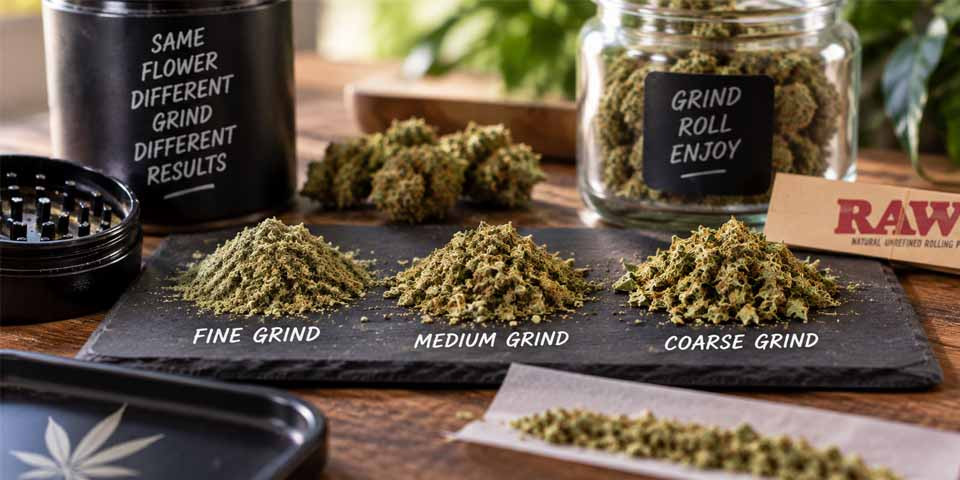
Fine Grind vs. Coarse Grind: Does Your Grinder Change the Way Weed Burns?
Most people think a weed grinder has one job:
make big weed smaller.
But two grinders can take the exact same flower and produce completely different results.
One creates:
tiny fluffy particles.
Another leaves:
larger, chunky pieces.
And another practically turns your flower into:
powder.
Does any of that actually matter once you light it?
Yes.
More than many people realize.
The size of your ground cannabis can change airflow, packing density, surface area, burn rate and even how cannabinoids are delivered from a joint.
And unlike a lot of cannabis folklore, researchers have actually tested this.
Scientists Literally Tested Different Weed Grind Sizes
Researchers prepared cannabis joints using flower separated into three particle sizes:
- 1 millimeter
- 3 millimeters
- 5 millimeters
Each joint contained approximately half a gram of flower.
Instead of having people smoke them and guess which burned better, researchers connected the joints to a controlled smoking machine.
The machine took standardized puffs while filters captured the resulting aerosol.
Researchers then measured cannabinoid delivery.
The results were surprisingly different.
Fine-Ground Weed Burned Much Faster
In the THC-dominant flower experiment, the joints made from the finest 1 mm particles finished in approximately:
28 puffs.
The 3 mm joints took approximately:
52 puffs.
And the coarse 5 mm joints took approximately:
54 puffs.
Same general type of product.
Same controlled smoking system.
Very different burn behavior.
Why Does Fine Weed Burn Faster?
The answer starts with:
surface area.
Imagine lighting one solid piece of wood.
Now cut that same wood into hundreds of tiny pieces.
You haven't created more wood.
But you've exposed much more surface to:
- Heat
- Oxygen
- Flame
Cannabis behaves according to the same basic physical principle.
Grinding Doesn't Create More THC
This distinction is important.
If you put 0.5 grams of flower containing a certain amount of THC into a grinder, grinding it doesn't magically increase the THC content.
What changes is:
how that material behaves when heated or burned.
The Fine Grind Produced Stronger Puffs in the Experiment
The researchers didn't just measure how long the joints burned.
They measured cannabinoid delivery per puff.
For the THC-dominant flower, average THC delivery was approximately:
| Particle Size | Average THC Per Puff | General Burn Characteristic |
|---|---|---|
| 1 mm | 0.67 mg/puff | Faster burning |
| 3 mm | 0.31 mg/puff | Slower than 1 mm |
| 5 mm | 0.51 mg/puff | Longest lasting |
So the smallest grind produced the highest average THC delivery per puff in that experiment.
But there's a twist.
Finer Didn't Mean More THC Delivered Overall
Although the fine 1 mm THC joints produced stronger average puffs, the researchers found that the coarse 5 mm joints delivered more THC across the complete joint.
The approximate totals reported were:
- 1 mm / 3 mm: roughly 16-19 mg THC delivered
- 5 mm: roughly 28 mg THC delivered
That's an important reminder:
bigger individual puffs and greater total delivery are not necessarily the same thing.
So Is Coarse Grind Actually Better?
Not necessarily.
And neither is fine.
This experiment wasn't designed to declare one universal grind size the winner.
Instead, it demonstrates something more useful:
particle size materially changes smoking performance.
Your Grinder Is Part of the Smoking System
When you think about a joint, you probably think about:
- The flower
- The paper
- The filter
- How tightly it was rolled
But before any of that happens:
your grinder determines the physical structure of the flower.
That structure affects everything downstream.
Your Grinder Changes More Than the Size of Your Weed
Different grinder teeth, hole sizes and designs can produce noticeably different textures. Browse grinders for joints, bowls, water pipes and dry herb vaporizer setups.
Shop Grinders at Waterbeds 'n' StuffWhat Is Considered a Fine Grind?
In everyday terms, fine-ground cannabis consists of small, relatively uniform particles.
It should not necessarily look like flour.
There's an important difference between:
fine
and:
pulverized.
The controlled joint experiment used approximately 1 mm particles for its finest condition.
What Is a Coarse Grind?
Coarsely ground cannabis contains larger pieces of flower.
Instead of tiny flakes, you'll see:
- Larger fragments
- More visible plant structure
- More open space between particles
The largest controlled particle size in the joint study was approximately 5 mm.
And What Is a Medium Grind?
A medium grind sits between the two extremes.
For many people, this is the practical sweet spot because it provides:
- Good surface area
- Predictable packing
- Reasonable airflow
- Less powder
But the best grind depends on what you're using.
Best Grind for Joints: Usually Medium to Medium-Fine
A joint needs something very important:
consistent airflow through the entire roll.
Large chunks can create irregular gaps.
Extremely fine particles can compress together.
Both extremes can cause problems.
Why Fine Weed Can Make a Joint Hard to Pull
This seems contradictory.
Didn't the laboratory experiment show that finer weed burns more readily?
Yes.
But laboratory particle size and real-world packing are separate variables.
If you take fine flower and compress it tightly:
the spaces between particles become extremely small.
Now air has difficulty moving through the joint.
So fine cannabis can simultaneously:
- Have high exposed surface area
- Burn readily when oxygen reaches it
- Restrict airflow when overpacked
That's why:
grind size and packing density have to be considered together.
Current Cannabis Users Report Exactly This Problem
In a 2025 rolling discussion, one user complained that grinders kept turning flower into material so fine that even lightly packed joints became difficult to smoke.
Other users pointed out another important variable:
flower moisture.
Very dry cannabis can fall apart into powder regardless of the grinder.
Moister flower may instead stick to the grinder teeth.
That leads us to something people often overlook.
Your Weed Changes How Your Grinder Performs
You can't judge a grinder completely independently of the flower.
Put extremely dry cannabis into almost any grinder and it may:
shatter.
Put unusually moist cannabis into that same grinder and it may:
clump.
Dry Weed + Fine Grinder = Powder
This combination can be particularly frustrating.
The flower is already brittle.
Then aggressive grinder teeth break it repeatedly.
The result can look more like:
cannabis dust.
That material packs differently from normally ground flower.
If your grinder suddenly turns every bud into dust, the grinder may not be the entire problem. Extremely dry flower becomes brittle and breaks apart much more easily.
Read: Why Does Weed Dry Out So Fast?
Moist Weed + Grinder = Clumps
Go too far in the other direction and cannabis can:
- Stick between teeth
- Form clumps
- Fail to fall through grinder holes
- Require repeated turning
Then people keep grinding because the flower isn't dropping through.
Eventually they may over-process it.
Does Turning Your Grinder More Times Make the Weed Finer?
Depending on the grinder design:
yes.
In many chamber grinders, material eventually falls through holes once it becomes small enough.
Until that happens, the teeth can continue breaking it apart.
Why People Grind Their Grinder Upside Down
This common trick deliberately prevents cannabis from immediately falling into the collection chamber.
The flower stays around the teeth longer.
Result:
a finer grind.
That's useful if your grinder normally produces material that's too coarse.
It's not useful if you're already producing powder.
Does Grinder Hole Size Matter?
Absolutely.
In many multi-piece grinders, the holes act as a rough particle-size gate.
Larger holes allow bigger pieces to fall through.
Smaller holes keep flower in the grinding chamber longer.
So two grinders with similar-looking teeth can produce noticeably different material simply because of:
- Hole diameter
- Hole shape
- Number of holes
- Tooth spacing
What About Grinder Teeth?
Tooth geometry also matters.
Different designs:
- Cut
- Tear
- Crush
- Shred
flower differently.
This is why two grinders with the same diameter can produce very different textures.
Does a More Expensive Grinder Make Weed Stronger?
No.
A grinder does not increase the amount of THC originally present in the flower.
What a better-designed grinder may improve is:
- Consistency
- Ease of turning
- Particle distribution
- Airflow in the finished roll or bowl
And those things can change the experience.
Fine Grind vs. Coarse Grind for Joints
| Characteristic | Fine Grind | Coarse Grind |
|---|---|---|
| Surface Area | Higher | Lower |
| Burn Tendency | Generally faster/easier | Generally slower |
| Packing | Can become very dense | Can create large air gaps |
| Airflow | Can restrict if compressed | Can become uneven |
| Joint Duration | Often shorter | Often longer |
| Practical Use | Good when not pulverized | Good when not excessively chunky |
So What's the Best Grind for a Joint?
For most people:
medium to medium-fine and reasonably uniform.
You're looking for:
- No huge chunks
- No powder
- No stems
- Consistent texture
- Enough structure for airflow
Then:
don't pack it like concrete.
Match the Grind With the Right Paper
Once you've found the grind you like, paper size, material and rolling style become the next variables. Browse rolling papers, wraps, cones, tips, trays and rolling accessories.
Shop Papers & WrapsBest Grind for Bowls
A bowl doesn't have exactly the same airflow requirements as a joint.
For many glass bowls:
medium to somewhat coarse works well.
Why?
The bowl already has a concentrated airflow path beneath the flower.
You don't necessarily need the tightly interconnected bed of particles used in a joint.
Fine Grind Can Fall Through a Bowl
If the bowl has a relatively large opening and no screen, very fine cannabis can:
- Fall through before lighting
- Get pulled through while inhaling
- Enter the water pipe
That's wasted flower.
Why Some People Put a Larger Piece on the Bottom
An old-school trick is placing a slightly larger piece of flower over the bowl opening before adding normally ground cannabis.
It acts as a crude plant-material screen.
Another option:
use an appropriate bowl screen.
Does Fine Grind Make a Bong Hit Bigger?
It can make more material ignite rapidly because of the increased surface area.
That may create a denser burst of smoke.
But again:
the grinder didn't create more cannabinoids.
It changed combustion behavior.
Fine Grind Can Also Pull Through Faster
If you aggressively inhale through a bong containing powdery flower, small particles and ash can be pulled through the bowl.
That can:
- Dirty the bong faster
- Waste unburned material
- Add debris to the water
Using Your Grinder With Glass?
A medium or slightly coarser grind can be easier to manage in many glass bowls while maintaining airflow through the bowl.
Shop Bongs & Water PipesWhat About Dry Herb Vaporizers?
This gets more complicated.
With combustion, we're trying to maintain a burning ember.
A dry herb vaporizer instead transfers heat into the flower without intentionally setting it on fire.
That makes surface area important—but airflow still matters.
Fine Grind Gives a Vaporizer More Surface Area
Smaller particles expose more flower to heat.
In theory, that can help:
- Heat penetrate material
- Release volatile compounds
- Create more even extraction
But there is a limit.
Too Fine Can Restrict Vaporizer Airflow
This is particularly relevant to convection-style vaporizers.
These devices depend on hot air moving:
through the flower.
If the chamber is packed with tightly compressed powder:
air can't move efficiently.
This Is Why Vaporizer Grind Advice Seems Contradictory
Search cannabis forums and you'll find:
"Grind it fine."
Then:
"Never grind it fine."
Both users may be getting excellent results.
Because they may be using completely different vaporizer designs.
Conduction vs. Convection Changes the Answer
Conduction Vaporizers
Heat is transferred primarily through contact with a hot chamber surface.
A finer, relatively even grind may improve contact with that heated surface in some designs.
Convection Vaporizers
Hot air moves through the cannabis.
Maintaining open air pathways becomes particularly important.
A medium or somewhat coarser fluffy grind may therefore perform better in some convection devices.
Hybrid Vaporizers
These use a combination of conduction and convection.
The ideal grind depends on the specific chamber and airflow design.
The Best Vaporizer Grind Is the One Designed for Your Device
This is one situation where:
read the manufacturer's instructions
is actually useful advice.
Different vaporizers are engineered around different:
- Chamber shapes
- Screens
- Air paths
- Heating systems
Prefer Flower Without Combustion?
Dry herb vaporizers heat ground flower rather than intentionally burning it. Grind size still matters because it changes surface area, packing and airflow through the chamber.
Shop Dry Herb VaporizersDoes Fine Grinding Destroy Terpenes?
Grinding doesn't instantly destroy the terpenes in your flower.
But it does dramatically increase exposed surface area.
That matters because many of the compounds responsible for cannabis aroma are volatile.
Once the bud is broken apart, more internal material is exposed to:
- Air
- Heat
- Light
So if you grind an entire ounce and leave it sitting around for weeks:
you've created much more opportunity for aroma loss than if the buds remained whole.
Grind Right Before You Use It
This remains one of the simplest ways to preserve flower quality.
Store buds mostly whole.
Then grind:
what you actually plan to use.
Does a Kief Catcher Make Your Weed Weaker?
This argument appears constantly online.
A multi-piece grinder can separate some trichome material through a fine screen into a lower chamber.
Technically, anything separated from the ground flower is no longer in that particular portion.
But it isn't necessarily lost.
It's:
in the kief chamber.
Whether you prefer that separation is mostly a matter of how you use your grinder.
Two-Piece vs. Three-Piece vs. Four-Piece Grinders
Two-Piece Grinder
Simple grinding chamber.
You control texture largely by how long you grind.
Three-Piece Grinder
Usually allows ground flower to fall into a separate collection chamber.
Four-Piece Grinder
Adds a screened lower section for collecting finer trichome-rich material.
Which Grinder Produces the Best Grind?
Don't choose purely by the number of chambers.
Look at:
- Tooth geometry
- Hole size
- Grinding resistance
- Consistency
- Diameter
- Construction quality
- How you actually consume flower
Can You Tell Grind Quality Just by Looking?
Usually you can spot the extremes.
Too coarse:
large chunks remain and the mixture is highly inconsistent.
Too fine:
much of the material resembles powder.
Good general-purpose grind:
relatively uniform small pieces that remain fluffy rather than compressed.
Why Uniformity May Matter More Than Fine vs. Coarse
Imagine a joint filled with:
- Powder
- 5 mm chunks
- Stem pieces
- Medium flakes
Each section packs differently.
Each section creates different air pathways.
Each section can burn differently.
So asking:
"fine or coarse?"
may actually miss the more important question:
"How consistent is the grind?"
What the Scientific Study Really Tells Us
It would be easy to turn the particle-size research into a headline like:
"Science proves 1 mm is the best grind!"
But that's not what the data show.
The fine particles:
- Burned readily
- Produced fewer total puffs
- Produced high average cannabinoid delivery per puff
The coarse particles:
- Lasted longer
- Required more puffs
- Produced different total cannabinoid delivery
And burn consistency varied depending on both:
particle size and the flower itself.
The Flower Matters as Much as the Grinder
The researchers specifically noted that flower characteristics appeared to influence smoking performance.
That makes sense.
Two cannabis samples can differ in:
- Moisture
- Density
- Resin content
- Plant structure
- Cannabinoid composition
Run both through the exact same grinder and you may still get different results.
Why Does My Grinder Suddenly Grind Too Fine?
Before replacing it, ask:
Did the flower change?
If your current flower is much drier than your previous batch, it may break apart much more aggressively.
The grinder may be doing exactly what it always did.
Why Is Weed Sticking Inside My Grinder?
Possible causes include:
- Sticky resinous flower
- Higher flower moisture
- Built-up residue on grinder teeth
- Overfilling the grinder
A Dirty Grinder Can Change the Grind
As sticky plant residue builds around:
- Teeth
- Edges
- Holes
- Threads
the grinder may stop operating as originally designed.
Holes become smaller.
Teeth don't move through the flower as cleanly.
The lid becomes harder to turn.
Don't Overfill the Grinder
Stuffing an enormous bud into a small grinder can produce an inconsistent result.
Break larger buds into a few manageable pieces first.
Then allow the teeth room to:
actually move through the flower.
Fine vs. Coarse: Best Starting Point by Method
| Method | Practical Starting Grind | Main Concern |
|---|---|---|
| Joint | Medium / medium-fine | Consistent airflow |
| Pre-Rolled Cone | Medium / medium-fine | Avoid overpacking |
| Glass Bowl | Medium / slightly coarse | Avoid pull-through |
| Bong | Medium / slightly coarse | Airflow + pull-through |
| Conduction Vaporizer | Often medium-fine | Surface contact |
| Convection Vaporizer | Often medium / fluffy | Hot-air movement |
Important: vaporizer designs vary significantly. Follow the grind and packing recommendations for your specific device.
How to Find the Best Grind With the Grinder You Already Own
You probably don't need laboratory sieves.
Instead, experiment systematically.
Test #1: Normal Grinding
Turn the grinder only until most flower falls into the chamber.
Look at the consistency.
Test #2: Fewer Turns
If the result is too fine, stop sooner.
Test #3: Upside-Down Grinding
If the result is too coarse, briefly grinding upside down may produce a finer texture.
Test #4: Change One Variable at a Time
Don't simultaneously change:
- Grinder
- Paper
- Flower
- Pack density
and then try to determine what fixed the problem.
If Your Joint Keeps Going Out, Check the Grind
This was one of the major lessons in Blog #16.
If the joint is:
- Hard to pull
- Constantly extinguishing
- Canoeing
- Burning paper ahead of flower
particle size and packing density should be part of your troubleshooting.
Grind is only one of seven common joint-burning problems. Flower moisture, packing, airflow, paper and lighting technique matter too.
Read: Why Does My Joint Keep Going Out? 7 Common Causes
What Cannabis Users Say: There Isn't One Perfect Grind
Recent cannabis-community discussions show just how different preferences can be.
Some joint smokers prefer relatively fine flower because they feel it creates a more even burn.
Others complain that fine grinders create powder that packs too densely and makes joints difficult to draw.
Bowl users sometimes prefer larger pieces because extremely fine flower can pull through the bowl.
Dry herb vaporizer users are even more divided because device airflow and heating design vary dramatically.
That disagreement doesn't mean grind size is irrelevant.
It actually reinforces the point:
the correct grind depends on what you're putting the flower into.
Frequently Asked Questions
Does grind size actually change how weed burns?
Yes. Controlled cannabis joint testing has shown that particle size affects burn rate, puff count and cannabinoid delivery.
Does finely ground weed burn faster?
Generally yes. Smaller particles expose more surface area and burned more readily in controlled joint experiments.
Does coarse weed burn slower?
Generally yes. In controlled joint testing, 5 mm cannabis particles produced longer-lasting joints than 1 mm particles.
What is the best grind for a joint?
A consistent medium to medium-fine grind is a practical starting point for many joints because it balances surface area, packing and airflow.
Can weed be ground too fine?
Yes. Powder-like cannabis can compact densely, restrict airflow and pass through bowl screens or openings.
Can weed be too coarse for a joint?
Yes. Very large pieces can create irregular packing, air pockets and inconsistent combustion.
Does a grinder make weed stronger?
No. Grinding does not create additional THC. It can change how rapidly and efficiently flower burns or heats, which can alter cannabinoid delivery.
Does fine grind get you higher?
Particle size can affect cannabinoid delivery per puff, but subjective effects depend on dose, flower potency, inhalation, tolerance and other variables. A fine grind does not increase the THC originally present in the flower.
Does grinder hole size matter?
Yes. In many grinders, hole size helps determine when flower falls from the grinding chamber and therefore influences final particle size.
Why does my grinder turn weed into powder?
The grinder may produce a fine cut, but extremely dry flower is also more brittle and can turn powdery even in a normal grinder.
Why does weed stick to my grinder?
Resin, higher flower moisture, overfilling and residue buildup can cause cannabis to stick around the teeth and grinding chamber.
Should I grind weed upside down?
Grinding upside down keeps flower around the teeth longer and generally produces a finer grind. It can help when a grinder produces material that is too coarse.
What's the best grind for a bong?
Medium to slightly coarse is a practical starting point for many glass bowls because it provides airflow while reducing the amount of fine plant material pulled through the bowl.
What's the best grind for a dry herb vaporizer?
It depends on the vaporizer. Some conduction devices work well with a finer grind, while convection devices may benefit from a fluffier medium grind that preserves airflow.
Does grinding weed make it lose terpenes?
Grinding increases exposed surface area, which can accelerate the loss of volatile aroma compounds during storage. Grind flower relatively close to use when freshness matters.
Is hand-breaking weed better than using a grinder?
Hand-breaking usually produces a coarser and less uniform result. Some bowl users prefer that texture, while grinders provide greater consistency.
Does a kief catcher make ground weed weaker?
A screened grinder separates some fine trichome-rich material into another chamber. That material has been separated from the flower but remains available in the grinder's collection chamber.
Can a dirty grinder change the grind?
Yes. Residue can clog holes, coat teeth and increase resistance, changing how flower moves through the grinder.
Final Verdict: Fine or Coarse?
If someone tells you:
"Fine grind is always better."
They're oversimplifying.
If someone tells you:
"Coarse grind is always better."
They're doing the same thing.
The science shows that particle size genuinely changes cannabis combustion.
In controlled joint experiments:
- Fine 1 mm material burned more readily.
- Fine material produced fewer total puffs.
- Fine material produced high cannabinoid delivery per puff.
- Coarse 5 mm material produced longer-lasting joints.
- Total cannabinoid delivery also changed with particle size.
But real-world smoking adds another critical variable:
airflow.
Grind fine flower and pack it too tightly and the joint may barely pull.
Leave flower extremely chunky and the joint may develop inconsistent air paths.
That's why the best all-around answer isn't:
fine.
And it isn't:
coarse.
For many situations, it's:
consistent.
A quality grinder should produce relatively uniform flower appropriate for the way you're using it.
For joints:
medium to medium-fine is an excellent starting point.
For many bowls:
medium to slightly coarse can reduce pull-through.
For vaporizers:
match the grind to the device's heating and airflow design.
So yes:
your grinder absolutely can change the way your weed burns.
It doesn't change what's genetically inside the flower.
It changes what happens when that flower meets:
heat, oxygen and airflow.
This article is intended for adults of legal age and for educational purposes only. Cannabis laws vary by jurisdiction. Smoking any combustible plant material produces harmful compounds and is not risk-free.
You May Also Like
- Why Is My Disposable Vape Blinking?
- Why Does My Cart Keep Clogging?
- Cold Start Dabs Explained
- Best Dab Temps for Flavor vs Clouds
Looking for premium smoking accessories, dab tools, quartz bangers, vaporizers, and more? Browse our full selection online or visit one of our Ohio locations.
Shop Our Online Headshop For Smoking Essentials and Tons More!
Want more cannabis education, news, and product tips?
Subscribe to our newsletter or follow us on social media.
Recent Posts
-
Why Does My Dab Rig Clog So Fast? How Reclaim Builds Up & How to Reduce It
You cleaned your dab rig. The glass looked perfect. The water was fresh. The percolator was comple …Sep 22, 2026 -
Why Concentrates Confuse So Many People: Wax vs Shatter vs Badder vs Rosin vs Resin
You walk up to a concentrate display and see: Wax Shatter Badder Budder Rosin Live rosin Resin Li …Sep 17, 2026 -
Fine Grind vs. Coarse Grind: Does Your Grinder Change the Way Weed Burns?
Most people think a weed grinder has one job: make big weed smaller. But two grinders can take the …Sep 16, 2026