
How Often Should You Really Clean a Bong? What Builds Up Inside & When It’s Time to Clean It
Look at the water in your bong.
Seriously.
If it's yellow, brown, cloudy or has mysterious little particles floating around in it, you probably already know the answer to the question you're asking.
It's time to change it.
But bong maintenance gets surprisingly confusing once you move beyond the obvious.
Should you change the water after every bowl?
Once per day?
Can bong water sit overnight?
How often should you actually deep-clean the glass?
Is a little resin harmless?
Can bacteria or mold really grow inside a bong?
And does a dirty bong actually change how good weed tastes?
The short answer is:
you should probably clean your bong more often than you think.
But that doesn't mean you need to perform a 30-minute deep cleaning after every bowl.
The trick is separating two different maintenance jobs:
changing the water
and
deep-cleaning the glass.
Those don't necessarily need to happen on the same schedule.
The Simple Answer: How Often Should You Clean a Bong?
For someone who uses a bong regularly, a practical routine looks like this:
| Maintenance | Practical Schedule |
|---|---|
| Change bong water | After a session or at least daily for regular use |
| Quick rinse | Frequently when changing water |
| Clean bowl | Whenever resin begins affecting airflow or flavor |
| Clean downstem | Whenever visible resin accumulates |
| Deep-clean bong | Weekly can be a useful starting point for frequent users; adjust based on buildup |
| Occasional users | Empty and rinse after use rather than storing dirty water inside |
These aren't medical rules.
They're practical maintenance guidelines.
Someone taking one small hit every Saturday obviously doesn't create resin at the same rate as someone using the same bong several times per day.
So instead of obsessing over a precise number of days, learn to recognize what the bong is telling you.
The 5 Signs Your Bong Needs Cleaning
If you notice any of these, don't wait for your designated "cleaning day."
1. The Water Has Changed Color
Fresh water went in clear.
If it's now:
- Yellow
- Brown
- Gray
- Cloudy
the water has clearly accumulated material from smoke.
2. You Can See Resin on the Glass
A light amber film eventually becomes:
dark brown → nearly black → thick and sticky.
The longer it stays there, the harder it usually becomes to remove.
3. The Bong Smells Even When It's Empty
Empty the water.
Rinse the piece.
Smell it.
If it still smells strongly like old smoke, resin remains somewhere inside.
4. Your Airflow Has Changed
A bong that suddenly feels harder to pull may have residue accumulating inside:
- The bowl opening
- Downstem
- Diffusion slits
- Percolators
5. Fresh Weed Tastes Like Old Weed
This is one of the biggest clues.
You buy a completely different strain.
It smells different.
It looks different.
But through your bong?
Same old resin taste.
Your bong may be overpowering the flower.
Ready for Fresh Glass?
Sometimes it's cleaning time. Sometimes it's upgrade time. Explore beaker bongs, straight tubes, percolator bongs and unique glass water pipes at Waterbeds 'n' Stuff.
Shop Bongs & Water PipesWhat Actually Builds Up Inside a Bong?
When cannabis burns, the result isn't simply THC floating through the air.
Combustion produces a complex mixture of:
- Smoke particles
- Ash
- Plant material
- Condensed organic compounds
- Combustion byproducts
Smoke then travels through the bowl, downstem, water chamber and potentially one or more percolators before reaching the mouthpiece.
As that hot smoke cools, some of its components condense onto surfaces.
That's how a perfectly clear piece of glass gradually develops brown residue.
Why Is Bong Resin So Sticky?
The material commonly called "resin" is a concentrated mixture of compounds left behind as smoke cools and deposits material onto glass.
It is very different from fresh cannabis trichome resin.
Don't confuse:
the resin naturally produced by the cannabis plant
with
the black smoke residue scraped from a used bowl.
They are not interchangeable substances simply because people casually call both "resin."
Your Bowl Usually Gets Dirtier Faster Than Your Bong
This makes sense when you think about where combustion occurs.
The bowl receives:
- Direct flame
- Burning plant material
- Ash
- Extremely concentrated smoke
It can become heavily coated long before the main chamber looks terrible.
That's why cleaning only the bong body can leave the strongest source of bad flavor untouched.
The Downstem Is Another Resin Magnet
Hot concentrated smoke travels directly from the bowl into the downstem.
Then it cools.
Sticky material condenses onto the inside walls.
Look through an old downstem and you may see a narrow tunnel surrounded by thick resin.
At that point, cleaning isn't just cosmetic.
The buildup may be changing airflow.
Why Bong Water Gets Dirty So Fast
The water is doing exactly what you asked it to do:
interacting with smoke.
Every hit sends smoke through the water.
Some material stays behind.
After enough hits, water can contain:
- Fine ash
- Plant debris
- Smoke-derived particles
- Organic residue
That's why clear water gradually changes color.
Should You Change Bong Water After Every Session?
If you're asking what gives you the cleanest starting point for the next session:
yes.
Fresh water is cheap.
It takes seconds to replace.
And it eliminates one of the easiest sources of stale smell and flavor.
You don't necessarily need to deep-clean the entire bong every time you replace the water.
Think of water replacement as routine maintenance.
What About Changing It Once a Day?
For regular users, changing the water at least daily is a sensible minimum habit.
If you use the bong heavily throughout the day, changing it more often can make sense.
If you take one hit and you're done, the water obviously hasn't accumulated as much smoke residue.
Again:
usage matters.
Can You Leave Bong Water Overnight?
You physically can.
The better question is:
why would you?
Once the session is finished, the water serves no useful purpose sitting inside the bong.
Instead, it leaves:
- Moisture
- Smoke residue
- Organic material
- Standing water
inside the piece.
Dumping and rinsing takes less than a minute.
Can Bacteria Grow in Bong Water?
This question gets exaggerated online, so it's worth being precise.
Bong water is not sterile.
During normal use, the piece can receive microorganisms from:
- The user's mouth
- Hands
- Ambient air
- The cannabis
- The surrounding environment
The water also receives organic material from smoke.
Standing water containing organic material can support microbial growth under suitable conditions.
That doesn't mean every bong becomes a dangerous bacterial swamp exactly 24 hours after filling it.
It means there is little reason to deliberately store dirty standing water when replacing it is so easy.
What About Mold?
Mold needs appropriate environmental conditions to grow.
Moisture is obviously one of them.
A bong provides a permanently wet environment if dirty water is continually left inside.
Residue can also accumulate in places that stay damp even after water is poured out.
This is especially important with complex glass.
Percolator Bongs Can Hide Dirty Water
A simple beaker is relatively easy to inspect.
Complex pieces can contain:
- Tree percs
- Honeycomb discs
- Showerhead percs
- Recycler chambers
- Multiple water levels
Some designs retain small amounts of water in internal sections after the main chamber has been emptied.
That makes thorough rinsing more important.
More Percolators = More Cleaning?
Usually.
Every extra:
- Tube
- Slit
- Disc
- Chamber
- Diffusion opening
creates another surface where residue can accumulate.
This doesn't mean complex bongs are bad.
It means the tradeoff for additional diffusion can be additional maintenance.
Simple Beakers Are Popular for a Reason
A traditional beaker bong is one of the easiest styles to maintain because it usually has:
- A large open chamber
- A removable bowl
- A removable downstem
- Relatively few hidden areas
If you're someone who hates cleaning complicated glass, simplicity has real value.
Does a Dirty Bong Make Weed Taste Worse?
Absolutely.
This was one of the main points in our previous Waterbeds 'n' Stuff guide:
good flower can taste bad because of everything surrounding the flower.
Fresh smoke traveling across layers of old smoke residue can pick up stale flavors before reaching you.
That can make:
- Fruity strains
- Gas-heavy strains
- Citrus strains
- Pine-forward strains
all start tasting suspiciously similar.
Your flower may not be the problem. Dirty glass, stale water, excessive flame, old rolling papers, poor storage and combustion can all affect cannabis flavor.
Read: Why Your Weed Tastes Bad Even When It's Good Flower
The Empty Bong Test
Here's an easy experiment.
Dump the water from your bong.
Give it a basic water rinse.
Then smell the mouthpiece and chamber.
If the empty glass smells strongly like:
- Old smoke
- Ash
- Resin
- Stale water
imagine passing premium flower through that air path.
That's why a rinse and a deep clean aren't the same thing.
What Reddit Users Say About Bong Cleaning
Ask cannabis users how often they clean their bongs and you'll get wildly different answers.
Some say:
fresh water every session.
Others rinse daily and deep-clean weekly.
Others admit they've gone weeks without doing anything.
What is interesting is that flavor-focused users tend to be much more aggressive about cleaning.
That's logical.
If you're trying to taste differences between flower, old resin becomes an unwanted variable.
Why Do Some People Let Bongs Get So Dirty?
Usually because resin builds gradually.
You don't go to bed with a spotless bong and wake up with a black one.
Instead:
Day 1: barely noticeable.
Day 3: a little amber.
Day 7: definitely brown.
Day 14: "I should probably clean this."
Day 30: archaeological excavation.
Because the change happens slowly, people adapt to it.
Then They Clean It and Suddenly Notice the Difference
This is a common experience.
After a deep cleaning:
- Airflow feels easier
- The piece smells better
- Fresh water stays visually clean longer
- Flower flavor becomes easier to distinguish
And the user wonders why they waited so long.
How Do You Clean a Glass Bong?
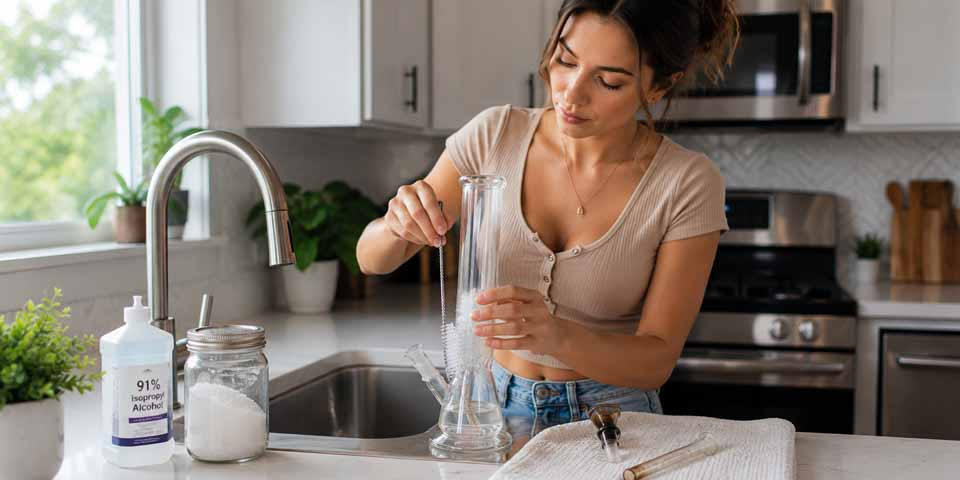
For ordinary borosilicate glass pieces, a common cleaning approach uses:
isopropyl alcohol + coarse salt.
The two ingredients perform different jobs.
What Does Isopropyl Alcohol Do?
Sticky cannabis smoke residue does not dissolve particularly well in plain water.
Isopropyl alcohol is a useful solvent for many of the hydrophobic organic compounds in resin.
That's why alcohol can loosen deposits that hours of rinsing with water barely touch.
What Does Salt Do?
Coarse salt acts as a physical abrasive.
When shaken inside the bong, salt crystals can mechanically scrub resin from glass surfaces.
The alcohol loosens.
The salt scrubs.
That's why the combination is so popular.
Step-by-Step: Cleaning a Basic Glass Bong
Step 1: Empty the Bong
Dispose of all old water.
Step 2: Remove Loose Components
Take out:
- Bowl
- Downstem
- Removable adapters
Step 3: Rinse With Warm Water
This can remove loose ash and debris before using cleaning solvent.
Avoid extreme temperature changes.
Step 4: Add Isopropyl Alcohol
Add enough to contact the resin-coated surfaces.
Step 5: Add Coarse Salt
Salt should remain abrasive rather than immediately dissolving.
Step 6: Seal the Openings
Use appropriate bong plugs or carefully cover the openings.
Step 7: Shake Carefully
Let the salt move across the interior surfaces.
Don't swing a wet glass bong around the room like you're mixing a cocktail.
Step 8: Let Stubborn Areas Soak
Thick resin may need additional contact time.
Step 9: Clean Bowl and Downstem Separately
Small pieces often need more attention because their openings become heavily coated.
Step 10: Rinse Thoroughly
Continue rinsing until:
- No alcohol odor remains
- No salt remains
- No visible cleaning solution remains
Step 11: Inspect the Glass
Look closely at:
- Percolators
- Downstem opening
- Base corners
- Joint connections
Step 12: Let It Drain and Dry
The bong should be clean and free of cleaning solvent before being used again.
Can You Use 70% Isopropyl Alcohol?
Yes, it can work.
Higher-concentration isopropyl alcohol is often preferred for heavy resin because it contains less water and generally works more aggressively as an organic solvent.
But even lower concentrations can clean lighter buildup with enough contact time and mechanical agitation.
Is 91% or 99% Better?
For thick sticky residue, stronger concentrations can make cleaning faster.
The practical advantage becomes especially obvious with heavily neglected bowls and downstems.
Regardless of concentration:
the glass must be thoroughly rinsed before reuse.
Never Smoke While Cleaning With Isopropyl Alcohol
Isopropyl alcohol is flammable.
That means:
- No smoking
- No lighter
- No torch
- No open flame
around open cleaning alcohol.
Clean first.
Rinse thoroughly.
Put everything away.
Then use the bong later.
Can You Clean a Bong With Boiling Water?
This is something we would not recommend as the default method.
Glass doesn't like sudden temperature changes.
Extreme thermal stress can potentially crack glass.
That's particularly risky if:
- The piece is cold
- The glass has small existing damage
- The glass thickness varies
- Boiling water contacts only one area
Warm water is one thing.
Pouring boiling water into a cold glass bong is another.
What Is Thermal Shock?
Glass expands when heated.
If one portion expands rapidly while another remains cooler, mechanical stress develops.
If the stress exceeds what the glass can tolerate:
crack.
Borosilicate glass is more resistant to thermal shock than ordinary soda-lime glass, but "more resistant" does not mean indestructible.
Can You Put a Bong in the Dishwasher?
We wouldn't assume every bong is dishwasher-safe.
Potential problems include:
- Delicate percolators
- Decorative finishes
- Printed graphics
- Temperature changes
- The piece moving during the wash cycle
A simple plain-glass piece may tolerate conditions that a complicated decorated bong does not.
Follow the manufacturer's cleaning recommendations when available.
What About Acrylic Bongs?
Don't automatically use the same solvent routine on every material.
Some plastics and acrylics can react poorly to strong solvents.
Cleaning methods suitable for borosilicate glass may damage:
- Acrylic
- Plastic
- Painted surfaces
- Special finishes
Know what your piece is made from before soaking it in a solvent.
What About Silicone?
Silicone pieces have different cleaning properties from glass.
Some removable silicone components may tolerate methods that glass cannot, while other pieces contain:
- Glass bowls
- Metal parts
- Printed designs
Again, manufacturer guidance matters.
How Do You Clean a Percolator Bong?
This is where maintenance gets more challenging.
You can't easily stick a brush through a honeycomb disc buried in the center of a tube.
The solution is usually:
solvent contact + repeated agitation + thorough rinsing.
Let cleaning solution reach the internal chambers.
Rotate the bong carefully so the solution contacts different surfaces.
Give stubborn resin time to loosen.
Don't Jam Objects Into Delicate Percolators
Trying to mechanically scrape an internal perc with:
- Metal tools
- Coat hangers
- Knives
- Screwdrivers
is a good way to turn a cleaning project into a broken bong.
How Do You Clean a Bowl?
Bowls can often be soaked separately.
This makes cleaning easier because the small piece can be completely surrounded by solvent.
After soaking, residue can often be removed with:
- Pipe cleaners
- Cotton swabs where appropriate
- Small cleaning brushes
Then rinse thoroughly.
How Do You Clean a Downstem?
A downstem can also be soaked separately.
Pay special attention to:
- The narrow interior tube
- Diffusion slits
- The joint area
Those are common places for resin to restrict airflow.
Why Cleaning More Often Is Actually Easier
This sounds backwards.
Cleaning weekly sounds like more work than cleaning monthly.
But consider the difference between:
a thin amber film
and
a thick black layer of hardened resin.
Light buildup may rinse or dissolve quickly.
Heavy buildup can require:
- Long soaking
- Repeated alcohol changes
- Multiple rinses
- Manual scrubbing
Five-minute maintenance can prevent a 45-minute rescue mission.
Keep Your Glass Setup Ready
Complete your setup with replacement bowls, downstems, glass accessories and other essentials from Waterbeds 'n' Stuff.
Shop Bong AccessoriesDoes Bong Size Affect How Often You Need to Clean It?
Not as much as usage does.
A huge bong used twice per day can accumulate less residue than a tiny bong used 20 times per day.
But small pieces can make residue more noticeable because:
- Smoke paths are shorter
- Openings may be narrower
- Less water is present
- Resin occupies a larger percentage of the available space
Do Ash Catchers Keep Bongs Cleaner?
They can.
An ash catcher sits between the bowl and main bong.
Its purpose is to catch some:
- Ash
- Plant debris
- Residue
before it reaches the main chamber.
That can make the bong itself easier to maintain.
But the Dirt Doesn't Disappear
It simply moves.
Now the ash catcher needs cleaning.
That's still useful because a small removable attachment is usually easier to soak than an elaborate multi-perc bong.
Do Screens Help?
A properly sized bowl screen can reduce the amount of loose plant material pulled through the bowl.
That means fewer pieces of cannabis floating in the water.
But screens don't eliminate smoke residue.
The bong still needs cleaning.
Why Does My Bong Smell So Bad?
Usually because odor-producing compounds remain inside:
- Resin
- Old water
- Bowl residue
- Downstem buildup
Simply dumping the water doesn't remove everything coating the glass.
Why Does My Bong Smell Immediately After Cleaning?
If you cleaned the main chamber but the smell returned quickly, check:
- Bowl
- Downstem
- Percolators
- Joint openings
One dirty component can make the entire piece smell dirty again.
Can a Bong Get Permanently Stained?
Long-term residue and mineral deposits can become difficult to remove.
Hard water can also leave:
- White spots
- Cloudiness
- Mineral rings
Those are different from cannabis resin.
If the brown resin is gone but cloudy white marks remain, you may be dealing with mineral deposits rather than smoke residue.
Why Does Hard Water Leave White Marks?
Tap water can contain dissolved minerals including calcium and magnesium.
When water evaporates, some minerals remain behind.
Repeated filling and drying can gradually create visible deposits.
Can You Reduce Water Spots?
Drying the piece after cleaning rather than allowing hard water to repeatedly evaporate inside can help.
Some users also choose filtered or lower-mineral water for glass they are particularly concerned about keeping visually pristine.
Should You Share a Bong?
Sharing any object that repeatedly contacts multiple people's mouths creates an obvious hygiene issue.
If several people use the same bong, the mouthpiece receives contact from multiple users.
Cleaning the mouthpiece between users or using individual mouthpiece accessories can reduce direct sharing of saliva.
Party Bong Maintenance Is Different
A bong used by six people during a party is not experiencing the same conditions as a personal piece used by one person.
More users mean:
- More hits
- More saliva exposure
- More handling
- More smoke residue
Cleaning frequency should reflect that.
Does a Clean Bong Make Hits Smoother?
It can improve airflow and remove stale residue that changes flavor.
But don't confuse cleanliness with making cannabis smoke harmless.
A spotless bong still contains:
smoke produced by combustion.
Water filtration does not remove every harmful constituent of smoke.
Would a Dry Herb Vaporizer Stay Cleaner?
It creates a different kind of residue.
A dry herb vaporizer heats cannabis without intentionally burning it.
That means there is no ash-filled combustion chamber in the same sense as a bong bowl.
But vaporizers still accumulate sticky condensed compounds inside:
- Cooling units
- Mouthpieces
- Screens
- Air paths
They also require regular maintenance.
Want to Skip Combustion?
Dry herb vaporizers heat flower without intentionally burning it. Explore portable and desktop dry herb vaporizers for temperature-controlled flower sessions.
Shop Dry Herb VaporizersShould You Clean Brand-New Glass Before Using It?
It's a good habit to rinse new glass before first use.
Manufacturing, packaging, shipping and handling can leave:
- Dust
- Packaging particles
- Fingerprints
- Other residue
A basic wash and thorough rinse provides a clean starting point.
How to Make Bong Cleaning Take Less Time
The best bong-cleaning hack isn't a mysterious chemical.
It's:
don't let it get disgusting.
A simple routine can prevent most major buildup.
After a Session
- Dump the water
- Rinse loose debris
Regularly
- Clean the bowl
- Clean the downstem
- Inspect percolators
When Film Appears
- Deep-clean before it becomes a thick layer
The 30-Second Habit That Makes the Biggest Difference
After you're finished:
- Dump the dirty water.
- Add a little clean water.
- Swirl it.
- Dump it again.
That's it.
It won't replace a deep cleaning.
But it removes loose material before it dries onto the glass.
Frequently Asked Questions
How often should I clean my bong?
There is no universal schedule because usage varies. Frequent users may find a weekly deep clean a useful starting point, while occasional users can clean according to visible buildup, odor and airflow. Water should be replaced much more frequently than the bong needs a full deep clean.
How often should you change bong water?
For the cleanest experience, replace it after a session. At minimum, regular users should avoid leaving dirty water sitting for extended periods.
Can I leave bong water overnight?
You can, but there is little benefit. Dumping and rinsing after use reduces the time dirty standing water and smoke residue remain inside the bong.
Can bacteria grow in bong water?
Bong water is not sterile and can receive microorganisms from the mouth, hands, air and surrounding environment. Standing water containing organic material can support microbial growth under suitable conditions.
Can mold grow in a bong?
Persistent moisture and organic residue can create conditions favorable to microbial growth. Complex areas that remain wet or dirty deserve particular attention.
Why is bong water brown?
Smoke-derived particles, ash and other material accumulate in the water as cannabis smoke passes through it.
Why is my bong water cloudy?
Cloudiness can indicate accumulated particulate matter, residue or microbial activity. Replace the water and clean the piece rather than attempting to identify contamination visually.
What is the black stuff inside my bong?
It is generally condensed cannabis smoke residue commonly called resin, potentially mixed with ash and plant material.
Can a dirty bong affect taste?
Yes. Fresh smoke passes over old resin and through used water, which can introduce stale flavors that mask differences between cannabis strains.
Can a dirty bong affect airflow?
Yes. Thick resin can narrow bowl openings, downstems and percolator slits, increasing draw resistance.
What is the easiest way to clean a glass bong?
For compatible plain glass, isopropyl alcohol combined with coarse salt is a common method. Alcohol helps dissolve resin while salt provides mechanical abrasion.
Is 70% isopropyl alcohol strong enough to clean a bong?
It can clean many pieces, although higher concentrations are often more effective against heavy sticky resin.
Can I use boiling water to clean a bong?
Boiling water can create thermal stress, especially when applied to cold glass. Warm water and appropriate cleaning methods are generally safer than sudden extreme temperature changes.
Can I put my bong in a dishwasher?
Do not assume every bong is dishwasher-safe. Percolators, graphics, finishes and complex glass construction can be damaged. Follow manufacturer instructions when available.
Can I use alcohol on an acrylic bong?
Do not assume a glass-cleaning solvent is compatible with acrylic or plastic. Some solvents can damage these materials.
Do ash catchers keep bongs cleaner?
Ash catchers can trap some ash and plant material before it enters the main bong, potentially reducing how quickly the main chamber becomes dirty.
Why does my bong smell even after I change the water?
Resin may remain on the bowl, downstem, chamber or percolators. Changing water removes the dirty water but doesn't remove residue bonded to surfaces.
Why does my clean bong have white spots?
White or cloudy spots may be mineral deposits from hard water rather than cannabis resin.
Should I rinse a new bong before using it?
Yes. Washing and thoroughly rinsing new glass can remove dust and residue from manufacturing, packaging and handling.
So, How Dirty Is Too Dirty?
You don't need a laboratory test.
Look at the piece.
Smell it.
Pay attention to airflow.
Pay attention to flavor.
If:
- The water is brown
- The glass is coated
- The bong smells terrible when empty
- The downstem is clogged
- The bowl is black
- Fresh flower tastes stale
you have already passed the point where cleaning would help.
The Best Bong Cleaning Schedule Is the One That Prevents Buildup
Instead of asking:
"How long can I get away without cleaning this?"
a better question is:
"How often do I need to clean it so cleaning stays easy?"
That's the key difference.
Regular maintenance:
thin film → quick clean.
Neglect:
thick resin → soaking, scrubbing and frustration.
Final Takeaway: Fresh Water Often, Deep Cleaning Before It Gets Nasty
There isn't a universal bong-cleaning calendar that fits every smoker.
Someone using a bong once a week and someone using one several times every day are creating completely different amounts of residue.
But a few rules are hard to argue with:
Don't keep using obviously dirty bong water.
Don't let standing dirty water sit around unnecessarily.
Don't wait until airflow becomes restricted before cleaning the bowl and downstem.
Don't expect expensive flower to taste its best through layers of old resin.
Don't use cleaning solvents around flames.
And don't pour boiling water into cold glass and hope for the best.
For frequent users, fresh water after sessions, quick rinses and regular deep cleaning can keep a bong from ever reaching the dreaded black-resin stage.
The bonus?
Cleaning becomes easier.
The glass looks better.
Airflow stays open.
And the next strain you buy has a chance to taste like that strain instead of everything you've smoked for the last month.
This article is for educational purposes only. Cannabis smoke contains combustion products and carries health risks. Cleaning solvents such as isopropyl alcohol are flammable and should be kept away from flames and heat. Always thoroughly rinse compatible smoking equipment before reuse and follow manufacturer cleaning instructions.
You May Also Like
- Why Is My Disposable Vape Blinking?
- Why Does My Cart Keep Clogging?
- Cold Start Dabs Explained
- Best Dab Temps for Flavor vs Clouds
Looking for premium smoking accessories, dab tools, quartz bangers, vaporizers, and more? Browse our full selection online or visit one of our Ohio locations.
Shop Our Online Headshop For Smoking Essentials and Tons More!
Want more cannabis education, news, and product tips?
Subscribe to our newsletter or follow us on social media.
Recent Posts
-

Is THCA Flower About to Become Illegal? November vs. December 2026 Explained
Last updated: October 20, 2026 THCA flower has become one of the most controversial products in the …Oct 21, 2026 -

Will Congress Save Hemp THC Before December 11, 2026? What Happens to Delta-8, THCA, CBD & THC Drinks
Updated October 19, 2026 The clock is ticking for America's hemp-derived THC industry. After years …Oct 20, 2026 -

New Ohio Weed Laws 2026: What Marijuana Buyers Need to Know After the October Changes
OHIO WEED LAWS CHANGE Updated October 7, 2026 Ohio's marijuana laws changed again. And judging fro …Oct 06, 2026