
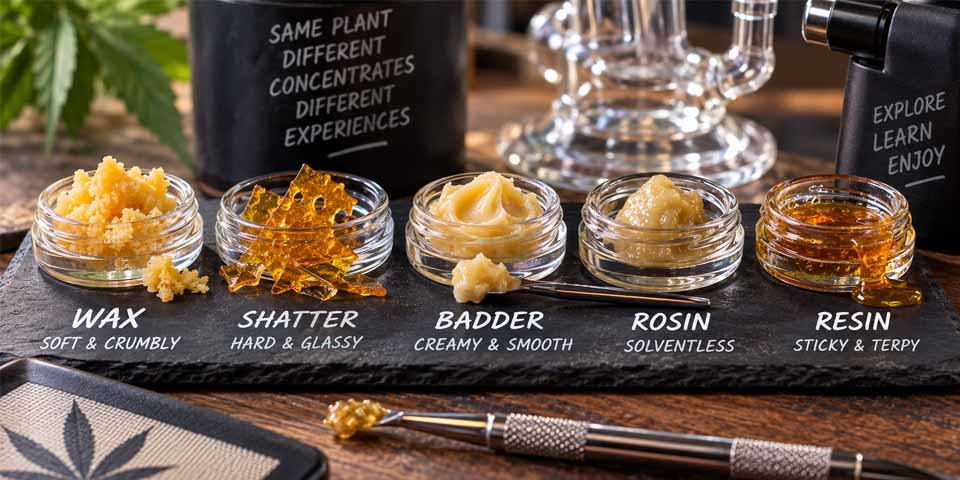
Why Concentrates Confuse So Many People: Wax vs Shatter vs Badder vs Rosin vs Resin
You walk up to a concentrate display and see:
- Wax
- Shatter
- Badder
- Budder
- Rosin
- Live rosin
- Resin
- Live resin
- Sugar
- Sauce
- Crumble
- Diamonds
At some point you start wondering:
Are these actually different products—or did the cannabis industry just invent twelve names for the same sticky stuff?
The answer is:
a little bit of both.
Concentrates confuse so many people because the names aren't based on one consistent classification system.
One word might describe:
texture.
Another describes:
how the concentrate was extracted.
Another describes:
the condition of the cannabis before extraction.
And another might describe:
what happened to the concentrate after extraction.
That's why comparing "shatter vs rosin" isn't quite like comparing apples to apples.
Shatter mostly tells you what a concentrate looks and feels like. Rosin tells you much more about how it was made.
Once you understand that distinction, the entire concentrate shelf gets much easier to understand.
First: What Is a Cannabis Concentrate?
Cannabis flower contains tiny glandular structures commonly called:
trichomes.
These structures contain many of the plant's:
- Cannabinoids
- Terpenes
- Other resinous compounds
A concentrate essentially separates and concentrates these compounds while removing much of the bulky plant material.
That's why a tiny concentrate container can contain a product dramatically more potent by weight than ordinary flower.
Concentrates Can Be Much Stronger Than Flower
Concentrates commonly contain substantially higher cannabinoid concentrations than cannabis flower.
Depending on the product, some concentrates can reach THC concentrations well above those normally found in flower.
That's important for anyone new to the category because:
a small amount of concentrate can contain a substantial amount of THC.
The Easiest Way to Understand Concentrates
Forget all the names for a moment.
Instead, ask three questions:
- What material did it start with?
- How were the cannabinoids and terpenes separated?
- What texture did the finished concentrate become?
Those three questions explain most of the concentrate shelf.
The Biggest Split: Solvent-Based vs Solventless
This is the first distinction worth learning.
Solvent-Based Extraction
Some concentrates are produced using extraction solvents that separate cannabinoids and terpenes from plant material.
Commercial extraction systems may use compounds such as:
- Butane
- Propane
- Carbon dioxide
- Other controlled extraction systems
After extraction, commercial processors use specialized equipment and procedures appropriate to the process and regulated market.
Products commonly associated with solvent extraction include:
- Shatter
- Many waxes
- Many badders
- Live resin
- Some sauces
- Some concentrates containing THCA crystals or "diamonds"
Solventless Concentrates
Other concentrates are produced without hydrocarbon extraction solvents.
Instead, separation may rely on:
- Mechanical separation
- Ice and water
- Heat
- Pressure
Examples include:
- Dry sift
- Bubble hash
- Rosin
- Hash rosin
- Live rosin
This gives us the first major shortcut:
Rosin = solventless.
Why "Wax vs Shatter vs Badder" Is Different From "Rosin vs Resin"
Here's where most concentrate guides make things unnecessarily complicated.
Wax, shatter and badder generally tell you about physical consistency.
Rosin and live resin tell you much more about production.
That means these categories can overlap.
For example:
A live resin product can have a:
- Badder-like consistency
- Sauce-like consistency
- Sugary consistency
A rosin can also appear:
- Sticky
- Creamy
- Badder-like
- Sap-like
So texture and extraction method are not the same classification.
What Is Cannabis Wax?
Wax is a broad term generally used for softer cannabis concentrates with an opaque or wax-like appearance.
Instead of forming a transparent brittle sheet, wax tends to remain:
- Soft
- Opaque
- Sticky
- Crumbly
- Waxy
Depending on processing, products within the general wax family can become:
- Budder
- Badder
- Crumble
- Honeycomb-like textures
What Does Wax Look Like?
Wax can resemble:
soft candle wax, thick honey, crumbly wax or whipped concentrate.
Its exact appearance varies substantially.
Is Wax an Extraction Method?
Not really.
This is critical.
"Wax" generally tells you more about consistency than the complete manufacturing process.
Two products both labeled wax can differ in:
- Starting material
- Cannabinoid concentration
- Terpene content
- Extraction process
- Post-processing
What Is Shatter?
Shatter is one of the easiest concentrates to recognize.
It typically appears as a:
translucent amber or golden sheet.
At suitable temperatures it can be:
- Hard
- Brittle
- Glassy
- Snappable
Hence the name:
shatter.
Why Does Shatter Look Like Glass?
The compounds in the extract have formed a relatively stable, glass-like structure.
Instead of being whipped into an opaque creamy consistency, the concentrate remains relatively clear and rigid.
Is Clear Shatter Automatically Better?
No.
Appearance can provide information about the physical product, but:
clarity alone does not prove purity, potency, safety or quality.
A laboratory label tells you far more than Instagram-worthy transparency.
Wax vs Shatter: What's the Actual Difference?
Here's the simplest answer:
| Feature | Wax | Shatter |
|---|---|---|
| Texture | Soft / waxy | Hard / brittle |
| Appearance | Often opaque | Often translucent |
| Handling | Scooped | Broken/snapped |
| Main Naming Clue | Consistency | Consistency/structure |
Neither one is automatically:
- Stronger
- Cleaner
- Safer
- More flavorful
- Higher quality
Those characteristics depend on the actual product.
What Is Badder?
Badder—sometimes spelled batter—is a soft concentrate with a consistency resembling:
cake batter or frosting.
It tends to be:
- Soft
- Whipped-looking
- Creamy
- Easy to manipulate
Badder is particularly confusing because people often assume it represents an entirely different extraction category.
Usually:
it doesn't.
Badder vs Budder: Are They Different?
Sort of.
But the distinction isn't always consistent across brands.
Generally:
Badder tends to resemble cake batter.
Budder tends to resemble thick butter.
However, manufacturers and consumers frequently use the terms loosely.
One company's badder may look almost identical to another company's budder.
So Is Badder Just Wax?
Badder can reasonably be thought of as part of the broad family of soft or waxy concentrates.
But concentrate terminology isn't standardized enough to assume every manufacturer uses the words identically.
Why Do People Like Badder?
One practical reason:
it's easy to handle.
Shatter can snap.
Sauce can run.
Extremely sticky resin can string.
A stable badder consistency can be easier to portion with an appropriate dab tool.
Exploring Concentrates? The Rig Matters Too
Wax, shatter, badder, rosin and resin can all behave differently when heated. A properly designed dab rig gives concentrates a dedicated setup separate from a traditional flower bong.
Shop Dab RigsNow for the Big One: What Is Rosin?
This is where the terminology shifts.
Rosin isn't primarily a texture.
Rosin describes how the concentrate is produced.
Rosin is produced through the application of:
heat + pressure.
No hydrocarbon extraction solvent is required.
That's why rosin is classified as:
solventless concentrate.
What Can Rosin Be Made From?
Rosin can begin with different cannabis materials, including:
- Flower
- Dry sift
- Hash
That leads to different categories.
Flower Rosin
Made by mechanically pressing cannabis flower with controlled heat and pressure.
Hash Rosin
Starts with separated trichome material such as hash rather than pressing whole flower directly.
Live Rosin
Typically begins with fresh-frozen cannabis that is first processed into hash, after which the trichome-rich material is pressed into rosin.
Why Is Rosin Often More Expensive?
Several factors can contribute.
Solventless processing can require:
- High-quality starting material
- Significant labor
- Careful handling
- Specialized equipment
- Lower or variable yields
You're not simply paying for a higher THC number.
You're also paying for:
the starting material and production method.
Does Solventless Mean Chemical-Free?
Be careful with that phrase.
Everything around us is made of chemicals—including:
- Water
- THC
- CBD
- Terpenes
When the cannabis industry says:
"solventless"
it generally means the concentrate was produced without extraction solvents such as butane or propane.
It doesn't mean the product somehow contains no chemicals.
What Is Cannabis Resin?
This is where terminology becomes especially confusing.
Resin is naturally produced by the cannabis plant.
The plant's glandular trichomes contain the sticky resinous material rich in cannabinoids and aromatic compounds.
But when shoppers say:
"resin"
they're frequently talking about:
live resin.
What Is Live Resin?
Live resin is generally produced from cannabis that is:
fresh-frozen shortly after harvest.
Instead of drying and curing the flower first, processors preserve the fresh plant material at low temperatures before extraction.
Why?
Terpenes.
Drying Cannabis Changes Its Aroma Profile
Many terpenes are volatile.
During traditional:
- Drying
- Curing
- Storage
some aromatic compounds can be lost or altered.
Freezing fresh material helps preserve more of the plant's original volatile profile for extraction.
That's Why It's Called "Live"
The word:
live
doesn't mean the concentrate itself is alive.
It refers to the use of fresh or fresh-frozen cannabis rather than traditionally dried and cured starting material.
Is Live Resin Solventless?
Usually:
no.
This is one of the biggest sources of confusion.
Live resin is generally produced using hydrocarbon extraction in a controlled commercial setting.
Live rosin, however, is:
solventless.
Live Resin vs Live Rosin
These names sound almost identical.
They are not the same thing.
| Feature | Live Resin | Live Rosin |
|---|---|---|
| Starting Material | Fresh-frozen cannabis | Fresh-frozen cannabis / resulting hash |
| Extraction | Typically hydrocarbon solvent | Mechanical / solventless |
| Main Goal | Preserve fresh-plant compounds | Fresh profile + solventless process |
| Texture | Varies | Varies |
The One-Letter Difference That Confuses Everybody
Resin
versus:
Rosin.
One letter.
Completely different production concept.
Here's the easiest memory trick:
ROSIN = PRESS.
Think:
heat + pressure.
Meanwhile:
LIVE RESIN = FRESH-FROZEN + EXTRACTION.
Can Rosin Look Like Badder?
Absolutely.
This is where understanding the two classification systems becomes useful.
A rosin can have a:
- Badder-like consistency
- Budder-like consistency
- Sap-like consistency
- Jam-like consistency
So you could encounter something described as:
live rosin badder.
That isn't contradictory.
"Live rosin" tells you about starting material and production.
"Badder" tells you what the finished consistency resembles.
Can Live Resin Be Badder?
Yes.
You might also see:
- Live resin badder
- Live resin sugar
- Live resin sauce
Again:
production category + texture category.
Once you understand that, dispensary menus suddenly make much more sense.
What Is Crumble?
Crumble is another texture term.
As the name suggests, it tends to be:
- Dry
- Porous
- Crumbly
- Easy to break apart
It can resemble:
honeycomb or dry cheese.
What Is Sugar?
Some concentrates develop a grainy, crystalline appearance resembling:
wet sugar.
These are commonly called:
sugar or sugar wax.
Again, this generally describes texture rather than a completely separate plant product.
What Is Sauce?
Sauce generally refers to a concentrate with a:
thicker liquid or syrup-like consistency.
It may contain:
- Terpene-rich liquid
- Cannabinoids
- Crystalline material
What Are THCA Diamonds?
Diamonds are crystalline structures rich in:
THCA.
They may appear as:
- Small crystals
- Large crystals
- Crystals suspended in sauce
They're another example of why concentrate names can describe:
physical structure rather than simply extraction method.
Wax vs Shatter vs Badder vs Rosin vs Resin: Quick Comparison
| Type | What the Name Mainly Describes | Typical Appearance |
|---|---|---|
| Wax | Texture | Soft / waxy / opaque |
| Shatter | Texture / structure | Hard / glassy / translucent |
| Badder | Texture | Creamy / batter-like |
| Rosin | Production method | Varies |
| Live Resin | Starting material + extraction category | Varies |
Which One Has the Most THC?
There isn't a universal winner.
You cannot reliably rank:
wax → shatter → badder → resin → rosin
by THC concentration based on the name alone.
Actual cannabinoid concentration depends on:
- Starting material
- Extraction
- Refinement
- Batch
- Formulation
That's why the product's laboratory information matters more than whether the jar says:
BADDER
or:
SHATTER.
Is 90% THC Automatically Better Than 70%?
No.
THC concentration measures one characteristic.
It doesn't directly tell you:
- Flavor
- Aroma
- Terpene profile
- Freshness
- Handling
- Overall product quality
A consumer interested entirely in maximum THC concentration may make a different choice than someone interested in:
aroma and terpene preservation.
Why Terpenes Matter More With Concentrates
Concentrating cannabis doesn't only concentrate cannabinoids.
Depending on the production process, aromatic compounds can also become highly concentrated.
That's one reason opening certain concentrate containers produces such a strong aroma.
Does More Terpenes Automatically Mean Better?
Not necessarily.
More isn't automatically better.
The important questions include:
- Which terpenes?
- At what concentration?
- Were they naturally retained?
- Were terpenes added back?
- How was the product stored?
Why Temperature Changes Concentrate Texture
Ever notice that concentrate can behave completely differently depending on temperature?
A concentrate that is firm in a cool room may become:
sticky and runny when warm.
Temperature changes:
- Viscosity
- Hardness
- Handling characteristics
- Volatile-compound loss
This is especially obvious with shatter.
Why Old Shatter Sometimes Turns Into Sugar
Shatter doesn't necessarily remain glass-like forever.
Over time, changes in:
- Temperature
- Moisture
- Composition
- Storage
can contribute to changes in consistency and crystallization.
Consumers often call this:
"sugaring up."
A texture change alone does not tell you everything about safety or potency.
Does Lighter Color Mean Better Concentrate?
No.
This is another persistent myth.
Color can be influenced by:
- Starting material
- Plant maturity
- Extraction
- Processing
- Storage
- Oxidation
A beautiful pale-yellow concentrate isn't automatically superior to a darker product.
And a dark concentrate isn't automatically bad.
What Should You Actually Look at on the Label?
Instead of judging entirely by:
color + texture + THC number
look for information such as:
- Total THC
- CBD if relevant
- Terpene information when provided
- Production date
- Batch information
- Testing information
- Producer
- Product type
Why Concentrates Can Feel So Different From Flower
The simplest reason is:
concentration.
A much larger amount of cannabinoid can be contained in a much smaller amount of material.
That means inhaled concentrates can deliver a substantial dose quickly.
For inexperienced consumers, this makes:
dose awareness especially important.
Do You Need a Different Device for Concentrates?
Usually, yes.
Traditional cannabis flower is burned or heated differently from concentrates.
Concentrate setups commonly include:
- Dab rigs
- Quartz bangers
- Electronic rigs
- Concentrate vaporizers
Traditional Rig or Electronic Concentrate Device?
Modern concentrate setups range from traditional quartz rigs to portable electronic devices that control heating without a separate torch.
Shop VaporizersWhy Quartz Is So Common for Dabs
Quartz bangers became popular because quartz provides a useful combination of:
- Heat tolerance
- Thermal behavior
- Flavor neutrality
- Availability
But even the best concentrate can taste terrible if the surface is overheated or covered in old residue.
Does Dab Temperature Matter?
Absolutely.
Concentrates contain compounds with different:
- Boiling behavior
- Volatility
- Thermal stability
Extremely high temperatures can produce:
- Harsher vapor
- Rapid terpene loss
- More residue baked onto quartz
Lower temperatures generally emphasize flavor and smoother vapor, while hotter surfaces can create faster and denser vaporization.
The concentrate is only half of the equation. Quartz temperature can dramatically change flavor, vapor production and how much residue remains behind.
Read: Best Dab Temps for Flavor vs Clouds
What Is a Cold Start Dab?
A cold start reverses the traditional sequence.
Instead of heavily heating the quartz first and adding concentrate afterward, the concentrate begins in a cool banger and the surface is then heated in a controlled manner.
The method became popular partly because it can make it easier to avoid unnecessarily overheating the concentrate.
Cold-start dabbing changes when concentrate enters the quartz and can make temperature management easier for some users.
Read: Cold Start Dabs Explained
Wax vs Shatter: Which Is Better for Beginners?
There isn't one objectively superior choice.
From a handling standpoint:
stable badder or wax can be easier to manipulate.
Shatter can be easy to portion when stable, but it can also:
- Snap unexpectedly
- Stick when warm
- Become difficult to handle as temperature changes
The bigger consideration for someone inexperienced with concentrates is:
potency.
Rosin vs Resin: Which Is Better?
This depends on what "better" means to you.
If You Prioritize Solventless Production
Rosin is the obvious category to investigate.
If You Prioritize Fresh-Frozen Terpene Preservation
Both:
live resin and live rosin
can be designed around fresh-frozen starting material.
If You Prioritize Price
Market pricing varies considerably, but solventless rosin often commands a premium because of starting-material requirements and production economics.
If You Prioritize THC Percentage
Don't assume either category automatically wins.
Read the actual laboratory label.
Is Rosin Safer Because It's Solventless?
"Solventless" tells you how extraction was performed.
It doesn't make inhaling concentrated cannabis risk-free.
High-potency THC exposure itself carries risks, regardless of whether the concentrate was produced mechanically or with a commercial solvent-based extraction system.
Likewise, regulated solvent-based products are produced with processes designed to remove extraction solvents and are subject to applicable testing requirements.
Don't reduce product safety to one word on the jar.
Why Homemade Solvent Extraction Is Different
Commercial hydrocarbon extraction involves specialized equipment and controlled environments.
Attempting solvent extraction with flammable hydrocarbons outside properly designed professional equipment can create serious:
- Fire
- Explosion
- Burn
- Contamination
hazards.
This is not something to improvise at home.
Concentrate Names: What They Actually Tell You
| Word | Usually Tells You About |
|---|---|
| Wax | Texture |
| Shatter | Texture / structure |
| Badder | Texture |
| Budder | Texture |
| Crumble | Texture |
| Sugar | Texture / crystallization |
| Rosin | Production method |
| Live | Fresh/frozen starting material |
| Live Resin | Starting material + extraction |
| Live Rosin | Starting material + solventless process |
| Diamonds | Crystalline structure |
The Simple Concentrate Family Tree
CANNABIS CONCENTRATES
↓
Solvent-Based / Extracted
- Shatter
- Wax
- Badder
- Live Resin
- Sauce
- Some diamonds/sauce products
Solventless / Mechanically Separated
- Kief / dry sift
- Bubble hash
- Flower rosin
- Hash rosin
- Live rosin
Then each category can have different:
textures.
Frequently Asked Questions
What is the difference between wax and shatter?
The main difference is physical consistency. Wax is generally soft and opaque, while shatter is typically hard, brittle and translucent. Both can be produced through similar solvent-based extraction processes.
What is the difference between wax and badder?
Badder is generally a softer, whipped, cake-batter-like concentrate and can be considered part of the broader family of waxy concentrates.
Are badder and budder the same thing?
They are closely related texture terms. Badder generally resembles batter or frosting while budder tends to be thicker and butter-like, but manufacturers do not always use the terms consistently.
What is the difference between rosin and resin?
Rosin is a solventless concentrate produced mechanically using heat and pressure. Live resin generally refers to a solvent-extracted concentrate produced from fresh-frozen cannabis.
Is live resin solventless?
No. Live resin is generally produced using commercial hydrocarbon extraction. Live rosin is the solventless counterpart.
What does "live" mean in cannabis concentrates?
Live generally indicates that fresh cannabis was frozen shortly after harvest rather than being traditionally dried and cured before processing.
Is live rosin the same as live resin?
No. Both can begin with fresh-frozen cannabis, but live resin generally uses solvent extraction while live rosin is produced through solventless mechanical processing.
Is shatter stronger than wax?
Not necessarily. Texture alone does not determine THC concentration. Compare the laboratory information for the individual products.
Is rosin stronger than resin?
Not necessarily. Cannabinoid concentrations vary by product and batch.
Why is rosin expensive?
High-quality starting material, labor-intensive solventless processing, specialized equipment and production yields can make rosin more expensive to produce.
Is lighter concentrate better?
No. Color alone does not establish purity, potency, safety or quality.
What is cannabis crumble?
Crumble is a dry, porous, crumbly concentrate texture often associated with processed wax-type extracts.
What is cannabis sugar?
Sugar is a concentrate that develops a grainy or crystalline texture resembling wet sugar.
What are THCA diamonds?
THCA diamonds are crystalline structures rich in tetrahydrocannabinolic acid and are often sold alone or suspended in terpene-rich sauce.
Can rosin be badder?
Yes. Rosin describes production method while badder describes consistency, so a rosin product can have a badder-like texture.
Can live resin be badder?
Yes. Live resin can be processed into badder, sugar, sauce and other consistencies.
Are concentrates stronger than flower?
They commonly contain much higher concentrations of THC by weight than cannabis flower, although actual potency varies widely.
Final Takeaway: Stop Comparing the Names Like They're All the Same Thing
The biggest reason concentrates seem complicated is:
the naming system mixes different categories together.
Remember these five:
WAX = soft/waxy texture.
SHATTER = hard/glassy texture.
BADDER = soft/whipped texture.
ROSIN = solventless heat-and-pressure production.
LIVE RESIN = fresh-frozen cannabis + typically solvent extraction.
Then remember:
texture and extraction method can overlap.
That's how you end up with products such as:
- Live resin badder
- Live resin sugar
- Live rosin badder
- Rosin jam
Once you stop expecting every concentrate name to describe the same characteristic:
the confusing concentrate menu suddenly becomes a lot easier to read.
And rather than assuming:
lighter = better
or:
higher THC = better
you can look at what actually matters:
- Starting material
- Production method
- Texture
- Cannabinoid profile
- Terpene profile
- Freshness
- Testing
That's the real difference between wax, shatter, badder, rosin and resin.
This article is intended for adults of legal age and for educational purposes only. Cannabis laws vary by jurisdiction. High-THC concentrates can deliver substantial doses quickly, and inhaling cannabis products is not risk-free.
You May Also Like
- Cold Start Dabs Explained: Why More Dabbers Are Switching
- Best Dab Temps for Flavor vs Clouds
- Why Bigger Bong Hits Don't Always Get You Higher
- How Often Should You Really Clean a Bong?
Looking for premium smoking accessories, dab tools, quartz bangers, vaporizers, and more? Browse our full selection online or visit one of our Ohio locations.
Shop Our Online Headshop For Smoking Essentials and Tons More!
Want more cannabis education, news, and product tips?
Subscribe to our newsletter or follow us on social media.
Recent Posts
-

New Ohio Weed Laws 2026: What Marijuana Buyers Need to Know After the October Changes
OHIO WEED LAWS CHANGE Updated October 7, 2026 Ohio's marijuana laws changed again. And judging fro …Oct 06, 2026 -

Why Does My Dab Rig Clog So Fast? How Reclaim Builds Up & How to Reduce It
You cleaned your dab rig. The glass looked perfect. The water was fresh. The percolator was comple …Sep 22, 2026 -
Why Concentrates Confuse So Many People: Wax vs Shatter vs Badder vs Rosin vs Resin
You walk up to a concentrate display and see: Wax Shatter Badder Budder Rosin Live rosin Resin Li …Sep 17, 2026