
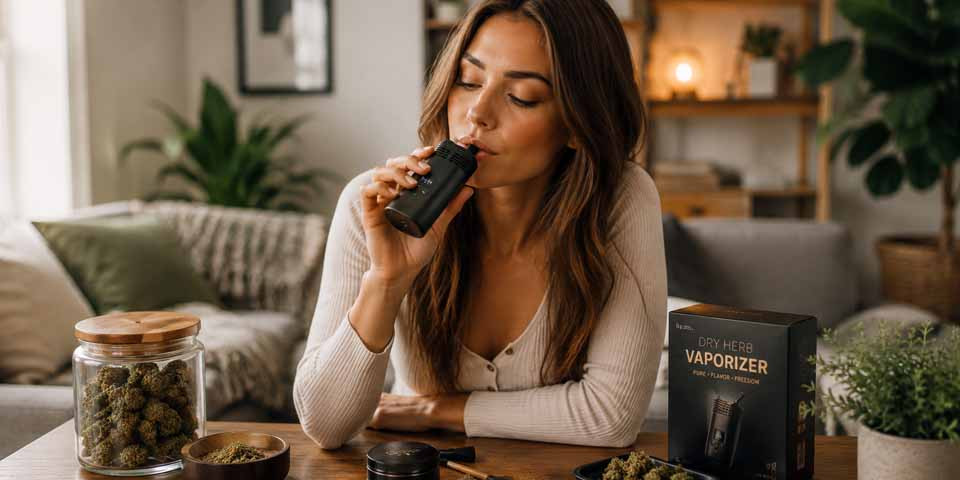
Are Dry Herb Vaporizers Better for Your Weed? Flavor, Efficiency & What the Science Says
How Efficient Are Vaporizers?
If you have smoked cannabis for years, using a dry herb vaporizer for the first time can be strangely confusing.
There may be almost no visible smoke.
The flower doesn't turn into white ash.
The smell is different.
The hit may feel lighter.
And then, five or ten minutes later, you may realize:
that definitely worked.
Dry herb vaporizers have become significantly better over the last decade, and modern devices can heat cannabis flower with far more control than older vape pens and early portable ovens.
But are they actually better than smoking a joint, bong or pipe?
The answer depends on what "better" means.
If you care about:
- Flavor
- Using less flower
- Temperature control
- Less lingering odor
- Avoiding combustion
a good dry herb vaporizer can have major advantages.
But vaping also has disadvantages.
Good devices can be expensive.
They require charging or heating.
They need cleaning.
There is a learning curve.
And perhaps most importantly:
vaporized cannabis can deliver THC very efficiently—sometimes more efficiently than smoking.
That means a dry herb vape should not automatically be treated as weak simply because the vapor feels smoother.
Let's look at what actually happens when you stop burning flower and start vaporizing it.
First: What Is a Dry Herb Vaporizer?
A dry herb vaporizer is a device designed to heat cannabis or other dry plant material without intentionally setting it on fire.
Traditional smoking involves combustion.
A joint, bowl or bong uses enough heat to burn the cannabis plant material.
That produces smoke.
A dry herb vaporizer attempts to remain below the temperatures where the flower continuously combusts.
Instead, heat releases volatile compounds from the plant into an aerosol or vapor that can be inhaled.
Dry Herb Vaping Is Not the Same as Using a THC Cartridge
This is one of the biggest sources of confusion.
When people hear "vape," they often think of:
- 510 cartridges
- Disposable vapes
- Distillate
- Live resin carts
- Oil pens
A dry herb vaporizer is different.
You open the chamber and put actual ground cannabis flower inside.
No oil cartridge is required.
No pre-filled concentrate is necessary.
You are heating the same type of loose flower that could otherwise go into a bowl, joint or bong.
Shop Dry Herb Vaporizers
Want to vaporize flower instead of burning it? Waterbeds 'n' Stuff carries portable and desktop dry herb vaporizers ranging from simple beginner devices to premium temperature-controlled models from leading brands.
Shop Dry Herb VaporizersThe Biggest Difference: Combustion vs Vaporization
When cannabis burns, temperatures can become extremely high.
Scientific literature describes smoking temperatures commonly reaching roughly:
600-900°C.
Dry herb vaporizers generally operate much lower, often around:
160-230°C.
That difference matters.
At combustion temperatures, plant material undergoes pyrolysis and burning.
That produces numerous combustion byproducts in addition to cannabinoids and terpenes.
At controlled vaporization temperatures, far less of that combustion chemistry occurs.
Does That Mean Dry Herb Vaping Is "Safe"?
No.
This is an important correction to a lot of online vaporizer marketing.
Avoiding smoke and combustion can reduce exposure to many combustion-derived toxicants.
That does not make cannabis vapor harmless.
Recent laboratory research comparing cannabis smoke and cannabis vapor found fewer toxicants in vapor than in smoke, but the vapor still contained compounds with potential respiratory and biological effects.
The correct statement is therefore:
dry herb vaporization generally avoids many combustion products associated with smoking, but inhaling heated cannabis aerosol is not risk-free.
Why Does Vapor Feel So Much Smoother?
One obvious reason is temperature.
Smoke from burning plant material contains:
- Hot combustion gases
- Particulate matter
- Ash
- Pyrolysis products
- Numerous combustion compounds
Vapor from a properly operating dry herb vaporizer does not contain the same mixture of combustion products.
That can make the inhalation feel much lighter.
Many longtime smokers initially mistake that smoothness for weakness.
But smooth does not necessarily mean low THC.
In Fact, Vaporized Cannabis Can Deliver THC Very Efficiently
This is one of the most interesting findings in controlled research.
Scientists have directly compared smoked and vaporized cannabis using equivalent THC doses.
In one controlled study involving infrequent cannabis users, vaporized cannabis produced:
- Higher blood THC concentrations
- Greater subjective effects
- Greater cognitive impairment
- Greater psychomotor impairment
than the same THC dose when smoked.
Researchers concluded that vaporization appeared to be a more efficient THC delivery method under those testing conditions.
So Can a Dry Herb Vape Get You Higher Than Smoking?
Potentially, yes—depending on the device, dose and technique.
That doesn't mean a vaporizer always gets every user higher.
But controlled studies demonstrate that a fixed amount of cannabis can sometimes produce greater blood THC exposure when vaporized instead of smoked.
Why?
Because combustion wastes cannabinoids.
Smoking Literally Destroys Some THC
When cannabis burns, not all THC reaches the smoker.
Some is destroyed through high-temperature pyrolysis.
Some escapes into the room as sidestream smoke.
Research has estimated that smoking can lose approximately:
- 23-30% of THC through pyrolysis
- 40-50% through sidestream smoke under some experimental conditions
Those numbers vary considerably with smoking method and experimental setup.
But the underlying point is straightforward:
a burning joint continues wasting material between hits.
A Dry Herb Vape Doesn't Sit There Burning Your Weed
This is one of the biggest practical efficiency advantages.
Light a joint and it keeps burning.
Take a break to talk?
Still burning.
Set it in the ashtray?
Still burning.
Every stream of smoke drifting into the air represents material that isn't being inhaled.
A vaporizer behaves differently.
Depending on the device, heating can be paused, sessions can be shorter, or material can be reheated later.
That makes it easier to control exactly how much flower is used.
How Efficient Are Dry Herb Vaporizers?
Device design matters enormously.
One laboratory study tested several commercial dry herb vaporizers and measured how much THC and CBD ended up in the vapor.
THC recovery ranged from approximately:
55% to more than 82%
depending on the vaporizer.
CBD recovery also varied significantly between devices.
The takeaway isn't that every vaporizer achieves 82% efficiency.
It's that:
some vaporizer designs extract cannabinoids much more efficiently than others.
This Is Why a $40 Vape and a $400 Vape Don't Necessarily Perform the Same
At first glance, dry herb vaporizers can seem overpriced.
After all, both expensive and inexpensive models appear to do the same thing:
heat weed.
But the engineering affects:
- Temperature stability
- Airflow
- Heating speed
- Extraction consistency
- Battery performance
- Chamber design
- Cooling
- Vapor density
- Ease of cleaning
Research comparing commercial devices has found meaningful differences in cannabinoid recovery.
So there is legitimate science behind the idea that vaporizer design matters.
Why Does Weed Taste Better in a Dry Herb Vape?
This may be the biggest surprise for someone switching from combustion.
Cannabis contains aromatic compounds including terpenes.
Those compounds contribute to aromas often described as:
- Citrus
- Pine
- Earthy
- Floral
- Diesel
- Fruit
- Spice
When cannabis is set on fire, you're exposing everything to extreme temperatures.
That creates the familiar flavor of smoke.
A dry herb vape allows the user to experience more of the plant's volatile compounds without the strong taste of combustion dominating the session.
Reddit Users Describe This Constantly
One of the most highly upvoted 2026 discussions about switching from joints to dry herb vaping came from a longtime smoker who said the biggest surprise was discovering how dramatically different cannabis could taste without combustion.
The user also reported using substantially less flower after switching.
That's an anecdote—not a controlled experiment—but it matches one of the most common observations in dry-herb vaping communities:
flavor becomes much easier to distinguish when everything doesn't taste primarily like smoke.
Why Does the First Hit Taste So Much Better Than the Last?
A dry herb vape session changes as the flower is heated repeatedly.
The first draws tend to contain a larger proportion of volatile aromatic compounds.
As the session continues:
- Terpenes are depleted
- Cannabinoids continue vaporizing
- The plant material dries
- The flavor becomes toastier
Eventually, the vapor becomes thin and the flower turns brown.
That is usually a sign much of the readily available material has been extracted.
What Should Vaped Weed Look Like?
Properly vaporized flower typically ends up:
light brown to dark brown.
It should not normally become the white or gray ash associated with combustion.
If your flower is turning black, the temperature may be too high, the chamber may contain a hot spot, or combustion may be occurring.
Why Doesn't a Dry Herb Vape Produce Huge Clouds?
Because visible cloud size is not a direct measurement of THC delivery.
This causes a lot of beginners to overheat their devices.
They expect something that looks like:
- A nicotine vape cloud
- A concentrate hit
- A giant bong rip
Dry herb vapor can be much thinner.
Lower-temperature sessions can produce especially light visible vapor while still delivering cannabinoids.
Chasing Clouds Can Ruin the Flavor
The temptation is to immediately increase temperature.
Higher temperature generally produces denser vapor and faster extraction.
But the tradeoff can include:
- Harsher vapor
- Faster terpene depletion
- More roasted flavor
- Greater chance of overheating material
The "best" temperature depends on whether the user prioritizes flavor, density or extraction speed.
What Temperature Should You Use?
There is no single perfect number.
But a practical way to think about temperature is:
Lower Temperature: Roughly 160-180°C / 320-356°F
Often produces:
- Lighter vapor
- Strong flavor
- Slower extraction
- Longer sessions
Medium Temperature: Roughly 180-200°C / 356-392°F
A common compromise between:
- Flavor
- Vapor density
- Cannabinoid extraction
Higher Temperature: Roughly 200-220°C / 392-428°F
Typically creates:
- Denser vapor
- Faster extraction
- More roasted flavor
- More throat sensation
Individual devices behave differently, so a displayed temperature should not always be treated as a perfect measurement of the flower itself.
What Happens Around 230°C?
Scientific vaporizer studies have explored temperatures up to approximately 230°C.
One study cited in the medical vaporization literature found high cannabinoid yield at that temperature.
But as temperatures approach combustion conditions, maintaining accurate temperature control becomes increasingly important.
A device with poor regulation can develop hot spots and begin burning flower.
Temperature Control Makes a Difference
Modern dry herb vaporizers let you choose between lower-temperature flavor sessions and hotter, denser extraction. Browse portable devices with adjustable temperature and airflow.
Browse Dry Herb VapesConduction vs Convection: What's the Difference?
This is one of the most important things to understand when buying a dry herb vaporizer.
Conduction Heating
The cannabis sits directly against a heated chamber or oven.
Think of food touching a hot frying pan.
Advantages can include:
- Simple design
- Fast heat-up
- Lower device cost
- Dense vapor
Potential disadvantages:
- Uneven heating
- Hot spots
- Material continuing to cook between draws
Convection Heating
Hot air moves through the cannabis.
Think of a convection oven.
Advantages can include:
- More even extraction
- Strong flavor
- Less cooking between draws
Potential disadvantages:
- Higher cost
- More complicated heating systems
- Longer heat-up on some devices
Most Premium Vaporizers Use Hybrid Heating
Many modern devices combine conduction and convection.
The oven helps maintain temperature while heated airflow extracts cannabinoids during the draw.
This can provide a balance between:
fast vapor production
and
even extraction.
Why Grind Size Matters
A vaporizer needs hot air or chamber heat to interact with the cannabis.
Break flower into smaller pieces and you increase its surface area.
But grinding extremely fine can create another problem:
restricted airflow.
A medium, relatively even grind is often a good starting point.
The correct grind depends on the device.
Don't Pack Every Vaporizer the Same Way
This is a mistake beginners make constantly.
Some devices perform better with:
- A loose chamber
- A medium pack
- A relatively full chamber
Convection-heavy devices especially need airflow.
Pack the chamber too tightly and hot air may struggle to move through the flower evenly.
Your Draw Speed Matters Too
Dry herb vaping isn't always the same as taking a bong hit.
Many devices perform better with:
long, slow, steady draws.
Pull too hard and the heater may struggle to keep air at the intended temperature.
Pull too gently on other devices and vapor can become overly hot or concentrated.
This is part of the learning curve that makes premium vaporizer performance difficult to judge after one session.
Why Do Some People Try a Dry Herb Vape and Say "This Thing Doesn't Work"?
Usually one of several things happened:
- Temperature was too low
- The grind was wrong
- The chamber was overpacked
- The chamber was underfilled
- The draw technique was wrong
- The device was inexpensive or inefficient
- The user expected huge smoke-like clouds
A poor first experience doesn't necessarily mean dry herb vaporization itself is ineffective.
A Good Vaporizer Can Actually Hit Harder Than Expected
This deserves repeating because the smoother inhalation can be misleading.
Controlled human research has found that vaporized cannabis can produce higher blood THC concentrations and stronger acute effects than equivalent smoked doses in infrequent users.
Someone switching from smoking should therefore avoid assuming they need to load a huge chamber simply because the vapor feels smoother.
Dry Herb Vape vs Joint: Which Is More Efficient?
If efficiency means using a larger fraction of the cannabinoids in the flower, dry herb vaporization has a strong theoretical and experimental advantage.
A joint:
- Continuously burns
- Loses sidestream smoke
- Destroys some cannabinoids through combustion
A vaporizer:
- Uses lower temperatures
- Does not continuously burn between hits
- Can extract cannabinoids without producing ash
That doesn't mean every vaporizer outperforms every joint under every condition.
But scientific reviews consistently describe better THC transfer efficiency for dry herb vaporization than smoking in many experimental setups.
Dry Herb Vape vs Bong: Which Uses Less Weed?
This is closer.
A bong allows the user to load small amounts and finish a bowl quickly.
Unlike a joint, it doesn't have to sit burning continuously.
But a bong still uses combustion.
A vaporizer allows the same small-dose approach while avoiding the cannabinoid destruction associated with burning.
Many users therefore report getting more sessions from the same quantity of flower after switching to vaporization.
That is anecdotal at the individual level, but it is consistent with laboratory evidence showing efficient cannabinoid recovery from well-designed vaporizers.
Still Prefer Glass?
Dry herb vaping isn't for everyone. If you prefer traditional water filtration, browse beaker bongs, straight tubes, percolators and glass water pipes at Waterbeds 'n' Stuff.
Shop Bongs & Water PipesWhat Is AVB or ABV?
Dry herb vaping creates something smoking doesn't:
brown cannabis left in the chamber.
Users call it:
- AVB — Already Vaped Bud
- ABV — Already Been Vaped
The important thing is that it hasn't been reduced to ash.
Depending on how thoroughly it was vaporized, residual cannabinoids can remain.
Does AVB Mean the Vape Didn't Extract Everything?
Usually, yes.
No inhalation method necessarily transfers every cannabinoid in the plant to the user.
Laboratory vaporizer studies show extraction efficiency varies by device.
Some cannabinoid material remains in the spent flower after vaporization.
Darker brown AVB generally indicates more thorough heating than light tan material, although color alone isn't a precise cannabinoid test.
Does Dry Herb Vaping Smell Less?
Usually, significantly.
Dry herb vapor still smells like cannabis.
It is not odorless.
But there is no continuously burning joint producing smoke into the room.
The odor tends to:
- Be lighter
- Dissipate faster
- Stick less strongly to fabrics
This is one reason portability and discretion come up constantly in dry herb vaping discussions.
Reddit Users Specifically Mention Portability
In a popular 2026 r/trees discussion, a bong user considering a dry herb vape explained that transporting glass had become inconvenient and worried about breaking it while traveling.
The user was attracted to dry herb vaporization because modern devices could be smaller, more discreet and potentially less wasteful.
The discussion also revealed the biggest barrier:
good vaporizers can look expensive compared with a simple pipe or rolling papers.
Are Expensive Dry Herb Vaporizers Actually Worth It?
Sometimes.
This depends heavily on how frequently someone uses flower.
A person smoking only occasionally may not save enough flower to justify a $300-$500 device.
A frequent flower user could potentially look at the economics very differently.
If a more efficient vaporizer meaningfully reduces daily flower consumption, the device can effectively pay back part of its purchase price over time.
Do the Math Before Buying a $400 Vaporizer
Suppose someone spends:
$150 per month on flower.
If switching consumption methods reduces flower use by even 20%, that's:
$30 per month.
Over a year:
$360.
That doesn't prove everyone saves 20%.
But it explains why daily users often view premium vaporizers as equipment rather than disposable accessories.
Premium Doesn't Automatically Mean Better for You
A giant desktop vaporizer might produce outstanding vapor.
But if you need something for your pocket, it's the wrong device.
A tiny portable unit might be incredibly convenient.
But if five people are using it during a session, the chamber and battery may become frustrating.
The "best" vaporizer depends on:
- Portability
- Session size
- Battery life
- Heating style
- Temperature control
- Budget
- Cleaning tolerance
Desktop vs Portable Dry Herb Vaporizers
Portable Vaporizers
Best for:
- Personal use
- Travel
- Smaller sessions
- Convenience
Typical advantages:
- Battery powered
- Compact
- Easy storage
Desktop Vaporizers
Best for:
- Home use
- Long sessions
- Multiple users
- High airflow
Typical advantages:
- Powerful heaters
- Consistent temperature
- Large vapor output
- No battery limitation
Why the Volcano Became So Famous
Desktop balloon vaporizers helped prove that cannabis flower could be heated in a controlled way and delivered reliably without traditional combustion.
Devices such as the Volcano have also been used extensively in cannabis research.
That doesn't mean everyone needs a desktop system.
But it demonstrates how seriously temperature-controlled dry herb vaporization has been studied compared with many newer cannabis-device categories.
Modern Portable Devices Have Closed the Gap
Today's premium portable dry herb vaporizers can offer:
- Fast heat-up
- Precise digital temperature control
- Hybrid heating
- Adjustable airflow
- USB-C charging
- Cooling units
Waterbeds 'n' Stuff currently carries portable and desktop dry herb devices including products from Storz & Bickel and other vaporizer manufacturers.
What About the Mighty+, Venty and Similar Premium Devices?
Premium portable vaporizers generally justify their price through heater performance, cooling, airflow and consistency rather than simply looking expensive.
For someone vaping once a month, that may be excessive.
For someone using flower daily, those design differences become much easier to notice.
Why Cleaning Matters So Much
Every time cannabis is heated, sticky resinous compounds travel through the vapor path.
Over time they accumulate.
A dirty vaporizer can develop:
- Restricted airflow
- Reduced flavor
- Sticky mouthpieces
- Uneven heating
- More difficult draws
Regular cleaning is part of owning the device.
Dry Herb Vapes Don't Eliminate Maintenance
This is one area where bongs and pipes can actually be simpler.
Glass is straightforward:
Soak it.
Rinse it.
Dry it.
A vaporizer may contain:
- Screens
- Cooling units
- O-rings
- Mouthpieces
- Chambers
- Air paths
The amount of maintenance varies enormously by model.
How Often Should You Clean a Dry Herb Vape?
There is no universal schedule.
A daily user will need more frequent maintenance than someone using a device once per week.
Signs it's time include:
- Noticeably restricted airflow
- Reduced vapor quality
- Sticky buildup
- Flavor contamination
Do Dry Herb Vapes Raise Tolerance Faster?
The device itself doesn't automatically cause tolerance.
But remember:
vaporization can deliver THC efficiently.
A user who assumes vapor is weak and repeatedly reloads a chamber may consume more THC than expected.
On the other hand, someone who uses the device to consume smaller quantities may actually reduce overall flower consumption.
Tolerance depends more on total THC exposure and frequency than whether the flower came through a bong or vaporizer.
Using stronger products isn't always the answer. Frequent THC exposure causes measurable changes in CB1 cannabinoid receptors, and human brain-imaging studies show those changes can begin reversing during abstinence.
Read: Cannabis Tolerance Explained
Does Vaporizing Weed Avoid a Drug Test?
No.
THC is still THC.
Vaporizing cannabis can produce THC metabolites detectable by drug tests just as smoking can.
In fact, controlled research has found substantial THC exposure after vaporization and, in some experiments, higher cannabinoid concentrations than after equivalent smoked doses.
Is Vaporized Cannabis Less Harsh on the Lungs?
Many users report that it feels less harsh because there is no burning plant material.
Studies consistently find fewer combustion toxicants when cannabis is vaporized rather than smoked.
But "less harsh" should not be confused with "healthy."
Inhaled cannabis vapor still exposes respiratory tissue to heated aerosol and biologically active compounds.
Someone with respiratory disease should not assume inhalation becomes harmless simply because a vaporizer is being used.
What About Carbon Monoxide?
Combustion generates carbon monoxide.
Controlled research using temperature-regulated vaporizers found that carbon monoxide production associated with cannabis smoking was effectively suppressed when cannabis was vaporized without combustion.
This is one of the clearer physiological distinctions between burning flower and heating it below combustion temperatures.
Does Water Filtration Make a Vaporizer Even Smoother?
Some dry herb vaporizers can be connected to a glass water piece using an adapter.
This can cool and humidify vapor.
It can be especially useful for:
- Higher-temperature sessions
- Larger vapor draws
- Users who find dry vapor irritating
This has also created an interesting crossover between traditional glass users and vaporizer users.
A Bong Doesn't Have to Become Obsolete
Someone who already owns a favorite water pipe may be able to use it as the cooling system for a dry herb vaporizer.
Instead of lighting a bowl:
the vaporizer supplies the vapor.
The bong simply cools it through water.
For some experienced users, this becomes the best of both worlds.
Dry Herb Vape vs Oil Vape: Which Is Better?
They serve different purposes.
Dry herb vaporizer:
- Uses cannabis flower
- Allows user to inspect material
- Provides flower-specific flavor
- Requires cleaning and loading
Oil cartridge:
- Extremely portable
- Pre-filled
- Usually higher cannabinoid concentration
- Depends on the oil formulation and hardware
Someone who specifically enjoys flower may prefer dry herb vaping because it preserves the experience of using actual cannabis rather than switching to concentrates.
Does Vaping Really Preserve Terpenes Better?
It can provide a noticeably more terpene-forward experience because it avoids the overwhelming flavor produced by combustion.
However, terpenes are volatile.
Once heated, they begin leaving the plant.
This is why early draws often taste strongest and why lower-temperature sessions are popular among flavor-focused users.
Why Does Weed Taste Like Popcorn at the End?
This is a classic dry herb vape experience.
As flavorful volatile compounds are depleted and plant material continues heating, cannabis can develop:
- Toasty
- Nutty
- Popcorn-like
flavors.
That usually means the session is reaching the later stages of extraction.
What Are People on Reddit Saying in 2026?
The dominant theme isn't that dry herb vaping is perfect.
It's that the switch can require some adjustment.
Longtime joint and bong smokers often mention:
- Better flavor
- Less flower use
- Reduced smell
- Portability
But they also complain about:
- Initial device cost
- Cleaning
- Learning draw technique
- Battery life
- Smaller sessions on some portables
One highly upvoted 2026 r/trees user said that after more than a decade smoking joints, dry herb vaping made cannabis flavors obvious that had been hidden by combustion.
Another user considering the switch specifically worried whether expensive premium devices were really worth it compared with a collection of bongs.
Those two discussions capture the modern vaporizer debate surprisingly well:
The experience can be excellent, but the hardware matters.
Who Should Consider a Dry Herb Vaporizer?
A dry herb vape makes particularly good sense for someone who:
- Uses flower regularly
- Values flavor
- Wants better control over temperature
- Wants less lingering smoke odor
- Is trying to make flower last longer
- Doesn't enjoy rolling joints
- Wants a portable flower device
Who Might Prefer Smoking?
Traditional smoking may still appeal more to someone who:
- Loves the ritual of rolling
- Likes very large smoke hits
- Doesn't want electronics
- Doesn't want to charge batteries
- Doesn't want to spend much upfront
- Uses cannabis only occasionally
There is nothing unusual about preferring one experience over the other.
Prefer the Traditional Joint?
Dry herb vaping isn't the only way to enjoy flower. Browse rolling papers, cones and rolling accessories for traditional sessions.
Shop Rolling Papers & ConesFrequently Asked Questions
Are dry herb vaporizers better than smoking?
They offer several potential advantages, including avoiding combustion, better temperature control, less sidestream loss, strong flavor and potentially more efficient cannabinoid delivery. Whether that makes them "better" depends on user preference.
Are dry herb vaporizers safer than smoking?
Vaporization avoids many combustion-derived toxicants and generally produces fewer toxicants than smoke, but cannabis vapor is not harmless and can still contain respiratory toxicants.
Do dry herb vaporizers save weed?
They can. Laboratory studies show substantial cannabinoid recovery from temperature-controlled vaporizers, while smoking loses cannabinoids through combustion and sidestream smoke. Actual savings vary by device and user behavior.
Can a dry herb vape get you higher than smoking?
Potentially. Controlled research found that vaporized cannabis produced higher blood THC concentrations and stronger subjective effects than equivalent smoked cannabis doses in infrequent users.
Why does weed taste better in a dry herb vape?
Vaporization releases cannabinoids and volatile aromatic compounds without the intense flavor of burning plant material dominating the experience.
What temperature is best for dry herb vaping?
There is no universal best temperature. Lower temperatures around 160-180°C emphasize flavor and lighter vapor, while approximately 180-200°C balances flavor and density. Higher temperatures around 200-220°C generally produce denser, more thoroughly extracted vapor.
What is the difference between conduction and convection?
Conduction heats cannabis through contact with a hot chamber, while convection uses heated air moving through the flower. Many modern devices use a combination of both.
Do dry herb vapes smell?
Yes, but usually considerably less than burning cannabis. Vapor odor tends to dissipate faster because there is no continuously burning joint or bowl.
Why doesn't my dry herb vape make huge clouds?
Visible vapor density depends on temperature, device design, flower moisture, draw speed and dose. Large clouds are not required for cannabinoid delivery.
Why is my vaped weed brown?
Brown flower is normal after vaporization. Heating removes cannabinoids and volatile compounds while drying and darkening the plant material.
Why did my weed turn black in the vape?
Black material can indicate excessive heat, hot spots or combustion.
What is AVB?
AVB means "already vaped bud" and describes the brown plant material remaining after a dry herb vape session.
Are expensive vaporizers worth it?
For frequent users, premium devices can offer more consistent temperature, airflow, vapor production, battery performance and cannabinoid extraction. Occasional users may not need those advantages.
Does a dry herb vape work with a bong?
Many devices can connect to water pipes using compatible adapters, allowing the glass to cool the vapor.
Does dry herb vaping increase tolerance?
Tolerance depends primarily on total THC exposure and frequency. Because vaporizers can deliver THC efficiently, users should not assume vapor is automatically weak.
Can dry herb vaping make you fail a drug test?
Yes. Vaporized THC produces THC metabolites detectable by drug testing.
The Most Important Misconception: "No Smoke Means It Isn't Working"
This is probably the biggest mistake new dry herb vape users make.
Smoking has trained people to associate:
huge visible clouds
with:
strong effects.
Those aren't the same measurement.
Smoke contains a huge quantity of combustion material that has nothing to do with THC.
A controlled vaporizer can produce lighter visible aerosol while delivering cannabinoids efficiently.
That's why someone can take a session that feels unusually smooth and later discover that it was actually quite potent.
The Second Misconception: "Vaping Doesn't Waste Any Weed"
That's also too simplistic.
Vaporizers still leave cannabinoids behind.
Device efficiency varies substantially.
Technique matters.
Temperature matters.
But compared with continuously burning flower, well-controlled vaporization has a strong efficiency advantage because cannabinoids aren't constantly being destroyed or drifting into the room between hits.
The Third Misconception: Every Dry Herb Vape Is Basically the Same
The scientific literature actually shows the opposite.
Commercial vaporizers tested under laboratory conditions produced dramatically different cannabinoid recoveries.
That means heater design isn't simply marketing.
A poorly controlled vaporizer can:
- Extract unevenly
- Waste material
- Create hot spots
- Produce inconsistent vapor
A well-designed vaporizer can reliably maintain temperature and extract cannabinoids much more consistently.
Final Takeaway: Is a Dry Herb Vaporizer Actually Better?
For many flower users:
yes.
Especially if the priorities are:
- Flavor
- Efficiency
- Temperature control
- Less lingering odor
- Avoiding combustion
The science supports several of the advantages enthusiasts have talked about for years.
Temperature-controlled vaporizers can efficiently convert THCA and release THC.
Laboratory devices have recovered more than 80% of available THC into vapor under some conditions.
Controlled human research shows vaporization can deliver THC at least as effectively as smoking and sometimes more effectively.
And avoiding combustion generally reduces exposure to combustion-derived toxicants.
But there are tradeoffs.
A good device costs more than papers or a basic pipe.
It needs maintenance.
There is a learning curve.
And vaporization is not harmless simply because there is no smoke.
For someone who loves the ritual of lighting a joint or taking a bong hit, a vaporizer may never completely replace combustion.
But for someone repeatedly buying flower and wondering why so much of it seems to disappear:
a good dry herb vaporizer may be one of the most interesting upgrades you can make.
You aren't changing the flower.
You're changing what happens to it before it reaches you.
And when the difference between those two methods is roughly 200°C versus a flame approaching 900°C, that change is much bigger than it looks.
This article is for educational purposes only and is not medical advice. Cannabis affects individuals differently. Inhaling cannabis smoke or aerosol carries potential health risks, and cannabis can impair judgment, coordination and driving ability.
You May Also Like
- Is THCA About to Become Illegal Federally? What Happens in November/December 2026
- Puffco Peak vs Peak Pro 3DXL: Which One Should You Buy?
- Will Congress Save THC Drinks From the Federal Hemp Ban? What the New Bipartisan Bill Could Mean
- Senate Votes to Delay Intoxicating Hemp THC Ban: What the Temporary Lifeline Means for THC Drinks, Delta-8 & Hemp
Looking for premium smoking accessories, dab tools, quartz bangers, vaporizers, and more? Browse our full selection online or visit one of our Ohio locations.
Shop Our Online Headshop For Smoking Essentials and Tons More!
Want more cannabis education, news, and product tips?
Subscribe to our newsletter or follow us on social media.
Recent Posts
-

New Ohio Weed Laws 2026: What Marijuana Buyers Need to Know After the October Changes
OHIO WEED LAWS CHANGE Updated October 7, 2026 Ohio's marijuana laws changed again. And judging fro …Oct 06, 2026 -
Why Does My Dab Rig Clog So Fast? How Reclaim Builds Up & How to Reduce It
You cleaned your dab rig. The glass looked perfect. The water was fresh. The percolator was comple …Sep 22, 2026 -
Why Concentrates Confuse So Many People: Wax vs Shatter vs Badder vs Rosin vs Resin
You walk up to a concentrate display and see: Wax Shatter Badder Budder Rosin Live rosin Resin Li …Sep 17, 2026