
Senate Votes to Delay Intoxicating Hemp THC Ban: What the Temporary Lifeline Means for THC Drinks, Delta-8 & Hemp
Intoxicating Hemp Ban Delay
Updated August 10, 2026: The federal battle over hemp-derived THC just took another major turn.
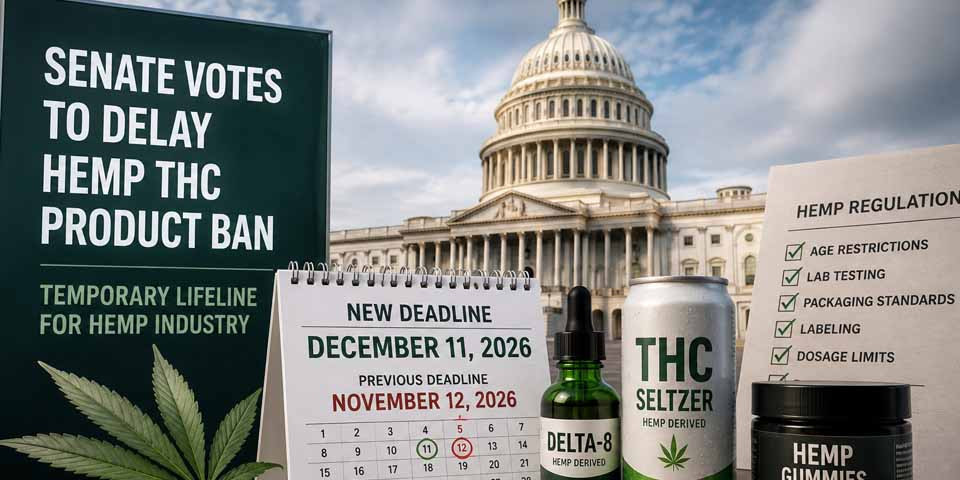
The U.S. Senate has approved legislation containing a temporary delay of the federal crackdown that threatens to remove most intoxicating hemp products from the legal hemp market. The move could push the critical deadline from November 12, 2026 to December 11, 2026.
That may sound like only a few extra weeks. Politically, however, those weeks could become extremely important.
The Senate also rejected an effort to remove the delay, providing one of the clearest signals yet that a significant number of lawmakers are willing to consider an alternative to simply eliminating much of the hemp-derived THC industry.
That alternative could eventually include federal rules covering age restrictions, laboratory testing, packaging, labeling, cannabinoid manufacturing and serving-size limits.
But consumers and retailers need to understand one crucial point:
The hemp THC ban has not been permanently repealed, and the Senate action alone does not yet change federal law.
The House still needs to approve the funding legislation before it can go to President Donald Trump for his signature.
Quick Answer: Did the Senate Stop the Federal Hemp THC Ban?
Not permanently.
The Senate approved a government funding measure that would postpone implementation of the new federal hemp restrictions from November 12 until December 11, 2026.
Sen. Ted Budd of North Carolina attempted to remove that delay and allow the restrictions to take effect on schedule. The Senate voted 61-32 to table that amendment, allowing the delay language to survive.
The larger funding package subsequently passed the Senate 90-6.
The practical result is that Congress may receive roughly another month to decide whether it can develop a regulatory framework for hemp-derived THC rather than allowing the sweeping restrictions to take effect unchanged.
Federal law is only half of the story for Ohio consumers and retailers. Ohio's SB 56 created its own restrictions, which are currently involved in federal litigation.
Read: Can Ohio Stores Sell CBD and Hemp THC Products Again? The SB 56 Court Battle Explained
Why Is There a Federal Hemp THC Ban in the First Place?
To understand the current fight, you have to go back to the 2018 Farm Bill.
That legislation removed qualifying hemp from the federal definition of marijuana and generally defined legal hemp using a threshold of no more than 0.3% delta-9 THC by dry weight.
The wording had enormous consequences.
Congress was largely thinking about industrial hemp and CBD when the law was written. The marketplace that eventually developed went much further.
Manufacturers discovered that cannabinoids extracted from federally legal hemp could be used to create or formulate products capable of producing significant intoxicating effects.
A nationwide market emerged around products including:
- Hemp-derived delta-9 THC gummies
- THC beverages and seltzers
- Delta-8 THC
- Delta-10 THC
- THCA flower
- Hemp-derived concentrates
- Full-spectrum cannabinoid products
- Other intoxicating or psychoactive cannabinoids
The strange result was a legal distinction based heavily on where cannabinoids came from and how products were formulated.
Two products could potentially produce similar intoxicating effects while one traveled through a state-regulated marijuana dispensary system and another was marketed as federally lawful hemp.
That became the central issue Congress eventually decided it wanted to address.
Shop Bongs & Water Pipes
Upgrade your setup with glass bongs, water pipes, percolators and unique designs from Waterbeds 'n' Stuff. Find options for everyday use or something new for your collection.
Shop Bongs & Water PipesWhat Changes on November 12, 2026?
Legislation enacted in 2025 dramatically changes the federal definition governing hemp products.
Among the most consequential provisions is a new standard that would allow only extremely small amounts of total THC in finished hemp products — generally 0.4 milligrams per container under the new framework.
That is an extraordinarily small quantity compared with many products currently sold in the hemp marketplace.
A beverage containing 5 mg of hemp-derived delta-9 THC, for example, would contain more than twelve times that amount.
A 10 mg gummy would contain twenty-five times the threshold.
A package containing multiple gummies could exceed it by dramatically more.
As a practical matter, the standard threatens a large portion of today's hemp-derived intoxicating product market rather than merely eliminating unusually high-dose products.
Why the Senate Vote Matters
The most important part of this story may not actually be the extra month.
It is the vote itself.
Sen. Ted Budd introduced an amendment intended to eliminate the delay and keep the November deadline intact.
Sen. Amy Klobuchar moved to table the amendment.
That motion succeeded 61-32.
That does not mean 61 senators support unrestricted hemp THC sales. It does, however, demonstrate that there was enough support to preserve additional negotiating time instead of immediately allowing the new restrictions to take effect.
That distinction matters.
The political question may be gradually changing from:
"Should intoxicating hemp exist?"
to:
"If intoxicating hemp exists, how should it be regulated?"
President Trump Has Become Part of the Hemp Fight
The White House has also become directly involved in the debate.
President Trump reportedly spoke with Sen. Budd about the THC issue while the Senate negotiations were underway. The funding package containing the temporary extension has also been described as receiving White House support.
That is significant because Trump originally signed the 2018 Farm Bill that created the modern federal hemp framework.
The current debate therefore presents an unusual political circle: legislation signed during Trump's first term helped create the hemp cannabinoid marketplace, while Congress and the Trump administration are now determining what that marketplace should look like going forward.
Explore Vaporizers
Looking for a different way to enjoy your favorite material? Browse portable vaporizers, concentrate devices and innovative vapor technology from popular brands at Waterbeds 'n' Stuff.
Shop VaporizersWhy Some Senators Want the Hemp Restrictions to Begin Immediately
Opponents of intoxicating hemp are not arguing solely about cannabis prohibition.
One of their strongest arguments involves consumer safety — particularly children.
Sen. Budd has pointed to increasing cannabis-related emergency room visits involving minors in North Carolina.
Critics have also repeatedly raised concerns about THC products packaged in brightly colored containers or designed to resemble familiar candy, snacks or beverages.
Those concerns deserve to be taken seriously.
A responsible hemp market should not depend on children accidentally consuming psychoactive products.
But that raises another question:
Does protecting children require eliminating the adult hemp THC marketplace, or could Congress regulate it similarly to other age-restricted products?
The Science: Hemp-Derived THC Can Still Be Real THC
The term "hemp-derived" sometimes creates the mistaken impression that a product cannot be intoxicating.
That isn't scientifically accurate.
Delta-9 THC is the same molecule regardless of whether its original source was legally classified hemp or marijuana.
Delta-8 THC is chemically different from delta-9 THC, but it is also psychoactive.
A scientific review of delta-8 THC research found that its pharmacokinetics and pharmacodynamics are broadly similar to delta-9 THC. Delta-8 acts as a partial agonist at cannabinoid CB1 receptors, although its weaker receptor affinity generally results in lower potency than delta-9 THC.
In plain English:
Delta-8 is not simply CBD with a different label. It can produce genuine THC-like intoxication.
There Are Legitimate Safety Concerns With an Unregulated Market
The FDA has previously documented adverse-event reports involving delta-8 THC products.
Between December 2020 and February 2022, the agency received 104 adverse-event reports involving delta-8 THC products. More than half required medical intervention or hospital admission.
Poison control centers also received thousands of delta-8 exposure reports during that period.
Reported effects included anxiety, vomiting, dizziness, confusion, hallucinations, tremors and loss of consciousness.
Those numbers do not establish that every properly manufactured hemp THC product is inherently dangerous. They do demonstrate why accurate dosing, child-resistant packaging, contaminant testing and manufacturing standards matter.
Why Regulation May Make More Sense Than Prohibition
The hemp industry's strongest argument is increasingly not that intoxicating products should exist without rules.
It is that Congress should establish better rules.
A serious federal framework could potentially include:
- Minimum purchase age of 21
- Government-recognized laboratory testing standards
- Accurate cannabinoid potency testing
- Serving-size limits
- Maximum package potency
- Child-resistant packaging
- Clear THC warning labels
- Ingredient disclosure
- Restrictions on cartoon or candy-style marketing aimed at minors
- Manufacturing standards
- Testing for residual solvents, pesticides, heavy metals and microbial contamination
- Rules governing chemically converted cannabinoids
- Retailer licensing or registration
- Product tracking and recall procedures
That would represent a very different approach from allowing almost anything under the hemp definition.
It would also be very different from wiping out nearly the entire product category with a 0.4 mg-per-container threshold.
Ohio has become one of the most important states to watch as lawmakers, hemp companies, retailers and courts battle over where legal hemp ends and regulated marijuana begins.
Read: The Battle Over Intoxicating Hemp in Ohio — What Happened & What's Next
What About THC Drinks?
THC beverages could become one of the biggest casualties if the new federal standard takes effect unchanged.
Today's hemp beverage market commonly includes products containing several milligrams of THC per can or bottle.
Under a 0.4 mg-per-container standard, even relatively low-dose beverages could fall outside the revised federal hemp definition.
That is why breweries, beverage manufacturers, distributors and retailers have become increasingly involved in the hemp debate.
THC drinks are also interesting because they increasingly compete with alcohol for the same occasion: socializing, relaxing after work, attending concerts or simply having a drink without consuming alcohol.
The future of hemp THC beverages may therefore become a much larger consumer-products battle than the early CBD industry ever was.
What About Delta-8 THC?
Delta-8 faces an even more complicated future.
Most commercially available delta-8 is not extracted directly from hemp in meaningful quantities. Instead, manufacturers typically begin with hemp-derived CBD and chemically convert it into delta-8 THC.
That manufacturing process has become one of the major targets of lawmakers concerned about converted or synthetic cannabinoids.
The Senate delay does not necessarily guarantee that every cannabinoid currently marketed as hemp will receive equal protection.
In fact, the legislation distinguishes certain cannabinoids that cannot naturally be produced by the cannabis plant.
That means the ultimate compromise could preserve some naturally occurring hemp cannabinoids while imposing much tougher restrictions on chemically manufactured alternatives.
What About THCA Flower?
THCA remains another major unresolved category.
THCA — tetrahydrocannabinolic acid — is the chemical precursor to delta-9 THC.
Raw THCA itself is not strongly intoxicating in the same way delta-9 THC is. But heat causes decarboxylation, converting THCA into delta-9 THC.
That is exactly what happens when cannabis flower is smoked or vaporized.
This chemistry created one of the strangest consequences of the original federal hemp definition: cannabis flower could potentially contain low delta-9 THC before use while containing substantial THCA capable of converting into delta-9 THC when heated.
Newer "total THC" approaches are designed largely to close that distinction.
What People on Reddit Are Saying
Online reaction shows just how uncertain the public remains about what the Senate vote actually accomplished.
One recurring theme is cautious optimism. Some commenters interpret the short extension as evidence that lawmakers believe they can negotiate a regulatory framework quickly rather than simply postponing the fight indefinitely.
Others are much more skeptical, questioning whether Congress can realistically resolve a complicated cannabinoid market in approximately one month.
There is also an important point being repeated by users following the legislation closely:
This is Senate action. It is not yet the final federal outcome.
That is the correct way to view the situation.
A One-Month Delay Could Be More Important Than It Looks
At first glance, moving a deadline from November 12 to December 11 doesn't look like much of a victory.
But congressional negotiations often turn on deadlines.
Once a prohibition takes effect, businesses close, products disappear, employees are laid off and supply chains begin dismantling.
Preventing the law from taking effect — even temporarily — keeps the existing industry alive while negotiations continue.
It also gives lawmakers an opportunity to replace the coming restrictions before businesses are forced to shut down.
There have already been congressional proposals seeking much longer extensions. For example, the Hemp Planting Predictability Act introduced in the House proposed changing the original implementation period from 365 days to three years.
That demonstrates that the debate over implementation has been underway for months.
The Hemp Industry's Real Problem: Congress Never Built a Consumer THC System
The larger problem dates back to 2018.
Congress legalized hemp.
It did not simultaneously create a comprehensive national system governing intoxicating products made from hemp.
That left states, federal agencies, laboratories, manufacturers and courts trying to interpret a marketplace that evolved much faster than the law.
CBD became delta-8.
Hemp-derived delta-9 gummies appeared.
THCA flower exploded in popularity.
THC beverages moved into liquor stores, smoke shops and convenience stores.
Novel cannabinoids continued appearing.
Meanwhile, federal law still relied heavily on language written before most of these markets existed.
The result was predictable: confusion.
The Next Battle: What Should Count as Hemp?
One possible compromise would preserve traditional hemp and naturally occurring cannabinoids while drawing a harder line around high-potency intoxicants and synthetic compounds.
But even that becomes scientifically complicated.
Cannabis plants naturally produce dozens of cannabinoids.
Modern chemistry can isolate, concentrate, convert and formulate those molecules in ways that never occur naturally inside the plant.
Congress therefore has to decide whether legality should depend on:
- The cannabinoid's chemical identity
- Whether it occurs naturally in cannabis
- How it was manufactured
- Its intoxicating potential
- The amount contained in a serving
- The total amount in a package
- Or some combination of all of those factors
That is far more complicated than simply saying "hemp is 0.3% THC."
Ohio Consumers Have Two Different Legal Battles to Watch
For Ohio residents, federal developments do not automatically settle state law.
Ohio enacted Senate Bill 56, creating its own major restrictions on hemp-derived intoxicating products.
Parts of those restrictions are currently involved in federal litigation, and an injunction has protected certain plaintiffs from enforcement of specific provisions while the lawsuit continues.
That means Ohio businesses have to watch two separate legal clocks:
- What happens with Ohio SB 56 and the ongoing court challenge.
- What Congress ultimately does with the federal hemp definition.
A federal extension does not automatically invalidate Ohio restrictions, just as an Ohio court ruling does not rewrite federal law.
For a deeper look at how Ohio marijuana, CBD, Delta-8 and hemp laws fit together, see our complete state guide.
Read the Ohio Marijuana, CBD, Delta-8 & Hemp Law Guide
What Happens Next?
The immediate next step is the House of Representatives.
The Senate passing the funding package does not itself make the extension law.
The House must approve legislation containing the extension. It would then need presidential approval.
If that occurs, the new December 11 deadline could create an intense negotiating period over the future of hemp-derived THC.
Several outcomes are possible.
Scenario 1: Congress Does Nothing Else
The restrictions take effect after the temporary extension expires, eliminating much of the current intoxicating hemp market.
Scenario 2: Congress Extends the Deadline Again
Lawmakers decide they need additional time and postpone implementation further.
Scenario 3: Congress Creates a Regulatory Compromise
Lawmakers replace the near-total restriction with federal rules covering age, potency, testing, labeling and manufacturing.
Scenario 4: Congress Protects Some Hemp Products but Not Others
THC beverages or naturally derived cannabinoids might survive under strict regulations while converted or synthetic cannabinoids face tougher restrictions.
This type of compromise may become increasingly important as Congress attempts to distinguish traditional hemp products from intoxicating products produced through advanced cannabinoid chemistry.
Stock Up on Rolling Papers
From classic papers to cones, wraps and rolling accessories, Waterbeds 'n' Stuff carries plenty of options for your preferred roll. Stock up on everyday essentials or try something different.
Shop Rolling PapersFrequently Asked Questions
Did the Senate legalize hemp THC?
No. Hemp was already federally legal under the 2018 Farm Bill when it met federal requirements. The Senate action would temporarily delay implementation of new restrictions threatening many intoxicating hemp products.
Did the Senate permanently cancel the hemp THC ban?
No. The current action is a temporary delay, not a permanent repeal.
When was the federal hemp THC crackdown supposed to begin?
The major new federal restrictions are scheduled to take effect on November 12, 2026.
What would the Senate legislation change?
It would temporarily move implementation to December 11, 2026.
Is the delay already law?
No. The House must still approve the legislation before it can be sent to the president.
What was the Senate vote involving Sen. Ted Budd?
Budd sought to remove the hemp extension. The Senate voted 61-32 to table his amendment, preserving the delay provision in the funding package.
How much THC would be allowed under the new federal standard?
The revised framework generally establishes an extremely low finished-product threshold of 0.4 milligrams of total THC per container, which would exclude many products currently sold as hemp.
Are THC drinks affected?
Yes. Many hemp-derived THC beverages contain several milligrams of THC per container and could therefore exceed the new threshold.
Is Delta-8 affected?
Potentially significantly. Delta-8 is psychoactive and commercial delta-8 is commonly manufactured by converting hemp-derived CBD. Converted cannabinoids are a major focus of the new federal restrictions.
Is THCA affected?
Yes. THCA converts into delta-9 THC when heated. Newer total-THC approaches are specifically designed to account for that conversion rather than looking only at delta-9 THC present before consumption.
Does this mean Ohio stores can sell every hemp THC product again?
No. Ohio has separate state restrictions under SB 56 and ongoing litigation over those restrictions. Federal and state law must be evaluated separately.
The Bigger Question: Regulation or Prohibition?
The United States may finally be approaching the debate that probably should have happened years ago.
There are legitimate reasons to regulate intoxicating hemp.
Consumers should know how much THC they are consuming.
Children should not be able to buy psychoactive gummies.
Packaging should not intentionally resemble children's candy.
Products should be tested for contaminants.
Manufacturers converting cannabinoids should follow meaningful chemical safety standards.
Those points do not automatically require eliminating an entire industry.
Alcohol is regulated.
Tobacco is regulated.
State-legal marijuana is heavily regulated.
The question Congress now has to answer is whether hemp-derived THC should finally receive its own rational regulatory system.
The Senate's decision does not answer that question.
It buys Congress a little more time to answer it.
And for hemp farmers, manufacturers, breweries, distributors, smoke shops, CBD stores and millions of consumers, the difference between regulation and prohibition could determine what the American hemp industry looks like for the next decade.
Federal and Ohio hemp laws are changing quickly. Waterbeds 'n' Stuff will continue following the Senate, House, federal hemp rules and Ohio's SB 56 litigation as new decisions are announced.
Visit the Waterbeds 'n' Stuff Blog for the Latest Updates
Final Takeaway
The Senate vote is unquestionably important for the hemp industry, but headlines saying the federal hemp ban has simply been "stopped" go too far.
What happened is more precise — and potentially more interesting.
The Senate preserved language giving the existing hemp THC marketplace a temporary extension. Senators rejected an effort to eliminate that extension. The broader funding legislation passed overwhelmingly.
Now the House must act.
If the extension becomes law, Congress will have a narrow window to decide whether the future of hemp THC is a near-total federal prohibition or a new regulatory system built around testing, labeling, age restrictions, manufacturing standards and responsible adult access.
November 12 was supposed to be the end of the road for much of the intoxicating hemp industry.
It may instead become another deadline in a much larger fight.
This article is for informational purposes only and is not legal or medical advice. Hemp and cannabis laws can change rapidly and may differ by state and locality.
You May Also Like
- Ohio's Cannabis Cartel? Inside the Attorney General's Lawsuit Against Nine Major Weed Companies
- Why More Cannabis Users Are Ignoring THC Percentage in 2026
- Cold Start Dabs Explained
- Best Dab Temps for Flavor vs Clouds
Looking for premium smoking accessories, dab tools, quartz bangers, vaporizers, and more? Browse our full selection online or visit one of our Ohio locations.
Shop Our Online Headshop For Smoking Essentials and Tons More!
Want more cannabis education, news, and product tips?
Subscribe to our newsletter or follow us on social media.
Recent Posts
-

New Ohio Weed Laws 2026: What Marijuana Buyers Need to Know After the October Changes
OHIO WEED LAWS CHANGE Updated October 7, 2026 Ohio's marijuana laws changed again. And judging fro …Oct 06, 2026 -
Why Does My Dab Rig Clog So Fast? How Reclaim Builds Up & How to Reduce It
You cleaned your dab rig. The glass looked perfect. The water was fresh. The percolator was comple …Sep 22, 2026 -
Why Concentrates Confuse So Many People: Wax vs Shatter vs Badder vs Rosin vs Resin
You walk up to a concentrate display and see: Wax Shatter Badder Budder Rosin Live rosin Resin Li …Sep 17, 2026