
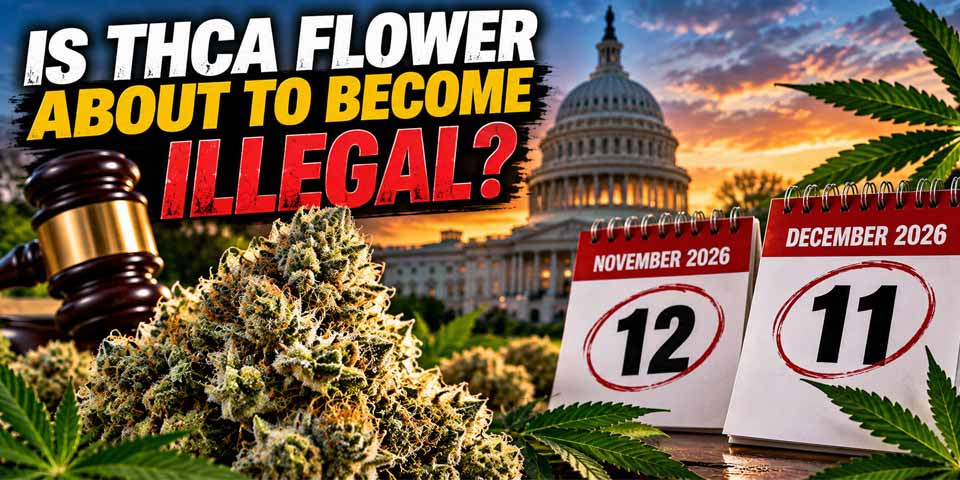
Is THCA Flower About to Become Illegal? November vs. December 2026 Explained
Last updated: October 20, 2026
THCA flower has become one of the most controversial products in the American hemp market, and its legal future is now approaching a critical deadline. For years, consumers have purchased high-THCA flower from smoke shops, hemp retailers and online businesses that marketed these products as federally lawful hemp. However, a change to federal law could bring much of that market to an end before 2027.
Adding to the confusion, two different dates are appearing in news reports and online discussions: November 12 and December 11, 2026. Both dates matter, but they involve different parts of the federal hemp law. The distinction is especially important for consumers who are trying to understand whether THCA flower will remain legal, whether online retailers can continue shipping it and whether Congress has enough time to prevent the restrictions from taking effect.
The current answer is that most high-THCA flower sold as hemp is expected to lose its federal hemp status on December 11, 2026, unless Congress changes the law again. The reason is a new federal definition that includes THCA when calculating total THC concentration. Although the change does not prohibit the THCA molecule in every circumstance, it substantially changes which cannabis products can legally qualify as hemp.
THCA Legality in 2026: Quick Answer
Congress enacted a narrower federal definition of hemp in November 2025. A subsequent law signed September 2, 2026, delayed the broader total-THC changes until December 11, 2026. Under the new definition, hemp generally cannot contain more than 0.3% total THC, including THCA, on a dry-weight basis.
Certain restrictions involving cannabinoids that cannot naturally be produced by cannabis are still scheduled for November 12, 2026. These are separate from the broader total-THC change affecting high-THCA flower. Congress can still modify the law, but another extension is not guaranteed.
What Is THCA Flower, and Why Is It So Popular?
THCA stands for tetrahydrocannabinolic acid, a naturally occurring cannabinoid found in cannabis plants. In freshly harvested cannabis flower, much of the plant's potential THC is present as THCA rather than Delta-9 THC. Unlike Delta-9 THC, unheated THCA is not generally associated with the same intoxicating effects. However, when cannabis is exposed to sufficient heat, THCA undergoes a chemical process known as decarboxylation, which converts a portion of it into Delta-9 THC.
This conversion explains why THCA-rich flower can produce intoxicating effects when smoked or vaporized. It also explains why high-THCA flower has attracted so much legal attention. Products containing substantial amounts of THCA may have relatively low measured Delta-9 THC before heating, even though their potential intoxicating effects can be comparable to those of conventional marijuana flower.
THCA flower became popular partly because some businesses interpreted the 2018 Farm Bill as allowing cannabis products with no more than 0.3% Delta-9 THC on a dry-weight basis, even when those products contained much higher concentrations of THCA. That interpretation helped establish a national market, although federal cultivation rules, state laws and enforcement interpretations have not always treated high-THCA flower the same way.
Is THCA Flower Really Different From Marijuana?
From a botanical and chemical perspective, THCA-rich hemp flower and marijuana flower can be remarkably similar. Both come from cannabis plants, and both can contain substantial amounts of THCA. The major distinction has often been the legal classification of the product rather than an obvious difference in its appearance, smell or potential effects when heated.
Under the original federal hemp definition established by the 2018 Farm Bill, the general statutory threshold focused on Delta-9 THC concentration. This created a distinction between the amount of Delta-9 THC already present in the plant and the amount that could potentially be produced when THCA was heated. The new federal definition addresses that distinction by including THCA in the total-THC calculation.
As a result, the argument that high-THCA flower should qualify as hemp solely because it contains less than 0.3% Delta-9 THC will become much harder to maintain under the revised federal framework.
What Did the 2018 Farm Bill Actually Legalize?
The Agriculture Improvement Act of 2018, commonly called the 2018 Farm Bill, removed qualifying hemp from the federal Controlled Substances Act's definition of marijuana. Under the general statutory definition, hemp included cannabis and its derivatives containing no more than 0.3% Delta-9 THC on a dry-weight basis. This was a major change because it allowed federally compliant hemp cultivation and helped establish a growing national market for hemp-derived products.
However, the law did not automatically legalize every cannabis product containing less than 0.3% Delta-9 THC in every circumstance. The Food and Drug Administration retained authority over products such as foods, drugs and dietary supplements, while states continued to enforce their own cannabis and hemp restrictions. Federal hemp production regulations also included testing requirements that considered potential THC after decarboxylation.
Despite those complications, the statutory wording contributed to a large commercial market for high-THCA flower, Delta-8 products, hemp-derived Delta-9 gummies and other cannabinoids. Congress has now responded by adopting a more restrictive federal definition.
What Is Changing Under the New Federal THCA Law?
Congress amended the federal hemp definition through legislation enacted in November 2025. The revised definition replaces the general Delta-9-only concentration standard with a broader total-THC standard that expressly includes THCA. Under the new framework, qualifying hemp generally must contain no more than 0.3% total THC on a dry-weight basis.
This change is especially significant for flower containing 15%, 20% or 25% THCA. Products with those concentrations would ordinarily exceed the new total-THC threshold by a substantial margin, even if their measured Delta-9 THC concentration before heating were relatively low.
The legislation also introduces separate exclusions for certain cannabinoid products and a 0.4 mg combined-THC-per-container threshold for covered finished hemp-derived cannabinoid products. Those additional provisions could affect gummies, beverages, extracts and other consumer products, but the total-THC concentration requirement is the most important issue for high-THCA flower.
How Is Total THC Calculated?
Understanding the difference between Delta-9 THC and total THC is essential to understanding the upcoming law. Delta-9 THC refers to the amount of that cannabinoid already present in the sample. Total THC calculations account for the potential contribution of THCA after decarboxylation.
A commonly used laboratory formula is:
Total THC = Delta-9 THC + (THCA × 0.877)
The conversion factor of 0.877 accounts for the difference in molecular weight when THCA loses carbon dioxide during decarboxylation. For example, imagine a flower product containing 0.2% Delta-9 THC and 22% THCA. Applying the formula produces approximately 19.49% total THC, which is far above the new federal hemp threshold of 0.3%.
This example illustrates why high-THCA flower faces such a substantial legal change. A product that previously appeared to satisfy a Delta-9-only concentration requirement may not come close to satisfying the revised total-THC standard. The precise regulatory calculation and testing method should always be evaluated under the applicable rules.
November 12 vs. December 11, 2026: Which Date Matters for THCA?
The two dates exist because Congress delayed some provisions of the federal hemp amendment without delaying every part of it. The original law was enacted November 12, 2025, with a one-year implementation period. That initially made November 12, 2026, the effective date for the major changes.
On September 2, 2026, President Donald Trump signed the Continuing Appropriations and Extensions Act, 2027, postponing the broader total-THC definition and finished-product threshold until December 11, 2026. However, certain exclusions involving cannabinoids that cannot naturally be produced by cannabis retained the original November 12 effective date.
| Date | Federal Change |
|---|---|
| November 12, 2026 | Certain exclusions involving cannabinoids that cannot naturally be produced by cannabis become effective. |
| December 11, 2026 | The broader 0.3% total-THC hemp definition and 0.4 mg-per-container limit for covered finished products are scheduled to take effect. |
For ordinary high-THCA flower, December 11 is the most important current federal date because the new total-THC definition is expected to prevent most high-potency THCA flower from qualifying as hemp. The November date is more directly relevant to certain synthetic-cannabinoid products and should not be confused with a blanket November ban on naturally occurring THCA.
Does the New Law Ban THCA Itself?
No. The law changes which cannabis products qualify as federally lawful hemp; it does not eliminate THCA as a naturally occurring cannabinoid or prohibit every product containing it. THCA remains a normal constituent of cannabis flower, including products sold through state-licensed marijuana dispensaries.
The legal consequence is that cannabis material exceeding the revised hemp definition may instead fall within federal marijuana controls. State-licensed marijuana businesses operate under their respective state programs, although state authorization does not automatically remove federal restrictions.
Consumers should therefore distinguish between high-THCA flower marketed through the hemp industry and marijuana sold through a licensed dispensary. These products may contain similar cannabinoids, but their legal treatment can be very different.
What Does the 0.4 mg THC Rule Mean for THCA Products?
In addition to the new total-THC percentage requirement, Congress adopted a separate restriction affecting covered finished hemp-derived cannabinoid products. Under that provision, products containing more than 0.4 milligrams of combined total THC and certain similar cannabinoids per container are excluded from the revised federal hemp definition.
The distinction between milligrams and percentages is important. A 0.4 mg limit measures the amount of THC in a container, while a 0.3% concentration limit measures THC relative to a product's dry weight. These are not interchangeable standards, and different products may be affected by different parts of the law.
For high-THCA flower, the total-THC percentage requirement is the clearest obstacle. For finished products such as gummies and beverages, the per-container threshold can create additional restrictions even when the product is marketed as low-dose.
Will Delta-8, Delta-9 and CBD Be Affected Too?
The new federal framework extends beyond THCA flower. Many commercially available Delta-8 products are manufactured through chemical conversion processes, which may create additional legal issues under the restrictions involving cannabinoids produced outside the plant. Hemp-derived Delta-9 gummies and beverages may also be affected by the 0.4 mg-per-container threshold, even when they previously complied with the original federal hemp definition.
CBD requires a more careful distinction. The new law does not categorically ban the CBD molecule, but some full-spectrum CBD products contain measurable amounts of THC or other covered cannabinoids. Depending on their composition and packaging, those products could face compliance problems under the revised definition. CBD isolate products without covered THC content may be treated differently, although existing FDA and state restrictions still apply.
Because the law contains several separate exclusions, consumers should be skeptical of claims that every hemp product will become illegal on the same day or that every product containing CBD will automatically disappear.
Why Is Congress Restricting High-THCA Flower?
Supporters of the new law argue that the original hemp definition created an unintended pathway for intoxicating cannabis products to enter the market without being subject to the same requirements as state-licensed marijuana. Their concerns include age verification, inconsistent testing, misleading labeling, child-attractive packaging and products capable of producing substantial intoxicating effects.
High-THCA flower became a particular concern because its potential effects after heating can resemble those of conventional marijuana. From the perspective of supporters, measuring total THC provides a more meaningful distinction between non-intoxicating hemp and cannabis products capable of producing substantial amounts of Delta-9 THC.
Other supporters believe intoxicating products should be sold only through tightly regulated marijuana systems rather than through the broader hemp marketplace. They argue that comparable products should face comparable oversight regardless of how they are marketed.
Why Are Hemp Businesses Opposing the Changes?
Hemp businesses argue that the new federal definition threatens legitimate companies that invested in farming, processing, laboratory testing, distribution and retail operations under the existing legal framework. Many businesses built substantial product lines around THCA flower and other hemp-derived cannabinoids, and losing federal hemp status could make those business models difficult or impossible to continue in their current form.
Industry advocates also argue that Congress could address safety concerns through regulation rather than broad product exclusions. Their proposed alternatives commonly include minimum purchase ages, independent laboratory testing, accurate cannabinoid labels, child-resistant packaging, restrictions on youth-oriented advertising and reasonable potency limits.
The disagreement is not simply about whether products should be regulated. Much of the debate concerns whether Congress should establish a regulated adult-use hemp market or effectively remove many intoxicating hemp products from the federal hemp category.
Are Consumers Angry About the THCA Changes?
Online discussions about the upcoming federal restrictions show substantial concern among some THCA consumers, particularly those who rely on hemp retailers or online ordering. Common complaints involve reduced product availability, higher prices, fewer purchasing options and the possibility that consumers in states without legal recreational marijuana may lose access to products they previously purchased through hemp businesses.
Other consumers support stronger regulation, especially when products are sold without reliable testing or age verification. Some believe THCA-rich flower should be treated similarly to marijuana because of its potential intoxicating effects after heating. These competing views demonstrate why the issue remains politically contentious.
However, online reactions should not be treated as a scientific measure of national opinion. There is no reliable basis for claiming that all THCA consumers oppose the law or that most Americans support a particular regulatory approach.
What Happens to Online THCA Flower Sales After December 11?
Online THCA retailers could face major changes if high-THCA flower no longer qualifies as federally lawful hemp. Interstate shipping is particularly important because the federal hemp framework has been central to how many businesses distribute products across state lines. If those products instead fall within federal marijuana controls, the legal basis for ordinary interstate hemp shipments may disappear.
That could affect more than product availability. Businesses may encounter difficulties involving payment processing, banking, insurance, supplier contracts and inventory management. Some retailers may discontinue products before the deadline, while others may wait for further congressional action or legal guidance.
Consumers should not assume that a product can legally cross state lines simply because marijuana is legal in both the shipping state and the destination state. Federal law and state marijuana laws remain separate considerations.
Will THCA Flower Still Be Available in Licensed Dispensaries?
THCA naturally occurs in conventional marijuana flower, so the federal hemp definition change does not mean state-licensed dispensaries will suddenly stop selling cannabis containing THCA. Marijuana sold through state-regulated programs is already treated differently from hemp products marketed under the federal hemp exemption.
However, the new law does not create a general federal exemption for marijuana dispensaries. State cannabis programs continue operating within a complicated relationship between state authorization and federal controlled-substances law.
For consumers, the practical difference is that high-THCA flower marketed as hemp could lose its federal classification, while licensed dispensaries may continue selling qualifying cannabis products under their applicable state laws.
Is THCA Flower Legal in Ohio in 2026?
Ohio consumers face an additional layer of complexity because the state has its own cannabis and hemp restrictions. Senate Bill 56 became effective March 20, 2026, and substantially changed Ohio's treatment of intoxicating hemp products. Additional Ohio Division of Cannabis Control rules took effect in September and October, affecting cannabis product limits, labeling, packaging and other requirements.
As a result, the federal December deadline is not the only issue Ohio consumers must consider. A product may be affected by Ohio law even before the revised federal hemp definition takes effect. Conversely, a federal extension would not automatically repeal Ohio's existing restrictions.
Ohio also has an adult-use marijuana program for adults 21 and older, but products sold through licensed marijuana dispensaries operate under a separate regulatory framework from hemp products sold through other retail channels.
Ohio Marijuana Laws Changed Again in October 2026
Our updated Ohio marijuana-law guide explains the state's latest rules involving possession, transportation, THC potency, concentrates, home cultivation, packaging, hemp restrictions and consumer reactions. If you live in Ohio, understanding both state and federal law is essential.
Could Ohio's Hemp Lawsuits Change the Situation?
Ohio's hemp restrictions have faced legal challenges, including litigation involving Fresh Farms E Liquid LLC. In September 2026, a federal court granted preliminary injunctive relief involving enforcement tied to Ohio's amended hemp definition for certain federally lawful hemp products. That development is important, but it does not mean the entire Ohio law has been struck down statewide.
The distinction is especially important because the federal hemp definition is also changing. Relief granted under an Ohio-related lawsuit does not automatically prevent Congress's revised federal definition from taking effect. Businesses and consumers must therefore follow developments at both the state and federal levels.
Can Congress Still Save THCA Flower Before December 11?
Yes. Congress retains the authority to amend, delay or repeal the new federal hemp provisions. Several proposals have been introduced to address the restrictions, including measures that would provide additional time for implementation or establish a different regulatory framework for hemp-derived cannabinoid products.
However, a bill being introduced does not mean it will become law. Legislation must move through Congress and receive the required approval before it can change the existing schedule. Although the September extension demonstrates that Congress can act, it does not guarantee another delay.
The current congressional calendar also creates uncertainty. Lawmakers have limited time before the December deadline, and competing priorities could make a comprehensive hemp agreement difficult. Another short-term extension remains possible, but businesses should not treat it as inevitable.
What Are the Possible Outcomes Before December 11?
Congress Allows the Existing Law to Take Effect
If Congress takes no further action, the broader federal hemp definition is scheduled to become effective December 11. Most high-THCA flower currently marketed as hemp would be expected to exceed the revised total-THC threshold and lose its federal hemp classification. Retailers, growers and distributors would then need to evaluate the legal consequences for their operations.
Congress Approves Another Temporary Extension
Lawmakers could postpone the broader definition changes again, giving the industry additional time to adjust or negotiate a replacement framework. An extension would not necessarily mean Congress has decided to preserve the current hemp market permanently, and separate state restrictions would remain relevant.
Congress Creates a New Regulatory Framework
Another possibility is legislation establishing specific requirements for intoxicating hemp products, including age restrictions, potency limits, laboratory testing and packaging standards. Many hemp-industry advocates prefer this approach because it could preserve a legal market while addressing consumer-safety concerns.
Congress Repeals the New Restrictions
Congress could also reverse the federal definition changes through new legislation. However, repeal would require sufficient political support and completion of the legislative process. At present, there is no reliable basis for assigning a meaningful probability to any particular outcome.
What Should THCA Consumers Do Before December?
Consumers should pay attention to the difference between enacted legislation and proposed changes. The revised federal hemp definition has already been enacted, and the broader provisions are currently scheduled for December 11. The possibility of further congressional action does not eliminate the need to follow existing state and federal laws.
It is also important to evaluate product information carefully. Cannabinoid labels, laboratory certificates of analysis and total-THC calculations can provide useful information, but a label alone does not establish that a product is lawful in every jurisdiction. Consumers should be cautious about retailers promising that all THCA products will remain federally legal regardless of the upcoming changes.
What Should Hemp Retailers Be Watching?
Retailers, growers and distributors should review their inventory and supplier documentation, particularly for products containing substantial THCA or other cannabinoids affected by the revised definition. Businesses may need to evaluate testing methods, total-THC calculations, state restrictions, interstate shipping practices and existing contractual obligations.
Retailers should also follow official federal developments rather than relying solely on social media claims about last-minute extensions. Qualified legal guidance is especially important when a product's federal classification could change while inventory remains in stock.
THCA Flower Federal Law: Important Dates
| Date | Development |
|---|---|
| 2018 | The Farm Bill establishes the federal hemp framework based on Delta-9 THC concentration. |
| November 12, 2025 | Congress enacts a narrower federal hemp definition that includes total THC and additional cannabinoid exclusions. |
| September 2, 2026 | A federal appropriations law is signed, delaying portions of the revised hemp definition. |
| November 12, 2026 | Certain synthetic-cannabinoid exclusions are scheduled to take effect. |
| December 11, 2026 | The broader total-THC hemp definition and finished-product THC threshold are scheduled to take effect. |
Frequently Asked Questions About THCA Flower in 2026
Is THCA flower going to become illegal in December 2026?
Most high-THCA flower currently marketed as hemp is expected to lose federal hemp status on December 11, 2026, because the revised definition includes THCA in the total-THC calculation. Congress could still change the law before that date.
Is the THCA ban November 12 or December 11?
December 11 is the current federal effective date for the broader total-THC definition affecting high-THCA flower. November 12 applies to certain separate synthetic-cannabinoid exclusions.
Did President Trump sign the hemp extension?
Yes. Federal legislation signed September 2, 2026, postponed portions of the hemp definition changes until December 11, 2026.
Is THCA the same as Delta-9 THC?
No. THCA is a naturally occurring acidic precursor that can convert into Delta-9 THC when heated. That conversion is one reason federal law is moving toward a total-THC calculation.
Does THCA flower get you high?
Unheated THCA is not generally associated with the same intoxicating effects as Delta-9 THC. However, smoking or vaporizing THCA-rich flower converts some THCA into Delta-9 THC, which can produce intoxicating effects.
What is the new federal total-THC limit?
The revised federal hemp definition generally establishes a maximum total-THC concentration of 0.3% on a dry-weight basis, including THCA.
Will THCA flower still be available online?
Interstate sales and shipping could become substantially more legally problematic for high-THCA flower that no longer qualifies as federally lawful hemp. The outcome will depend on applicable federal and state requirements.
Will THCA flower still be sold at dispensaries?
THCA naturally occurs in marijuana flower sold through state-licensed dispensaries. The federal hemp definition change does not eliminate state-regulated marijuana programs, although federal marijuana restrictions remain relevant.
Will CBD become illegal too?
CBD itself is not categorically banned by the revised hemp definition. However, certain CBD products containing THC or other covered cannabinoids could be affected by the new restrictions.
Can Congress delay the law again?
Yes. Congress can approve another extension, amend the requirements or repeal the changes. However, another delay is not guaranteed and would require new legislative action.
Is THCA flower legal in Ohio?
Ohio has separate cannabis and hemp restrictions, including changes made through Senate Bill 56. A product's federal hemp classification does not automatically determine whether it can legally be sold or possessed in Ohio.
What happens if Congress does nothing?
The broader federal hemp definition changes are scheduled to take effect December 11, 2026. Most high-THCA flower currently marketed as hemp would be expected to exceed the new total-THC threshold.
Final Takeaway: Is THCA Flower About to Become Illegal?
The federal legal status of high-THCA flower is approaching a major turning point. Under the revised hemp definition scheduled for December 11, 2026, cannabis containing substantial THCA would generally no longer qualify as hemp because the new law includes THCA in the total-THC calculation. This is a significant change from the general Delta-9-focused definition that helped the commercial THCA flower market develop.
Congress still has the authority to intervene, and the September extension shows that the implementation schedule can change. However, the law has already been enacted, and another extension should not be assumed. Consumers and businesses must also remember that Ohio and other states maintain separate restrictions that may apply regardless of what happens in Washington.
For THCA flower, December 11 is the critical federal date to watch. November 12 remains important for certain other cannabinoid restrictions, but the broader total-THC change is what threatens the federal hemp status of most high-THCA flower.
Waterbeds 'n' Stuff will continue covering developments affecting THCA, hemp-derived cannabinoids and Ohio marijuana laws as these deadlines approach.
This article is intended for educational purposes only and does not constitute legal advice. Cannabis and hemp laws can change rapidly. Consult current federal and state statutes, regulatory guidance and qualified legal counsel regarding specific products or business decisions.
Related Waterbeds 'n' Stuff Articles
- New Ohio Weed Laws 2026: What Marijuana Buyers Need to Know After the October Changes
- Can Ohio Stores Sell CBD and Hemp THC Products Again? The SB 56 Court Battle Explained
- The Battle Over Intoxicating Hemp in Ohio: What Happened & What's Next?
Waterbeds 'n' Stuff: Serving Ohio Since 1972
Explore smoking accessories, rolling papers, wraps, grinders, glass water pipes and vaporizers at Waterbeds 'n' Stuff. Shop online or visit one of our Ohio locations.
Official Sources and Further Reading
```
Recent Posts
-

Is THCA Flower About to Become Illegal? November vs. December 2026 Explained
Last updated: October 20, 2026 THCA flower has become one of the most controversial products in the …Oct 21, 2026 -

Will Congress Save Hemp THC Before December 11, 2026? What Happens to Delta-8, THCA, CBD & THC Drinks
Updated October 19, 2026 The clock is ticking for America's hemp-derived THC industry. After years …Oct 20, 2026 -

New Ohio Weed Laws 2026: What Marijuana Buyers Need to Know After the October Changes
OHIO WEED LAWS CHANGE Updated October 7, 2026 Ohio's marijuana laws changed again. And judging fro …Oct 06, 2026