
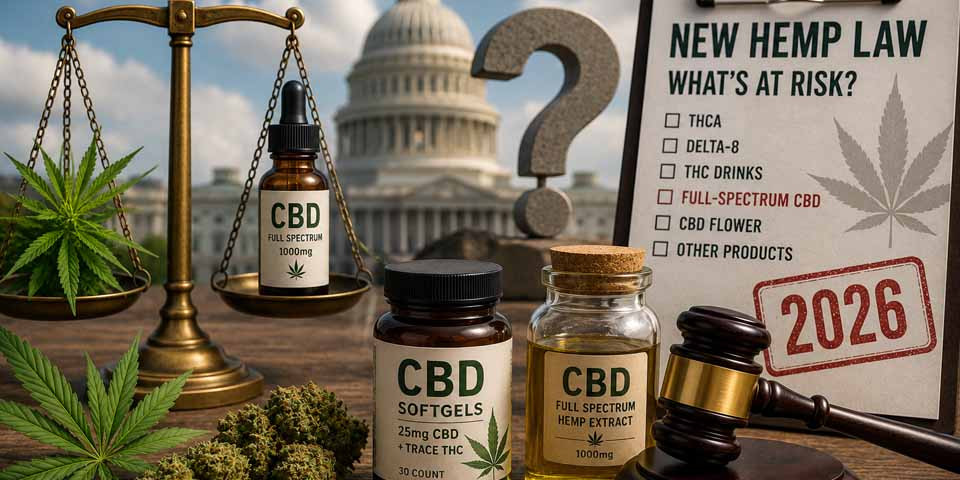
Will CBD Be Banned Too? The Surprising Products That Could Be Caught in the New Hemp Law
Is CBD Going To Be Banned?
Updated August 24, 2026: Most headlines about the coming federal hemp crackdown focus on products such as Delta-8, THCA flower, THC gummies and intoxicating hemp beverages.
But there is another part of this story that could affect a much larger group of consumers:
ordinary CBD products.
CBD itself is not simply being declared illegal by Congress.
That distinction is important.
However, the new federal definition of hemp contains an extraordinarily low limit for THC in finished cannabinoid products:
0.4 milligrams of total THC and similar cannabinoids per container.
Not per serving.
Per container.
And that creates a serious problem for many products people would never consider "intoxicating hemp."
A full-spectrum CBD tincture may contain only a tiny amount of THC in each dose.
A CBD gummy may contain CBD as its primary cannabinoid and only trace THC.
A full-spectrum topical may not be marketed for intoxication at all.
But if the entire bottle, jar or package contains more than the federal limit, it could potentially fall outside the revised definition of hemp.
That is why calling the coming law simply a "Delta-8 ban" or "THCA ban" does not tell the whole story.
Depending on how the law is implemented, full-spectrum CBD may be one of the biggest unintended casualties.
Quick Answer: Is CBD Being Federally Banned?
No, CBD itself is not simply being banned by name.
But many CBD products could be affected because the federal government is changing the legal definition of hemp.
The key issue is whether a finished hemp-derived cannabinoid product contains more than approximately:
0.4 milligrams of combined total THC and cannabinoids with similar effects per container.
If it does, the product may no longer qualify as federally defined hemp after the new law takes effect.
That means there is an enormous difference between saying:
"CBD is illegal."
and saying:
"Many currently legal CBD products may no longer meet the federal definition of hemp."
The second statement is much closer to what the law actually does.
Why Would a Law Targeting Intoxicating Hemp Affect CBD?
Because most cannabis products are not chemically pure.
The hemp plant naturally contains a mixture of cannabinoids.
A product marketed primarily for CBD may still contain tiny quantities of:
- Delta-9 THC
- THCA
- CBG
- CBC
- Other naturally occurring cannabinoids
That is especially true for full-spectrum hemp extracts.
The whole idea behind full-spectrum extraction is to preserve a broader portion of the plant's natural cannabinoid and terpene profile rather than isolating only CBD.
Under the old federal hemp framework, trace amounts of THC could often remain inside those products while still meeting applicable hemp standards.
The new law treats finished products much differently.
Congress has already enacted a narrower definition of hemp scheduled to take effect in November 2026. The Senate has also approved a temporary extension that could move parts of the deadline into December while lawmakers consider a longer-term solution.
Follow Our Latest Federal Hemp & Cannabis Law Coverage
The Number Everyone Needs to Understand: 0.4 Milligrams
This may be the single most important number in the entire federal hemp debate.
The new federal law excludes certain final hemp-derived cannabinoid products containing more than:
0.4 mg combined total THC and cannabinoids with similar effects per container.
That is less than half of one milligram.
And again:
the threshold applies to the entire container.
Why "Per Container" Changes Everything
Suppose a CBD tincture contains:
- 30 servings
- 25 mg CBD per serving
- 1 mg THC per serving
The product is clearly being sold primarily as CBD.
But the entire bottle contains:
30 mg of THC.
Compare that with the new federal threshold:
0.4 mg per container.
The bottle would contain approximately:
75 times the threshold.
Even a product with dramatically less THC can run into trouble.
Example: A Very Low-THC CBD Oil
Imagine a 30-serving CBD oil containing only:
0.1 mg THC per serving.
Most people would consider that an extremely small quantity.
But:
0.1 mg × 30 servings = 3 mg THC in the bottle.
That's still:
7.5 times the 0.4 mg container threshold.
This demonstrates why full-spectrum CBD companies are alarmed.
The issue isn't whether each serving intoxicates someone.
The law looks at the entire finished container.
A 60-Serving Bottle Makes the Problem Even Bigger
Now imagine a product with just:
0.05 mg THC per serving.
That sounds almost negligible.
But put 60 servings inside one bottle:
0.05 × 60 = 3 mg THC.
Again, the bottle would exceed the 0.4 mg threshold.
That's why changing package size or serving count doesn't necessarily solve the problem.
Does This Mean Full-Spectrum CBD Is in Serious Trouble?
Potentially, yes.
Full-spectrum CBD is designed to retain multiple naturally occurring components of hemp.
Depending on the extract and formulation, that can include trace THC.
Many consumers specifically choose full-spectrum products because they prefer a less-isolated hemp extract.
But that same characteristic creates difficulty under an extremely low total-THC-per-container limit.
If a bottle or package exceeds the statutory threshold, it may no longer qualify as hemp.
What Is Full-Spectrum CBD?
The term generally refers to hemp extracts that retain a wider range of naturally occurring plant compounds.
Depending on the product, full-spectrum hemp extracts can contain:
- CBD
- Small quantities of THC
- CBG
- CBC
- Other minor cannabinoids
- Terpenes
- Other plant compounds
Federal hemp law historically allowed qualifying products to retain limited THC.
That helped create the modern full-spectrum CBD industry.
Why Do Consumers Specifically Buy Full-Spectrum CBD?
Some consumers prefer using a more complete plant extract rather than purified CBD.
You may hear this discussed as the "entourage effect."
The general hypothesis is that multiple cannabis compounds may interact in ways that produce effects different from isolated CBD alone.
Research into these interactions is still developing, and the phrase is often used more confidently in marketing than the scientific evidence justifies.
But there is no question that many consumers intentionally seek full-spectrum formulations.
For those people, switching from full-spectrum CBD to pure isolate is not necessarily viewed as an equivalent product.
Explore Vaporizers
Browse portable vaporizers, concentrate devices and electronic smoking accessories from leading brands at Waterbeds 'n' Stuff.
Shop VaporizersWhat About CBD Isolate?
CBD isolate may have a much easier path.
Isolate is highly purified cannabidiol with most other cannabinoids removed.
A properly manufactured CBD isolate product containing effectively no measurable THC may avoid the specific 0.4 mg THC problem.
That doesn't automatically settle every FDA or state-law issue involving CBD.
But from the perspective of the new federal hemp THC threshold, THC-free isolate products appear less exposed than traditional full-spectrum products.
Could the Future CBD Market Become Mostly Isolate?
That's one possible unintended outcome.
If full-spectrum products become legally difficult while highly purified CBD remains compliant, manufacturers may reformulate toward:
- CBD isolate
- THC-free formulations
- Highly refined extracts
That would be ironic.
A law primarily promoted as a crackdown on intoxicating hemp could potentially push the ordinary CBD industry toward more heavily processed products.
What About Broad-Spectrum CBD?
Broad-spectrum CBD sits between full-spectrum extract and pure isolate.
Broad-spectrum products typically attempt to preserve several cannabinoids and other hemp compounds while removing THC.
That could make broad-spectrum formulations better positioned under the new rules.
But there is an important catch:
"THC-free" on the front of a package is not the same thing as laboratory-confirmed compliance.
Trace quantities can sometimes remain.
With a threshold as low as 0.4 mg across an entire container, even tiny amounts may matter.
Laboratory Detection Limits Suddenly Matter a Lot
This creates another technical problem.
Laboratories don't measure infinitely small quantities with perfect certainty.
Tests have limits of detection and limits of quantification.
When the legal threshold becomes extremely low, questions emerge such as:
- How sensitive must the laboratory method be?
- What happens when THC is detected below the quantification limit?
- How are measurement uncertainty and rounding handled?
- Which cannabinoids count toward the combined total?
- What exactly constitutes a container?
Those aren't obscure laboratory questions anymore.
They can determine whether a product is legally considered hemp.
FDA Was Supposed to Clarify Some of This
This is one of the newest developments in the story.
The 2025 law directed the FDA, in consultation with other federal agencies, to publish several important cannabinoid lists and additional information concerning the definition of a product container.
The agency was given a deadline.
But as of August 2026, Congressional Research Service reporting indicates the required material still has not been published.
That is a significant problem for businesses approaching a compliance deadline.
Companies are being asked to prepare for a new federal framework while some important implementation details remain unresolved.
Why Does "Container" Need Federal Guidance?
Because package design could dramatically change the legal calculation.
Imagine 30 CBD capsules.
Are they:
one container containing 30 capsules?
Or could individually sealed units potentially be interpreted differently?
What about:
- Blister packs
- Individually wrapped gummies
- Dropper bottles
- Multi-packs
- Single-dose pouches
- Topical packets
If the statutory limit is based on the container, the precise meaning of that word becomes commercially enormous.
The FDA Delay Could Make November Especially Messy
The closer the industry gets to implementation without detailed federal guidance, the harder compliance becomes.
Manufacturers need time to:
- Reformulate products
- Redesign packaging
- Order new labels
- Validate laboratory methods
- Change suppliers
- Modify inventory systems
- Communicate with retailers
Retailers also need to know which existing inventory can still legally be sold.
The federal government cannot reasonably expect businesses to change complex product lines overnight without clear definitions.
What Happens November 12, 2026?
Under enacted federal law, the revised hemp definition is scheduled to take effect on:
November 12, 2026.
Beginning on that effective date, products excluded from the federal hemp definition would no longer receive the legal treatment provided to qualifying hemp.
Congressional Research Service analysis explains that excluded products may instead become subject to federal regulation as marijuana under the Controlled Substances Act.
That is why this is much more consequential than a new labeling requirement.
But Didn't the Senate Delay the Hemp Ban Until December?
The Senate approved legislation that would temporarily postpone certain portions of the new hemp restrictions until:
December 11, 2026.
That includes the new total-THC definition and the 0.4 mg finished-product rule under the Senate proposal.
However, the House version of the funding legislation did not originally include the same hemp extension.
That means the House still has to agree to the change before businesses can treat December as the definitive new federal deadline.
As of August 24, this remains a developing congressional issue.
The same federal hemp rewrite directly counts THCA toward total THC and threatens the national THCA flower market. We've broken down exactly why November 12 and December 11 are both being discussed.
Read: Is THCA About to Become Illegal Federally? What Happens in November/December 2026
Could CBD Oil Really Be Caught by a Law Aimed at Intoxicating THC?
Yes.
And this is exactly why hemp groups are pushing Congress to revise the language.
Consider the difference between intent and chemistry.
A consumer may buy a CBD tincture containing:
1,500 mg CBD
and perhaps only:
15 mg total THC across the entire bottle.
The product is overwhelmingly CBD.
But 15 mg is still drastically above a 0.4 mg threshold.
The law doesn't ask whether CBD is the dominant ingredient.
The numerical THC limit still applies.
What About CBD Gummies?
Full-spectrum CBD gummies could face the same problem.
Imagine a package containing 30 gummies.
Each gummy contains:
- 25 mg CBD
- 0.25 mg THC
One gummy contains very little THC.
But the package contains:
7.5 mg THC total.
That's nearly nineteen times the 0.4 mg threshold.
Again, the product can exceed the federal limit without any individual serving being particularly high in THC.
What About CBD Capsules?
The same mathematics apply.
Small amounts of THC multiplied across a bottle containing 30, 60 or 90 capsules can quickly exceed an absolute container threshold.
Capsules marketed for daytime wellness, nighttime routines or general CBD use could therefore face exactly the same issue as tinctures.
Could CBD Lotions and Topicals Be Affected?
Potentially.
The federal definition of hemp-derived cannabinoid products is broad enough to include products intended for human use through various methods of application.
That can include topical products.
A full-spectrum lotion may not be intended to produce intoxication.
Yet if its cannabinoid profile and container totals exceed the statutory threshold, it can still create a legal problem.
This is one of the stranger consequences of using a uniform THC-per-container limit across dramatically different product categories.
A 2-Ounce Lotion and a Gummy Package Are Not the Same Product
A topical lotion doesn't function pharmacologically like an edible THC gummy.
A tincture isn't the same product as flower.
A 5 mg THC beverage isn't the same as CBD isolate.
Yet a broad numerical threshold can sweep very different products into the same legal category.
That is one reason critics argue Congress should regulate products according to:
- Method of use
- Intoxicating potential
- Serving size
- Product type
- Manufacturing method
rather than applying one blunt standard to everything derived from hemp.
What About CBD Flower?
CBD flower faces a different but related problem.
The new federal definition changes the plant-level THC standard from primarily delta-9 THC to:
total THC, including THCA.
That means CBD-rich flower must stay below a 0.3% total-THC concentration.
Some hemp cultivars that easily met a delta-9-only standard may struggle to satisfy the total-THC limit because they contain THCA.
CBD Flower Can Naturally Contain THCA
A plant bred primarily for CBD production doesn't necessarily produce zero THCA.
Cannabinoid pathways overlap biologically.
Depending on genetics and growing conditions, CBD-dominant hemp can still develop enough THCA to complicate compliance.
This creates particular concern for farmers.
A Crop Can Become "Hot"
Hemp farmers have long used the term "hot hemp" for crops testing above legal THC thresholds.
A stricter total-THC standard can make that risk more difficult to manage.
Variables such as:
- Genetics
- Plant maturity
- Environmental stress
- Harvest timing
- Sampling methods
can influence cannabinoid concentration.
A farmer trying to produce CBD may therefore face legal problems even without intentionally growing intoxicating cannabis.
Shop Glass Bongs & Water Pipes
Browse glass bongs, water pipes, percolators and unique smoking accessories at Waterbeds 'n' Stuff, including everyday pieces and distinctive glass designs.
Shop Bongs & Water PipesWhat About Hemp Seeds?
The revised law also changes treatment of certain viable cannabis seeds.
The legal analysis can depend on the THC concentration associated with the plant from which the seed came rather than simply the negligible cannabinoid content inside a dry seed.
This is another example of the new hemp definition reaching farther than finished Delta-8 gummies or THCA flower.
Why Are CBD Users Calling This a "CBD Ban"?
Because from a consumer's perspective, the difference between:
"CBD is banned"
and
"the exact full-spectrum CBD product I use becomes federally noncompliant"
can feel academic.
If most full-spectrum products disappear from ordinary retail channels, many consumers will experience the law as a CBD ban even though pure cannabidiol itself was not prohibited.
That explains why the phrase has spread online.
But Calling It a Total CBD Ban Is Still Misleading
Accuracy matters.
CBD isolate products may remain possible.
Some broad-spectrum products could potentially comply.
Manufacturers may reformulate products.
Congress may amend the law.
FDA guidance could clarify important details.
And state marijuana systems create another potential retail pathway in some jurisdictions.
So saying:
"CBD becomes federally illegal on November 12"
goes too far.
A better description is:
The new hemp law could remove many full-spectrum and trace-THC CBD products from the federally legal hemp category.
What Are CBD Users Saying on Reddit?
The issue has become increasingly visible in CBD communities.
One current Reddit discussion calling attention to the November deadline generated dozens of comments and a debate over whether describing the law as a "CBD ban" is technically correct.
Several users made an important distinction:
CBD isn't being banned outright, but many full-spectrum products may be caught because of the THC threshold.
Others expressed concern that isolate or highly refined broad-spectrum CBD may become the only practical federally compliant option.
Another recurring concern is that consumers using the same product for years may have no idea that anything is scheduled to change.
The "Compliance Cliff" Is a Real Consumer Communication Problem
CBD consumers aren't necessarily cannabis-policy enthusiasts.
Someone buying a CBD tincture at a health store may not follow:
- Congressional appropriations
- Farm Bill debates
- USDA hemp regulations
- FDA cannabinoid policy
- Controlled Substances Act definitions
They may simply assume that because a product has been legal for years, it will remain available.
That makes the November deadline potentially surprising for ordinary consumers.
Reddit Users Are Also Asking a Strange Question: Why Can Marijuana Be Legal While CBD Becomes Harder to Buy?
This is one of the biggest contradictions consumers notice.
Imagine living in a state with legal recreational marijuana.
You may legally walk into a licensed dispensary and purchase a concentrate containing extremely high THC.
Yet a full-spectrum CBD oil containing only a small amount of THC could potentially lose its federal hemp status.
That sounds absurd at first.
But the explanation is that these products operate under different legal systems.
State Marijuana Law and Federal Hemp Law Are Different
A marijuana dispensary operates under a state cannabis program.
Those products generally aren't relying on federal hemp status.
A CBD company selling nationwide relies heavily on the federal hemp definition.
If its product falls outside that definition, federal controlled-substance law becomes much more important.
This can produce situations that seem logically inconsistent to consumers.
Could Full-Spectrum CBD Move Into Marijuana Dispensaries?
Potentially, in states where marijuana is legal and state rules allow those products.
But that's not an equivalent replacement for the existing hemp marketplace.
The current CBD market includes:
- Online sales
- Wellness stores
- Smoke shops
- Specialty retailers
- Other non-dispensary channels
Moving products into marijuana systems could dramatically change availability, taxation, licensing and interstate distribution.
Could Major CBD Brands Simply Reformulate?
Some likely will try.
Possible strategies include:
- Moving from full-spectrum to broad-spectrum extracts
- Using CBD isolate
- Reducing THC content further
- Changing package size
- Changing serving formats
- Waiting for federal container guidance
But reformulation is not free.
Companies may need:
- New formulas
- New stability testing
- New labels
- New packaging
- New certificates of analysis
- New manufacturing runs
Smaller CBD Companies Could Be Hit Hardest
Large manufacturers may have the resources to reformulate entire product lines.
Small hemp companies may not.
A company built around full-spectrum products could face a choice between:
- Changing its identity
- Entering state cannabis systems
- Abandoning major products
- Closing
That economic impact is one reason hemp businesses are asking Congress for more time.
Could CBD Prices Increase?
Possibly.
If manufacturers have to:
- Use additional purification
- Perform more testing
- Change packaging
- Discard inventory
- Reformulate products
those expenses can eventually reach consumers.
Reduced competition could also affect prices.
Could There Be a Rush to Buy Full-Spectrum CBD Before November?
That's possible as public awareness grows.
Reddit discussions already include people talking about stocking up.
But consumers should avoid making purchasing decisions solely from alarming social-media claims.
The law is still subject to congressional changes, and some products may remain compliant or be reformulated.
Can Companies Just Make Smaller Bottles?
This is one of the strangest practical questions created by a per-container rule.
In theory, package configuration could affect total cannabinoid content.
But businesses should not assume creative packaging will automatically defeat the statutory intent.
FDA guidance on the meaning of a container is specifically important here.
And as of August 2026, that guidance remains overdue.
Why the Missing FDA Guidance Matters So Much
This isn't merely bureaucratic paperwork.
The definition of a container could determine whether:
- One bottle counts as one container
- An individually wrapped serving counts separately
- A multi-pack counts as a single retail container
- Blister packs are treated individually
With only 0.4 mg to work with, those distinctions can decide whether a product survives.
The Federal Government Is Targeting Intoxication, but the Math Doesn't Measure Intoxication
This may be the core criticism.
A 0.4 mg total-container rule does not ask:
Can this product realistically intoxicate someone?
It asks:
How much THC is in the entire package?
Those aren't necessarily the same question.
A large bottle containing trace quantities over dozens of servings can exceed the limit despite having little intoxicating potential per dose.
Would a Per-Serving Rule Make More Sense?
Many industry advocates think so.
A per-serving standard could theoretically distinguish between:
- Trace-THC CBD
- Low-dose adult THC products
- High-dose intoxicating products
Congress could then add package limits, age restrictions and other safeguards.
That would resemble how regulators approach other consumer substances.
Could Congress Fix This Before November?
Yes.
Several lawmakers have proposed alternatives to the current framework.
Possible approaches include:
- Delaying implementation
- Repealing the new definition
- Creating a regulated cannabinoid framework
- Establishing age restrictions
- Creating reasonable serving limits
- Protecting non-intoxicating CBD products
The Senate's proposed extension is intended to create additional time for precisely this kind of negotiation.
The Lawful Hemp Protection Approach
Bipartisan lawmakers have also been discussing broader regulatory frameworks that would replace prohibition with taxation and federal oversight of cannabinoid products.
That kind of legislation could ultimately create specific protection for legitimate CBD products while applying different rules to intoxicating products.
The central challenge is time.
The Senate's Extra Month May Not Be Much Time
If the deadline moves from November 12 to December 11, Congress gets roughly four additional weeks.
That may be enough to attach another legislative fix to a larger funding bill.
But creating a complete national cannabinoid regulatory framework in one month would be difficult.
Businesses therefore cannot assume a permanent solution will appear automatically.
What About the 35 Attorneys General Asking Congress Not to Delay the Ban?
This is where the CBD issue becomes politically complicated.
A coalition of state attorneys general has urged Congress to keep the new intoxicating-hemp restrictions on track.
The attorneys general cite legitimate concerns including:
- Youth access
- Inconsistent testing
- High-potency intoxicants
- Misleading packaging
- Synthetic and converted cannabinoids
But ordinary full-spectrum CBD demonstrates why the law can reach beyond those concerns.
A CBD tincture containing trace naturally occurring THC isn't necessarily comparable to a high-dose Delta-8 gummy.
A bipartisan coalition of attorneys general is urging Congress not to weaken the new federal hemp law. Their concerns focus heavily on minors, intoxicating cannabinoids, testing and public safety—but the law may reach much farther than those products.
Read: 35 Attorneys General Want Congress to Keep the Hemp THC Ban
CBD Demonstrates Why "Intoxicating Hemp" Is Too Broad a Category
Consider these products:
- 25% THCA flower
- 50 mg Delta-8 gummies
- A 5 mg THC seltzer
- A full-spectrum CBD tincture containing 0.1 mg THC per dose
- CBD isolate containing essentially zero THC
They are all cannabis-derived cannabinoid products.
But their pharmacology and intended uses are dramatically different.
A sophisticated regulatory system should arguably recognize those differences.
What About Drug Testing?
This is another reason some consumers specifically choose isolate or broad-spectrum CBD.
Full-spectrum CBD containing THC can potentially contribute to a positive THC drug test, particularly with repeated use.
Products marketed as THC-free may reduce that risk, although no commercial product should be treated as an absolute guarantee of passing a drug test unless testing conditions and product composition are known.
The federal law may therefore unintentionally push more consumers toward formulations already preferred by people concerned about workplace testing.
Could Full-Spectrum CBD Still Exist in Legal Marijuana States?
Potentially, yes, through state-regulated cannabis systems.
But a product being permitted under state marijuana law doesn't restore its status as federally legal hemp.
This distinction matters for:
- Interstate shipping
- Banking
- Payment processing
- Online sales
- National distribution
What About Ohio?
Ohio consumers have to consider both federal and state law.
Ohio has already enacted major restrictions involving intoxicating hemp through Senate Bill 56.
Those rules have led to federal litigation and temporary court orders affecting certain businesses.
But Ohio's hemp fight does not automatically determine what federal law will do to CBD products nationwide.
Likewise, a congressional delay does not automatically invalidate Ohio restrictions.
Ohio SB 56 created major changes involving CBD, THC, THCA and intoxicating hemp products. The law is now involved in federal litigation, making it especially important for Ohio consumers and retailers to distinguish state law from federal law.
Read: Can Ohio Stores Sell CBD and Hemp THC Products Again? The SB 56 Court Battle Explained
Could Ohio Stores Still Sell CBD After the Federal Change?
That depends on the product.
CBD isolate and sufficiently THC-free products present a very different legal issue from a full-spectrum extract containing measurable THC.
Retailers will need to evaluate:
- Certificates of analysis
- Total THC per container
- Product formulation
- Federal hemp status
- Ohio law
- Any applicable court order
Simply seeing the letters "CBD" on a label won't be enough to determine compliance.
CBD, Delta-8, THCA, marijuana and hemp don't all follow identical rules in Ohio. Our complete guide explains how these categories intersect with state and federal law.
Read the Ohio Marijuana, CBD, Delta-8 & Hemp Law Guide
What CBD Products Appear Most at Risk?
Based on the statutory structure, categories deserving particularly close attention include:
- Full-spectrum CBD tinctures
- Full-spectrum CBD gummies
- Full-spectrum CBD softgels
- Full-spectrum CBD capsules
- Full-spectrum hemp extracts
- CBD flower containing THCA
- CBD topicals containing measurable THC
- Multi-serving products with trace THC accumulated across the package
What CBD Products May Be Better Positioned?
Products potentially better positioned include:
- CBD isolate
- THC-free broad-spectrum products
- Products with total THC below applicable federal thresholds
But product labels alone should not be relied upon.
Actual laboratory results matter.
Why Certificates of Analysis Are About to Matter Even More
A certificate of analysis, or COA, can show quantities of cannabinoids detected in a product.
Consumers and retailers may increasingly need to look beyond the large number printed on the front label.
Instead of only asking:
"How much CBD is in this?"
they may need to ask:
"How much total THC is in the entire container?"
The Math May Be More Important Than the Marketing
A product could proudly say:
3,000 MG CBD
on the front.
That does not tell you whether it complies with the upcoming federal hemp definition.
You need to know the THC concentration, serving size and total package volume.
Rolling Papers, Cones & Accessories
Browse rolling papers, cones, wraps and rolling accessories from Waterbeds 'n' Stuff, including classic papers and specialty rolling products.
Shop Rolling PapersFrequently Asked Questions
Is CBD becoming federally illegal in November 2026?
No. CBD itself is not simply being federally prohibited. However, many hemp-derived CBD products containing trace THC could fail to satisfy the new federal hemp definition.
When does the new hemp law take effect?
The currently enacted effective date is November 12, 2026.
Why is December 11 being discussed?
The Senate has approved a temporary extension that would postpone certain hemp-definition changes and the 0.4 mg rule until December 11, 2026. The House must agree before the extension becomes law.
What is the 0.4 mg rule?
The new federal framework excludes certain final hemp-derived cannabinoid products containing more than 0.4 milligrams combined total THC and cannabinoids with similar effects per container.
Is 0.4 mg per serving?
No. The statutory language applies the threshold per container, which is why multi-serving CBD products can exceed it even when individual servings contain only trace THC.
Will full-spectrum CBD become illegal?
Many currently marketed full-spectrum products could have difficulty qualifying as federal hemp because they contain trace THC that accumulates across an entire bottle or package.
Will CBD isolate remain legal?
CBD isolate containing effectively no THC appears less directly affected by the new THC threshold, although other federal and state requirements may still apply.
What about broad-spectrum CBD?
Broad-spectrum products that successfully remove THC may be better positioned, but actual laboratory results and future federal guidance matter.
Could CBD oil be affected?
Yes. Full-spectrum CBD tinctures are particularly vulnerable because a multi-serving bottle can contain more than 0.4 mg total THC even when each serving contains only a tiny quantity.
Could CBD gummies be affected?
Yes. Trace THC multiplied across 20 or 30 gummies can easily exceed an absolute per-container threshold.
Could CBD lotion be affected?
Potentially. Hemp-derived cannabinoid products intended for topical application can fall within the broader statutory framework.
What happens to CBD flower?
CBD flower must also contend with the new 0.3% total-THC definition, which counts THCA rather than looking only at delta-9 THC.
Will every CBD product disappear?
No. Some THC-free isolate and broad-spectrum formulations may remain compliant, and manufacturers may develop new products designed around the federal thresholds.
Why hasn't FDA clarified the law?
The statute required FDA to publish cannabinoid information and additional guidance concerning the meaning of a product container. As of August 2026, Congressional Research Service reporting says that material has not yet been published.
Could Congress change the law?
Yes. Congress can delay, amend or repeal portions of the new hemp definition and can create a new federal regulatory pathway.
Will CBD still be available at marijuana dispensaries?
CBD products may continue to exist inside state-regulated marijuana systems where state law permits them. That is separate from whether a product qualifies as federally legal hemp.
The Three CBD Categories to Remember
1. Full-Spectrum CBD
Contains a wider range of naturally occurring hemp compounds and may contain trace THC.
Potentially most exposed to the 0.4 mg container rule.
2. Broad-Spectrum CBD
Typically preserves multiple cannabinoids while attempting to remove THC.
Potentially better positioned if actual THC levels remain below federal thresholds.
3. CBD Isolate
Highly purified CBD with other cannabinoids largely removed.
Potentially least affected by the new THC threshold if it contains no meaningful THC.
The Biggest Misconception About This Law
The biggest misconception is that Congress created a simple ban on "getting high from hemp."
The actual statutory language is much broader.
It uses chemical definitions and numerical thresholds.
Those thresholds don't automatically know whether a consumer is trying to get high.
They simply measure cannabinoids.
That is how a law aimed at products such as Delta-8 gummies and THCA flower can potentially sweep ordinary full-spectrum CBD into the same federal problem.
The Other Misconception: Nothing Has Been Decided Yet
The underlying federal change has already been enacted.
Congress does not need to pass the November law again.
Unless lawmakers intervene, the new definition is scheduled to take effect.
What remains unresolved is whether Congress will:
- Delay it
- Modify it
- Create exemptions
- Replace it with a regulatory framework
What Should Consumers Watch Between Now and November?
The most important developments include:
- Whether the House accepts the Senate's December 11 extension
- Whether Congress creates a permanent hemp regulatory framework
- Whether lawmakers explicitly protect non-intoxicating CBD
- FDA cannabinoid guidance
- FDA guidance defining a product container
- Manufacturer reformulations
- Changes to full-spectrum product availability
- State-level hemp legislation
- Ohio SB 56 litigation
What Retailers Should Start Looking At
Retailers carrying CBD should understand that the front label won't provide enough information.
Important questions include:
- Is the product full-spectrum, broad-spectrum or isolate?
- What does the latest COA show?
- How much THC exists per serving?
- How much THC exists in the entire package?
- Does the supplier have a compliance plan?
- Will the product be reformulated?
- Will new packaging be issued?
- What happens to existing inventory?
The Law May End Up Separating CBD From Intoxicating Hemp Again
One possible congressional compromise would establish clearly different categories.
For example:
Industrial hemp: fiber, grain and non-cannabinoid uses.
Non-intoxicating CBD: regulated consumer wellness products.
Adult hemp THC: age-restricted, tested and taxed products.
High-THC cannabis: state marijuana programs.
Synthetic or converted cannabinoids: separately regulated or prohibited.
That would be far more complex than the original 2018 Farm Bill.
It could also be much more rational.
Final Takeaway: CBD Isn't Simply Being Banned — But Don't Ignore This Law
If someone tells you:
"Congress banned CBD."
That is too simplistic.
CBD itself is not simply disappearing from federal law.
But if someone tells you:
"The new hemp law only affects intoxicating Delta-8 and THCA products, so CBD users have nothing to worry about."
that is also misleading.
The 0.4 mg-per-container rule is extraordinarily restrictive.
Many full-spectrum CBD oils, gummies, capsules and potentially topicals can contain more than that amount of THC across an entire retail package despite having very little THC per serving.
CBD flower faces an additional problem because the federal definition of hemp is shifting to a total-THC standard that includes THCA.
CBD isolate may survive more easily.
Broad-spectrum products may be reformulated.
Full-spectrum products could face the largest disruption.
And manufacturers are trying to prepare while important FDA guidance remains overdue.
The currently enacted federal deadline is:
November 12, 2026.
The Senate has proposed temporarily moving certain requirements to:
December 11, 2026.
But unless Congress creates a permanent solution, the fundamental problem remains.
The debate therefore isn't only about keeping psychoactive hemp products on smoke-shop shelves.
It is becoming a much bigger question:
Can Congress stop truly problematic intoxicating products without accidentally dismantling the traditional CBD market it legalized eight years ago?
Over the next several months, that may become one of the most important hemp questions in Washington.
This article is provided for informational purposes only and is not legal or medical advice. Federal and state hemp and cannabis laws can change rapidly. Consumers and businesses should verify the laws applicable to their jurisdiction and products.
You May Also Like
- Ohio's Cannabis Cartel? Inside the Attorney General's Lawsuit Against Nine Major Weed Companies
- Why More Cannabis Users Are Ignoring THC Percentage in 2026
- Cold Start Dabs Explained
- Best Dab Temps for Flavor vs Clouds
Looking for premium smoking accessories, dab tools, quartz bangers, vaporizers, and more? Browse our full selection online or visit one of our Ohio locations.
Shop Our Online Headshop For Smoking Essentials and Tons More!
Want more cannabis education, news, and product tips?
Subscribe to our newsletter or follow us on social media.
Recent Posts
-
New Ohio Weed Laws 2026: What Marijuana Buyers Need to Know After the October Changes
OHIO WEED LAWS CHANGE Updated October 7, 2026 Ohio's marijuana laws changed again. And judging fro …Oct 06, 2026 -
Why Does My Dab Rig Clog So Fast? How Reclaim Builds Up & How to Reduce It
You cleaned your dab rig. The glass looked perfect. The water was fresh. The percolator was comple …Sep 22, 2026 -
Why Concentrates Confuse So Many People: Wax vs Shatter vs Badder vs Rosin vs Resin
You walk up to a concentrate display and see: Wax Shatter Badder Budder Rosin Live rosin Resin Li …Sep 17, 2026