
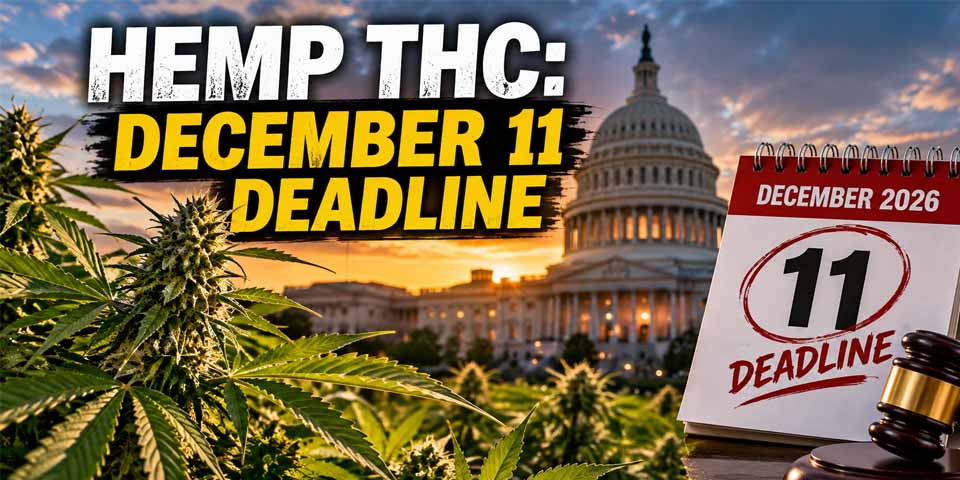
Will Congress Save Hemp THC Before December 11, 2026? What Happens to Delta-8, THCA, CBD & THC Drinks
Updated October 19, 2026
The clock is ticking for America's hemp-derived THC industry. After years of growth following the 2018 Farm Bill, thousands of hemp businesses and millions of consumers are facing a major change in federal law. Unless Congress intervenes, new federal restrictions are scheduled to take effect in two stages:
November 12, 2026
and:
December 11, 2026.
These changes could dramatically affect products that consumers have been buying legally under the federal hemp framework, including:
- Delta-8 THC products
- Hemp-derived Delta-9 gummies
- THCA flower
- THC beverages
- Hemp-derived vape products
- Certain CBD products containing THC
- Other hemp-derived cannabinoid products
But the industry isn't giving up. Hemp businesses, trade associations, cannabis advocates and some members of Congress are pushing for another delay, a repeal or a completely different regulatory approach.
Meanwhile, supporters of tighter restrictions argue that Congress needs to close a loophole that allowed intoxicating THC products to be sold outside state-regulated marijuana systems. So will Congress save hemp THC before December 11?
Here's what is happening, what could change, and what consumers and retailers need to know.
Congress has not yet enacted a permanent solution preventing the scheduled federal hemp restrictions.
November 12: Certain exclusions involving cannabinoids that cannot naturally be produced by cannabis are scheduled to take effect.
December 11: The broader total-THC definition and 0.4 mg combined-THC-per-container restriction for covered finished hemp products are scheduled to take effect.
Congress can still delay, amend or repeal the restrictions. But until it does, those are the dates businesses and consumers must take seriously.
1. Why Is Congress Changing the Federal Hemp Law?
The controversy goes back to the 2018 Farm Bill. That legislation removed hemp from the federal definition of marijuana, provided it met the statutory requirement of no more than 0.3% Delta-9 THC on a dry-weight basis. The change helped create an enormous national market for hemp products.
CBD became widely available, followed by products containing Delta-8 THC, hemp-derived Delta-9 THC, THCA and other cannabinoids. But the original federal definition created a controversial situation.
Products could potentially contain intoxicating amounts of THC while remaining within the legal definition of hemp based on their Delta-9 concentration.
That became especially significant for products such as:
- THC gummies
- THC beverages
- Hemp-derived concentrates
- THCA flower
- Converted-cannabinoid products
Some lawmakers began arguing that the federal hemp definition was being used to bypass marijuana restrictions. Others argued that the hemp industry should be regulated rather than prohibited. Congress ultimately approved a much narrower definition of hemp in a federal appropriations law enacted in November 2025.
2. What Exactly Changes on December 11, 2026?
The new federal framework changes the way THC is calculated. Instead of focusing only on Delta-9 THC, the law introduces a broader total-THC approach that includes THCA and certain other cannabinoids. It also excludes covered finished hemp-derived cannabinoid products containing more than:
0.4 milligrams of combined total THC per container.
That number is extremely important.
It is not 0.4% THC.
It is not 0.4 mg per serving.
It is:
0.4 mg per container.
For many currently marketed hemp-derived THC products, that threshold would be extraordinarily restrictive.
3. How Small Is 0.4 mg of THC?
Consider a hemp-derived gummy containing 10 mg THC. That single gummy contains 25 times the proposed 0.4 mg-per-container threshold. Or consider a THC beverage containing 5 mg THC. That beverage contains 12.5 times the threshold. Even a product with just 1 mg THC contains more than twice the limit.
| Example Product | Total THC | Compared With 0.4 mg |
|---|---|---|
| Low-dose THC product | 1 mg | 2.5 times the limit |
| THC beverage | 5 mg | 12.5 times the limit |
| THC gummy | 10 mg | 25 times the limit |
| Package of ten 10 mg gummies | 100 mg | 250 times the limit |
These are mathematical illustrations, not determinations of a particular product's legal status. Product classification also depends on the other statutory exclusions and requirements.
The key point is simple:
Many products currently sold in the hemp market could no longer qualify as federally lawful hemp products.
4. Don't Forget: Another Federal Change Is Scheduled for November 12
This is something many headlines have missed. The December 11 delay did not move every provision of the new federal hemp law. According to Congressional Research Service analysis, certain exclusions involving cannabinoids that cannot naturally be produced by cannabis are still scheduled to take effect:
November 12, 2026.
That means businesses should not assume they have until December 11 for every category of hemp-derived cannabinoid product. The legal distinction between naturally occurring, converted and synthetic cannabinoids is becoming increasingly important.
5. Will Delta-8 THC Become Illegal?
Delta-8 is one of the product categories facing substantial legal uncertainty. Delta-8 THC can occur naturally in cannabis in small amounts, but many commercial Delta-8 products are manufactured through chemical conversion of other cannabinoids.
The new federal framework restricts certain cannabinoids that are synthesized or manufactured outside the plant, as well as products exceeding the new THC limits. That could exclude many commercially available Delta-8 products from the federal definition of hemp. However, the legal analysis depends on the product, how its cannabinoids were produced and the applicable effective date.
Consumers should not assume every Delta-8 product will be treated identically.
6. Is THCA Flower About to Become Illegal?
THCA flower is another major concern. Under the original 2018 federal hemp framework, the definition focused on Delta-9 THC concentration. The new definition uses a broader total-THC calculation that includes:
THCA.
That matters because THCA can convert to THC when heated. Flower that contains relatively little Delta-9 THC but substantial THCA may no longer meet the new federal hemp definition.
For businesses built around THCA flower, this could be one of the most significant consequences of the law. And it is important to remember that some states, including Ohio, already have their own restrictions.
7. Will Hemp-Derived Delta-9 Gummies Be Banned?
Many hemp-derived Delta-9 gummies became popular because they could comply with the original federal hemp definition while still containing intoxicating doses of THC.
But the new 0.4 mg-per-container rule changes the equation dramatically. A finished package containing 10 mg, 25 mg or 100 mg THC would substantially exceed that threshold. Unless federal law changes again, many existing hemp-derived Delta-9 gummy formulations would no longer qualify as hemp under the new definition.
8. What About THC Drinks and Seltzers?
THC beverages have become one of the most visible parts of the hemp industry.
Some products contain only a few milligrams of THC, while others contain considerably more. Under the new federal framework, a covered finished hemp-derived cannabinoid beverage containing more than 0.4 mg combined total THC per container would be excluded from the federal hemp definition.
That creates a major problem even for beverages marketed as low-dose alternatives to alcohol. A 2 mg or 5 mg THC drink may be relatively low-dose compared with some cannabis products, but it still exceeds the new federal threshold.
9. Is CBD Going to Be Banned Too?
This question deserves a careful answer. No, the federal change does not categorically ban the CBD molecule. However, some CBD products may be affected. Full-spectrum CBD products can contain small amounts of THC.
Depending on the product's total cannabinoid content and how it is manufactured, those amounts could create problems under the new definition. CBD isolate products with no covered THC content may be in a different position. But businesses still need to consider federal food, drug and cosmetic requirements, as well as state law.
The important distinction is:
CBD itself is not the same thing as an intoxicating hemp-derived THC product.
Still, the new definition could affect more than just products marketed to get consumers high.
10. Why Was the Deadline Delayed From November to December?
The broader federal hemp definition changes were originally scheduled to take effect November 12, 2026.
But Congress approved a short-term appropriations measure that delayed portions of the new definition until:
December 11, 2026.
The legislation was signed in September. That delay gave the hemp industry additional time to seek a legislative solution. It did not permanently repeal the restrictions. And it did not postpone every provision.
11. Is Congress Actually Trying to Save Hemp THC?
Yes, some members of Congress and industry advocates are pursuing alternatives.
But there is a difference between:
- A bill being introduced
- A proposal receiving public support
- A committee considering legislation
- Congress passing a law
- The president signing that law
As of October 19, 2026, the scheduled restrictions remain the operative federal framework.
Congressional Research Service has identified several proposals that would delay or repeal the new definition, including:
- H.R. 7024
- H.R. 7010
- S. 3686
- H.R. 6209
Some proposals would provide additional time for regulation, while others would reverse the federal definition changes. These proposals are not interchangeable, and introduction alone does not mean they will become law.
12. Major Cannabis Advocacy Group Urges Congress to Regulate, Not Ban
On October 13, 2026, reporting highlighted a renewed push by the Marijuana Policy Project to persuade Congress to reconsider the restrictions.
The organization is urging supporters to contact federal lawmakers and advocate for a regulated hemp marketplace rather than a broad prohibition.
Its preferred approach includes measures such as:
- Age restrictions
- Product testing
- Clear labels
- THC potency limits
- Restrictions on dangerous products
- Consumer education
The central argument is that legitimate safety concerns can be addressed through regulation without eliminating most of the existing hemp-derived THC market. This is a significant development because it shows the fight is continuing as the deadlines approach.
13. How Big Is the Hemp THC Industry?
The economic stakes are substantial. Industry research cited in October reporting estimates that the affected hemp-derived THC market generates approximately:
$28.3 billion in annual retail revenue.
The same industry analysis estimates roughly:
225,000 jobs.
These figures are industry estimates, not a government census of affected businesses or workers. Nevertheless, they help explain why manufacturers, retailers, distributors, farmers and trade associations are fighting so hard to change the law.
14. Why Do Supporters of the Restrictions Want the Law to Take Effect?
There is another side to this debate. Supporters of the new restrictions argue that the 2018 Farm Bill unintentionally created a market for intoxicating products that did not always operate under the same rules as state-licensed marijuana.
Their concerns include:
- Products sold without consistent age verification
- THC products marketed with candy-like packaging
- Inconsistent product testing
- Unclear cannabinoid concentrations
- Accidental exposure involving children
- Converted or synthetic cannabinoids
- Unregulated retail distribution
Some lawmakers argue that intoxicating products should be sold only through tightly regulated systems rather than under the broader hemp exemption. From that perspective, the new law closes a regulatory loophole.
15. Why Does the Hemp Industry Say a Ban Is the Wrong Answer?
Hemp businesses generally agree that product safety matters.
But many argue that the answer should be:
regulation instead of prohibition.
They contend that a workable federal framework could require:
- Minimum purchase age of 21
- Independent laboratory testing
- Child-resistant packaging
- Accurate cannabinoid labeling
- Reasonable THC serving limits
- Restrictions on youth-oriented marketing
- Licensing or registration
- Product traceability
rather than imposing a finished-product threshold so low that many existing products would disappear from the federally lawful hemp market.
16. What Do Consumers Think About the Potential Ban?
Consumer opinion is divided. Some adults use hemp-derived THC products because they prefer low-dose beverages or gummies over alcohol or conventional marijuana products.
Others live in states where adult-use marijuana remains illegal or difficult to access. Some consumers worry that eliminating regulated hemp products could push demand toward unlicensed or untested sellers.
But other consumers support tighter restrictions, particularly when products resemble candy or are sold without adequate age controls. There is no single nationwide consumer consensus. And online comments should not be mistaken for scientific polling.
17. Could a Ban Push More Customers Toward Marijuana Dispensaries?
Potentially.
If hemp-derived THC products lose their federal hemp status, some consumers may seek similar products through state-licensed marijuana dispensaries where adult-use cannabis is legal.
That could benefit parts of the licensed marijuana industry. However, access is not equal nationwide.
Not every state has legal adult-use marijuana. Some consumers may also prefer products that are no longer available in the same form through licensed cannabis retailers.
So a federal hemp restriction would not necessarily produce a simple one-for-one shift into dispensary sales.
18. What Does This Mean for Ohio?
Ohio is already dealing with a major hemp controversy of its own. Senate Bill 56 took effect March 20, 2026 and substantially changed the state's approach to intoxicating hemp. Ohio has also faced litigation involving the law.
That means Ohio businesses face two separate legal questions:
1. What does Ohio law allow?
2. What will federal law allow after November 12 and December 11?
A product must be evaluated under both applicable systems.
19. If Congress Delays the Federal Ban, Does That Automatically Make Hemp THC Legal in Ohio?
No.
This is especially important for Ohio consumers. A federal delay would not automatically repeal Ohio's SB 56 restrictions. Likewise, changes in Ohio law would not automatically override the federal Controlled Substances Act. Federal and state law operate separately.
Businesses must account for both.
Ohio's marijuana laws changed substantially in 2026, including rules for possession, transportation, product potency, home growing, cannabis packaging and intoxicating hemp.
20. What About the Ohio Hemp Lawsuits?
Ohio's hemp restrictions have also been challenged in court. In September, a federal judge granted preliminary injunctive relief in litigation involving Fresh Farms E Liquid LLC and enforcement tied to Ohio's amended hemp definition.
That development is important, but it should not be interpreted as a complete statewide repeal of SB 56. Nor does it guarantee that federal hemp restrictions scheduled for November or December will be stopped.
Ohio litigation and federal congressional action are related issues, but they are not the same legal proceeding.
21. What Are the Most Likely Outcomes Before December 11?
There are several realistic possibilities.
Scenario One: Congress Does Nothing
The scheduled federal changes take effect. Many currently marketed hemp-derived THC products could lose their status as federally lawful hemp.
Scenario Two: Congress Approves Another Delay
Lawmakers provide additional time for businesses and regulators to develop an alternative framework. That would not necessarily mean permanent legalization.
Scenario Three: Congress Passes a New Regulatory Framework
Lawmakers replace some restrictions with age, testing, labeling, potency and licensing requirements. This is the approach many hemp-industry advocates prefer.
Scenario Four: Congress Repeals the New Definition
The federal government reverses the pending hemp definition changes. This would require new legislation.
Which outcome is most likely?
There is not enough reliable evidence to assign a meaningful percentage to any of these outcomes. Congress has already approved one short delay, which demonstrates that further action is possible. But the existence of bills and lobbying campaigns does not guarantee another extension.
22. Could the Deadline Be Extended Again at the Last Minute?
Yes.
Congress can change federal law through subsequent legislation. Another appropriations measure or a separate bill could potentially include a hemp provision. However, lawmakers would need to pass it through the legislative process. Consumers and businesses should not assume an extension will happen simply because one happened previously.
23. What Should Hemp Retailers Be Doing Right Now?
Businesses need to identify which products may be affected by each effective date.
That includes reviewing:
- Whether cannabinoids are naturally occurring or manufactured outside the plant
- Total THC content
- THCA content
- Total THC per finished container
- Supplier documentation
- Independent laboratory reports
- Current state restrictions
- Inventory and purchasing commitments
- Federal legislative developments
Retailers should seek qualified legal guidance before making decisions about products that may no longer meet the federal hemp definition. Importantly, a federal delay is not a substitute for checking existing Ohio restrictions.
24. What Should Consumers Know Before Buying Hemp THC Products?
The biggest issue is uncertainty. A product's legal classification may change even though the product itself has not changed.
Consumers should pay attention to:
- Current federal and state laws
- Accurate cannabinoid labels
- Third-party testing
- Age restrictions
- Product ingredients
- Changes announced by reputable retailers and regulators
And they should be cautious about claims that every hemp-derived product will remain legal because it was lawful under the original 2018 Farm Bill.
Federal Hemp Law Timeline: 2018–2026
| Date | Development |
|---|---|
| 2018 | Farm Bill establishes federal hemp framework based on Delta-9 THC concentration. |
| November 2025 | Congress enacts a much narrower federal hemp definition. |
| September 2026 | Federal legislation delays portions of the definition change until December 11. |
| October 13, 2026 | New reporting highlights Marijuana Policy Project's push for regulation instead of a broad ban. |
| November 12, 2026 | Certain exclusions involving cannabinoids that cannot naturally be produced by cannabis are scheduled to take effect. |
| December 11, 2026 | Broader total-THC definition and 0.4 mg-per-container threshold scheduled to take effect. |
Frequently Asked Questions
Will Congress stop the hemp THC ban before December 11?
Congress can still delay, amend or repeal the pending restrictions. However, as of October 19, 2026, a permanent solution has not been enacted.
Is the federal hemp ban already in effect?
The new definition changes are scheduled to take effect in stages. Certain provisions begin November 12, 2026, while the broader total-THC changes and 0.4 mg-per-container threshold are scheduled for December 11.
Is Delta-8 going to be banned in 2026?
Many commercial Delta-8 products could lose federal hemp status because of the new restrictions on manufactured cannabinoids and total THC. The precise treatment depends on the product and how its cannabinoids were produced.
Will THCA flower still be legal after December 11?
The new federal definition includes THCA in its total-THC calculation. High-THCA flower that previously qualified as hemp under the Delta-9-only standard may no longer qualify.
Are hemp-derived Delta-9 gummies being banned?
Many currently marketed hemp-derived Delta-9 gummies exceed the new 0.4 mg-per-container threshold and would no longer qualify as hemp under that provision.
Will THC drinks be banned?
Many hemp-derived THC beverages would exceed the new federal threshold. Their legal status would also depend on other applicable federal and state requirements.
Will CBD become illegal?
CBD itself is not categorically banned by the definition change. However, some CBD products containing THC or covered cannabinoids may be affected.
Is the new limit 0.4% THC?
No. The new finished-product threshold is 0.4 milligrams of combined total THC per container for covered hemp-derived cannabinoid products.
Why are there two different deadlines?
Federal legislation delayed some portions of the hemp definition change until December 11, 2026, while certain other provisions retained the original November 12 effective date.
Can Congress extend the deadline again?
Yes, but a further extension would require new legislative action. It is not automatic.
Will a federal extension make hemp THC legal in Ohio?
Not automatically. Ohio's SB 56 restrictions and federal hemp law must be evaluated separately.
Are hemp businesses fighting the restrictions?
Yes. Industry groups, manufacturers, retailers and cannabis advocates are lobbying for delays, repeal or a regulatory alternative.
Why do some lawmakers support the restrictions?
Supporters cite youth access, intoxicating products sold outside licensed marijuana systems, inconsistent testing and concerns about misleading or child-attractive packaging.
What Happens Next?
The hemp industry now faces two important dates:
November 12, 2026
and:
December 11, 2026.
There is still time for Congress to act. But there is no guarantee lawmakers will agree on a solution. Some want stronger restrictions. Others want a regulated hemp market that preserves adult access. Still others want to delay implementation while a more comprehensive framework is developed.
The outcome could affect:
- Hemp farmers
- Manufacturers
- Retailers
- Distributors
- Convenience stores
- Smoke shops
- CBD businesses
- Consumers
across the country.
Final Takeaway: Can Hemp THC Still Be Saved?
Yes, Congress still has the authority to change the law before the deadlines. But whether it will is another question. The federal government has already delayed portions of the new hemp definition once. That gives the industry a limited opportunity to advocate for a different approach.
However, a delay is not a repeal. And the November 12 provisions make the timeline even more urgent than the December 11 headline suggests. For consumers and businesses, the safest conclusion is:
prepare for the law currently scheduled to take effect, while watching closely for congressional action. We'll continue following developments affecting Ohio and the national hemp industry as the deadlines approach.
This article is provided for general educational and informational purposes and does not constitute legal advice. Federal and state cannabis laws can change rapidly. Consult current statutes, official regulatory guidance and qualified legal counsel regarding specific products or business decisions.
Related Waterbeds 'n' Stuff Articles
- New Ohio Weed Laws 2026: What Marijuana Buyers Need to Know After the October Changes
- Can Ohio Stores Sell CBD and Hemp THC Products Again? The SB 56 Court Battle Explained
- The Battle Over Intoxicating Hemp in Ohio: What Happened & What's Next?
- Ohio SB 56: Why We're Fighting Back
Shop Waterbeds 'n' Stuff
Waterbeds 'n' Stuff has served Ohio since 1972 with smoking accessories, glass, rolling papers, wraps, grinders, vaporizers and more for adults.
Sources and Further Reading
- Congressional Research Service — Changes to the Statutory Definition of Hemp and Implications for Agricultural Policy (September 28, 2026)
- United States Code — 7 U.S.C. Section 1639o, Definition of Hemp
- Vicente LLP — Federal Hemp Update: Definition Change Delayed to December 11 (October 13, 2026)
- Cannabis Business Times — Cannabis Advocacy Group Lobbies Congress to Avoid Blanket Ban (October 13, 2026)
- NACS — Hemp-Derived THC: Federal Policy and Retail Impact
- Ohio General Assembly — Senate Bill 56
```
Recent Posts
-

Will Congress Save Hemp THC Before December 11, 2026? What Happens to Delta-8, THCA, CBD & THC Drinks
Updated October 19, 2026 The clock is ticking for America's hemp-derived THC industry. After years …Oct 20, 2026 -

New Ohio Weed Laws 2026: What Marijuana Buyers Need to Know After the October Changes
OHIO WEED LAWS CHANGE Updated October 7, 2026 Ohio's marijuana laws changed again. And judging fro …Oct 06, 2026 -

Why Does My Dab Rig Clog So Fast? How Reclaim Builds Up & How to Reduce It
You cleaned your dab rig. The glass looked perfect. The water was fresh. The percolator was comple …Sep 22, 2026