
The Truth About THCA Flower: What It Is, Why Heat Changes It & Is It Legal in Ohio in 2026?
THCA Flower explained in detail
If you've spent any time inside a smoke shop, browsed hemp websites, or followed cannabis discussions online over the last few years, you've probably seen a product that confused a lot of people:
THCA flower.
It can look like marijuana.
It can smell like marijuana.
It comes from the same cannabis plant.
And once it's heated, it can produce effects associated with traditional THC-rich cannabis.
Yet for years, THCA flower was openly sold online and in stores across states where ordinary recreational marijuana wasn't legal.
How was that possible?
The answer comes down to chemistry, the wording of the 2018 federal Farm Bill, and a legal distinction between THCA and delta-9 THC that helped create an enormous national hemp marketplace.
But in 2026, that marketplace is changing dramatically.
Ohio has already changed its definition of hemp through Senate Bill 56, and a new federal definition scheduled to take effect in November 2026 specifically includes THCA when calculating total THC.
So let's break through the confusing labels and online arguments.
What exactly is THCA? Why does heating it change everything? Why was high-THCA flower sold as hemp in the first place? What does Ohio law say now? And could THCA flower largely disappear from the federally legal hemp market before the end of 2026?
What Is THCA?
THCA stands for tetrahydrocannabinolic acid.
It is a cannabinoid naturally produced by the cannabis plant and is the chemical precursor to delta-9 THC.
Fresh cannabis doesn't necessarily begin with enormous amounts of delta-9 THC already sitting inside the flower.
Instead, much of the cannabinoid exists initially as THCA.
That's why laboratory reports for cannabis flower commonly list both:
- THCA
- Delta-9 THC
- Total THC
THCA itself does not produce the same intoxicating effect associated with heated delta-9 THC.
But that changes when heat enters the picture.
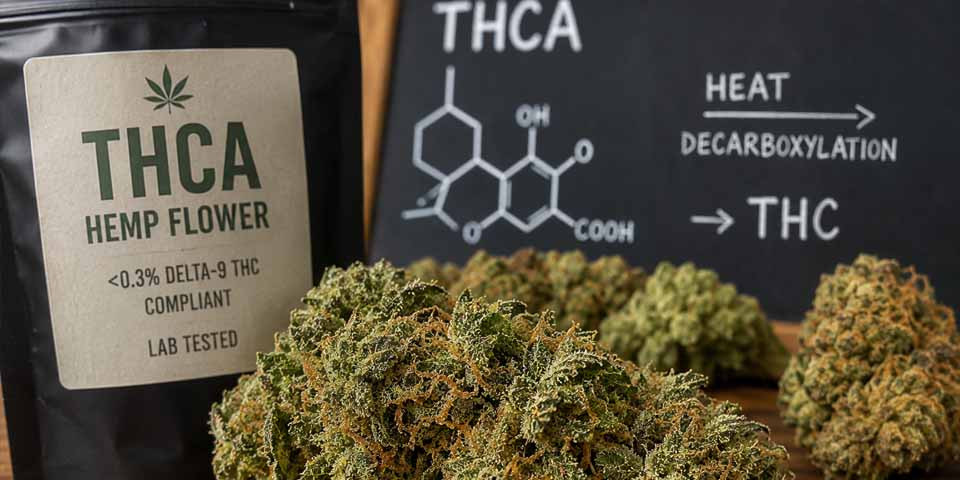
Why Does Heat Turn THCA Into THC?
The process is called decarboxylation.
When THCA is exposed to sufficient heat, part of the molecule is released and the compound converts into delta-9 THC.
This happens when cannabis is:
- Smoked
- Vaporized
- Heated during cooking
- Decarboxylated for extraction
This chemistry explains one of the strangest things about THCA flower.
A flower sample might contain relatively little delta-9 THC before heating while containing a very large percentage of THCA.
Once that flower is heated, much of that THCA can become delta-9 THC.
That is why simply looking at the delta-9 THC number on a laboratory report can give an incomplete picture of how potent cannabis may ultimately be after heating.
THCA Flower vs Regular Marijuana: Is There Really a Difference?
This is where marketing language can become confusing.
From a botanical standpoint, both products come from Cannabis sativa L.
A high-THCA flower sold as "hemp" may visually resemble marijuana because cannabis plants naturally produce THCA before much of it converts into delta-9 THC.
For years, the crucial distinction wasn't necessarily what the flower looked or smelled like.
It was how the law measured THC.
That legal technicality became the foundation of the THCA hemp industry.
• Shop Vaporizers at Waterbeds 'n' Stuff
Browse portable vaporizers, 510 devices, concentrate vaporizers, replacement accessories, and innovative vaping technology from trusted brands.
How Did the 2018 Farm Bill Create the THCA Market?
The federal 2018 Farm Bill removed hemp from the Controlled Substances Act and defined hemp largely by its concentration of delta-9 THC.
The federal threshold was no more than 0.3% delta-9 THC on a dry-weight basis.
That wording created an unusual situation.
A finished cannabis flower could potentially test below 0.3% delta-9 THC while containing considerably more THCA.
Businesses began selling flower based on the argument that if the product satisfied the federal delta-9 threshold, it qualified as hemp—even though heating the flower could convert its THCA into substantial amounts of delta-9 THC.
This became commonly known as the THCA loophole.
People in the hemp industry often object to that phrase, arguing that businesses were simply following the definition Congress actually wrote.
Either way, the result was the same:
A massive interstate market developed for high-THCA cannabis sold as federally compliant hemp.
• Shop Smell-Proof Bags & Storage
Protect aroma and freshness with smell-resistant stash bags, lockable storage cases, travel organizers, and other cannabis storage solutions available from Waterbeds 'n' Stuff.
Why "Total THC" Changes the Entire Equation
There are two very different ways regulators can look at cannabis.
One approach asks:
How much delta-9 THC is in this flower right now?
The other asks:
How much THC could this flower effectively contain once its THCA is converted?
The second approach is commonly referred to as a total THC standard.
That distinction is extremely important because high-THCA flower that qualifies under a delta-9-only calculation may fail dramatically under a total-THC calculation.
A flower containing a very low amount of delta-9 THC but 20% or 25% THCA obviously looks very different when THCA is included in the legal test.
What Did Ohio Change?
Ohio Senate Bill 56 changed the state's hemp definition in 2026.
The law took effect March 20, 2026.
Ohio law now defines hemp using a total tetrahydrocannabinols concentration, including THCA, of not more than 0.3% on a dry-weight basis.
That language is crucial.
Ohio is no longer looking only at the amount of delta-9 THC already present in the plant.
THCA is specifically included.
That means flower containing substantial amounts of THCA generally cannot qualify as hemp in Ohio merely because its pre-heating delta-9 THC concentration is below 0.3%.
For the traditional high-THCA flower market, that's a major change.
So Is THCA Flower Legal in Ohio Right Now?
The answer depends on what someone means by "THCA flower."
THCA naturally occurs in legal marijuana sold through Ohio's regulated cannabis system. THCA itself was not somehow erased from cannabis.
The legal problem concerns products marketed as hemp despite containing substantial amounts of THCA.
Under Ohio's current hemp definition, total THC—including THCA—cannot exceed 0.3% on a dry-weight basis.
As a result, the high-THCA flower commonly marketed nationally as "Farm Bill compliant hemp" generally does not fit Ohio's new hemp definition.
Consumers should therefore be extremely cautious about claims that any product containing less than 0.3% delta-9 THC alone is automatically legal hemp in Ohio.
That is no longer how Ohio's statute is written.
But Didn't a Federal Judge Block Ohio's Hemp Restrictions?
This is where another layer of confusion has developed.
Federal courts have issued preliminary relief against portions of Ohio Senate Bill 56 in litigation brought by certain hemp businesses.
Those orders have received enormous attention because they allowed products from protected plaintiffs—particularly hemp-derived THC beverages—to return to some Ohio retailers while litigation continues.
But consumers should not interpret that ruling as:
"All THCA flower is legal again in every Ohio store."
That isn't what the court decided.
The injunction protects specific plaintiffs and parties covered by the court's order while the constitutional challenge moves forward.
It does not provide a blanket declaration that every high-THCA product sold by every company is legal throughout Ohio.
• Can Ohio Stores Sell THC Drinks Again? What the Court Actually Decided
See why a federal judge blocked enforcement of portions of Ohio SB 56 for certain hemp companies, who the ruling protects, and why the case does not simply make every hemp THC product legal statewide.
What Happens to THCA Federally in November 2026?
This may become the biggest change of all.
Congress amended the federal definition of hemp in November 2025 through Public Law 119-37.
The new definition is scheduled to take effect on November 12, 2026.
Until then, the existing federal definition generally continues to use the familiar 0.3% delta-9 THC dry-weight standard.
After the new definition takes effect, federal law will instead calculate total THC, specifically including THCA.
That dramatically changes the legal position of high-THCA flower.
A flower containing 20% THCA will no longer be able to qualify as hemp simply because its current delta-9 THC concentration happens to remain below 0.3%.
The THCA itself will count toward the federal threshold.
For most of the commercial THCA flower market as consumers know it today, that is an enormous problem.
The Federal Change Is Already Law
This point is important because people sometimes describe November's hemp change as merely a proposal.
The new definition was enacted in November 2025.
The law simply included a one-year delayed effective date.
Unless Congress changes the statute before then, the new rules are scheduled to become effective November 12, 2026.
Congress could still:
- Delay implementation
- Modify the limits
- Create a regulated cannabinoid market
- Replace the provision with different hemp legislation
Industry groups and lawmakers have been pushing for changes.
But businesses cannot assume that congressional action will happen.
What Else Changes Under the New Federal Hemp Definition?
THCA flower isn't the only category affected.
The federal amendment makes several major changes.
It moves from delta-9 THC alone toward total THC and excludes certain hemp-derived cannabinoid products.
It also establishes an extraordinarily low threshold for many finished hemp cannabinoid products: more than 0.4 milligrams combined total THC and similar cannabinoids per container can exclude a finished product from the federal definition of hemp.
The changes could therefore affect much more than THCA flower.
- Hemp-derived THC gummies
- THC beverages
- Delta-8 products
- Full-spectrum CBD
- Some tinctures
- Some topical products
- Converted cannabinoids
For the hemp cannabinoid industry, November 2026 represents one of the biggest federal regulatory changes since the 2018 Farm Bill.
Will THCA Flower Become Marijuana Under Federal Law?
High-THCA flower that exceeds the new total-THC hemp limit would no longer qualify for the federal hemp exemption once the new definition becomes effective.
That means it would generally fall back under federal Controlled Substances Act rules applicable to marijuana unless another federal legal framework applies.
This is why saying "THCA is being banned" is somewhat oversimplified.
THCA itself isn't disappearing.
Cannabis plants will continue producing it.
What changes is whether high-THCA cannabis can legally be classified and distributed nationally as hemp.
That is the real issue.
Could States Still Allow THCA Flower?
State marijuana legalization creates another complicated layer.
Many states already allow licensed businesses to produce and sell cannabis containing substantial THCA through regulated medical or adult-use marijuana programs.
That isn't the same thing as allowing interstate THCA "hemp."
Ohio, for example, has a legal adult-use marijuana system.
THCA-rich cannabis can exist inside that regulated system while the same type of flower may not qualify as legal hemp sold through an ordinary smoke shop.
This distinction will become increasingly important.
Could THCA Flower Still Be Shipped Across State Lines?
Interstate commerce has been one of the biggest advantages of the hemp classification.
Federally legal hemp can generally move between states in ways marijuana cannot.
Once high-THCA flower no longer meets the federal definition of hemp, that legal foundation changes considerably.
Products treated as marijuana under federal law cannot simply rely on hemp protections for ordinary interstate shipping.
That could fundamentally change online THCA businesses.
• The Ultimate Guide to Weed Storage
Learn how heat, oxygen, humidity, and sunlight affect cannabis over time, plus the best ways to preserve aroma, freshness, and quality.
Why Do Lab Reports Sometimes Show Almost No Delta-9 THC?
Because cannabis chemistry changes.
A raw flower sample can naturally contain far more THCA than delta-9 THC.
This doesn't necessarily mean the flower is weak.
Instead, the THCA represents cannabinoid material capable of converting during heating.
That's why knowledgeable consumers increasingly look at the entire cannabinoid profile instead of focusing on one number.
Does THCA Flower Get You High?
Unheated THCA doesn't behave exactly like delta-9 THC.
But when THCA flower is smoked or vaporized, heat causes decarboxylation and converts a portion of the THCA into delta-9 THC.
That's why smoked high-THCA flower can produce intoxicating effects even though the product may have originally been marketed based on its low measured delta-9 THC content.
Does THCA Show Up on a Drug Test?
Consumers should never assume a product is drug-test safe simply because the label says THCA or hemp.
Once THCA is converted into THC and metabolized by the body, common drug-testing methods may detect THC metabolites.
Anyone subject to workplace, probation, athletic, military, transportation, or other drug testing should understand that using THCA flower can create a positive result.
Is THCA the Same Thing as Delta-8?
No.
THCA is naturally produced by cannabis plants as a precursor to delta-9 THC.
Many commercial delta-8 products, on the other hand, are produced by chemically converting hemp-derived CBD into delta-8 THC.
This distinction matters because upcoming federal hemp rules also target cannabinoids produced through synthesis or conversion outside the plant.
Why Has THCA Become So Popular?
The answer is pretty straightforward.
THCA flower allowed consumers in many areas to purchase cannabis products through the hemp marketplace even when their state did not operate a recreational marijuana market.
Businesses could sell online.
Products could cross state lines.
Smoke shops could carry flower without obtaining a marijuana dispensary license.
That created a national marketplace almost overnight.
The combination of widespread availability, online shipping, familiar flower formats, and traditional cannabis-like effects made THCA one of the largest categories created by the post-2018 hemp industry.
Why Regulators Want the Rules Changed
Supporters of stricter hemp laws argue that Congress intended the 2018 Farm Bill to legalize industrial hemp and non-intoxicating hemp products—not create an alternative recreational marijuana industry.
They point to concerns including:
- Sales to minors
- Inconsistent laboratory testing
- Unregulated intoxicating products
- Products sold outside state marijuana systems
- Differences in packaging requirements
- Lack of seed-to-sale tracking
From that perspective, high-THCA flower demonstrates exactly why the federal definition needed to change.
What the Hemp Industry Says
Hemp businesses generally respond that Congress created the current legal framework and allowed an enormous legitimate industry to develop around it.
They argue that outright prohibition isn't the only solution.
Many favor regulations such as:
- 21+ age limits
- Independent laboratory testing
- Potency limits
- Accurate labeling
- Child-resistant packaging
- Retail licensing
- Restrictions on youth-oriented marketing
The industry's argument is essentially:
Regulate it instead of eliminating it.
What Happens to THCA Flower After November?
If federal law takes effect exactly as currently written, high-THCA flower will have an extremely difficult time qualifying as federally legal hemp.
For consumers, that could mean:
- Far fewer THCA products online
- Reduced interstate shipping
- More sales moving into state-licensed marijuana systems
- Retailers dropping high-THCA hemp inventory
- Greater emphasis on genuinely low-total-THC hemp
For businesses, the transition could be even more dramatic.
Companies that built entire brands around high-THCA hemp may need to restructure, obtain marijuana licenses where possible, reformulate products, or exit certain markets.
Could Congress Save the Current THCA Market?
Possibly.
There are ongoing efforts to change, delay, or replace the new federal hemp restrictions.
Some lawmakers and industry groups want a national regulatory structure for hemp-derived cannabinoid products instead of the extremely low limits scheduled for November.
But nothing should be considered guaranteed.
The current law already contains its effective date.
Unless Congress acts, November 12, 2026 remains the date businesses and consumers should be watching.
The Bottom Line on THCA Flower
THCA flower became popular because federal law historically focused on delta-9 THC concentration rather than the full amount of THC a cannabis plant could produce after heating.
That distinction created a national marketplace for cannabis flower containing large amounts of THCA while maintaining low pre-heating delta-9 THC levels.
In 2026, that era appears to be approaching a major turning point.
Ohio already defines hemp using total THC and specifically includes THCA.
Federal law is scheduled to follow a similar approach beginning November 12, 2026.
That doesn't mean THCA itself will disappear.
It means high-THCA cannabis may increasingly have to be sold through regulated marijuana markets instead of relying on the federal hemp classification.
And that distinction could reshape smoke shops, online hemp businesses, cannabis retailers, and consumer access across the country.
Stay Informed as Cannabis Laws Change
The cannabis and hemp industries are changing faster than almost any other consumer market.
Waterbeds 'n' Stuff will continue following Ohio legislation, federal hemp developments, cannabis science, product trends, and major court decisions so consumers can understand what is actually changing without getting lost in misleading headlines.
We've served Ohio customers since 1972 and continue to offer premium glass, vaporizers, smoking accessories, storage products, rolling supplies, and trusted brands online and through our Ohio retail locations.
This article is intended for educational purposes and is not legal advice. Cannabis and hemp laws change frequently and may vary by federal, state, and local jurisdiction.
You May Also Like
- Ohio's Cannabis Cartel? Inside the Attorney General's Lawsuit Against Nine Major Weed Companies
- Why More Cannabis Users Are Ignoring THC Percentage in 2026
- Cold Start Dabs Explained
- Best Dab Temps for Flavor vs Clouds
Looking for premium smoking accessories, dab tools, quartz bangers, vaporizers, and more? Browse our full selection online or visit one of our Ohio locations.
Shop Our Online Headshop For Smoking Essentials and Tons More!
Want more cannabis education, news, and product tips?
Subscribe to our newsletter or follow us on social media.
Facebook
Instagram
Twitter X
Pinterest
Recent Posts
-

Why Is Weed So Much More Expensive in Ohio Than Michigan?
Why Is Weed So Much More Expensive in Ohio Than Michigan? 2026 Price Comparison Published October …Oct 23, 2026 -

Is THCA Flower About to Become Illegal? November vs. December 2026 Explained
Last updated: October 20, 2026 THCA flower has become one of the most controversial products in the …Oct 21, 2026 -

Will Congress Save Hemp THC Before December 11, 2026? What Happens to Delta-8, THCA, CBD & THC Drinks
Updated October 19, 2026 The clock is ticking for America's hemp-derived THC industry. After years …Oct 20, 2026